
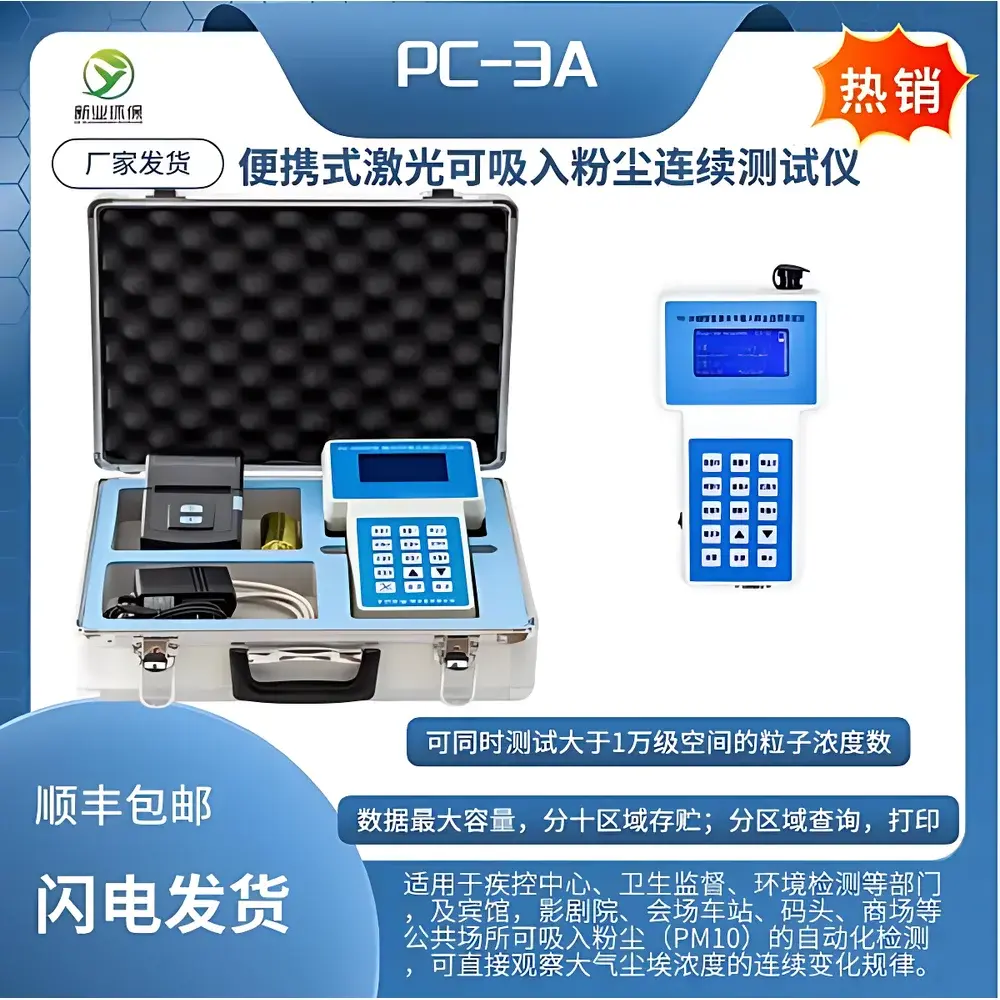
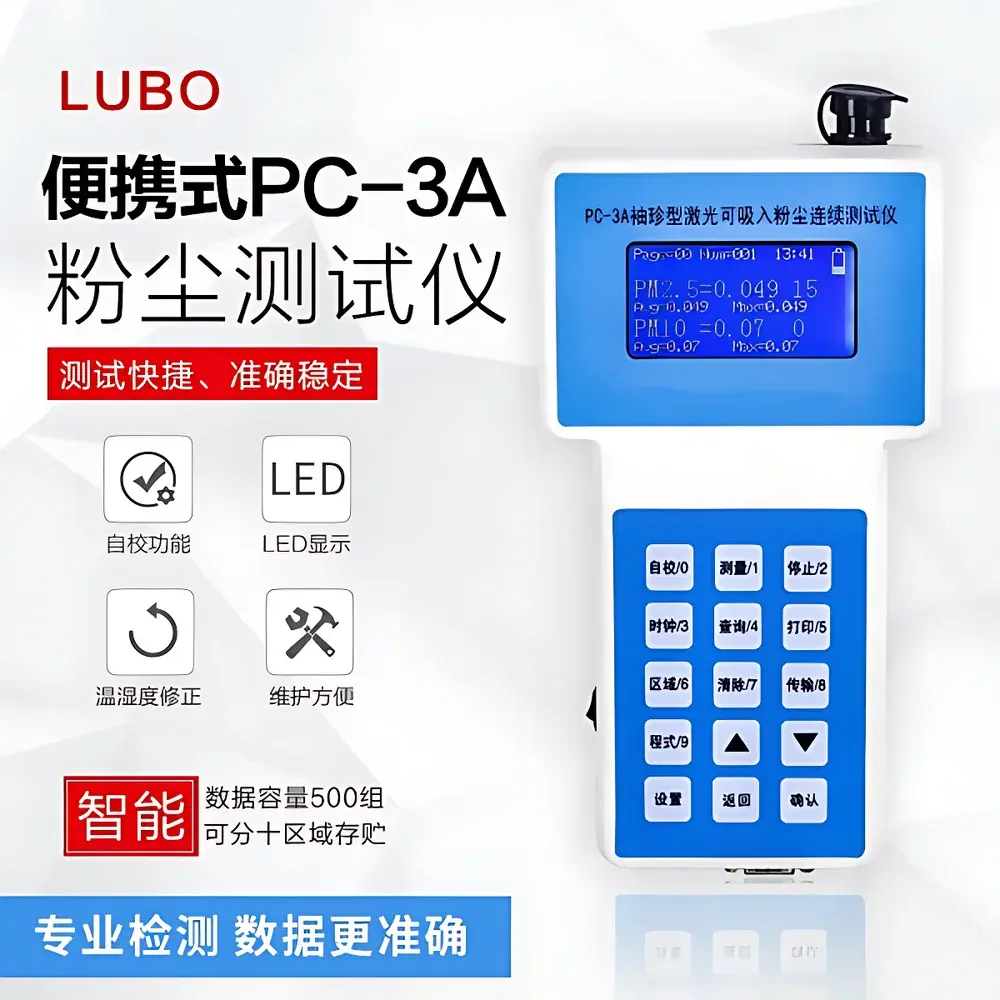
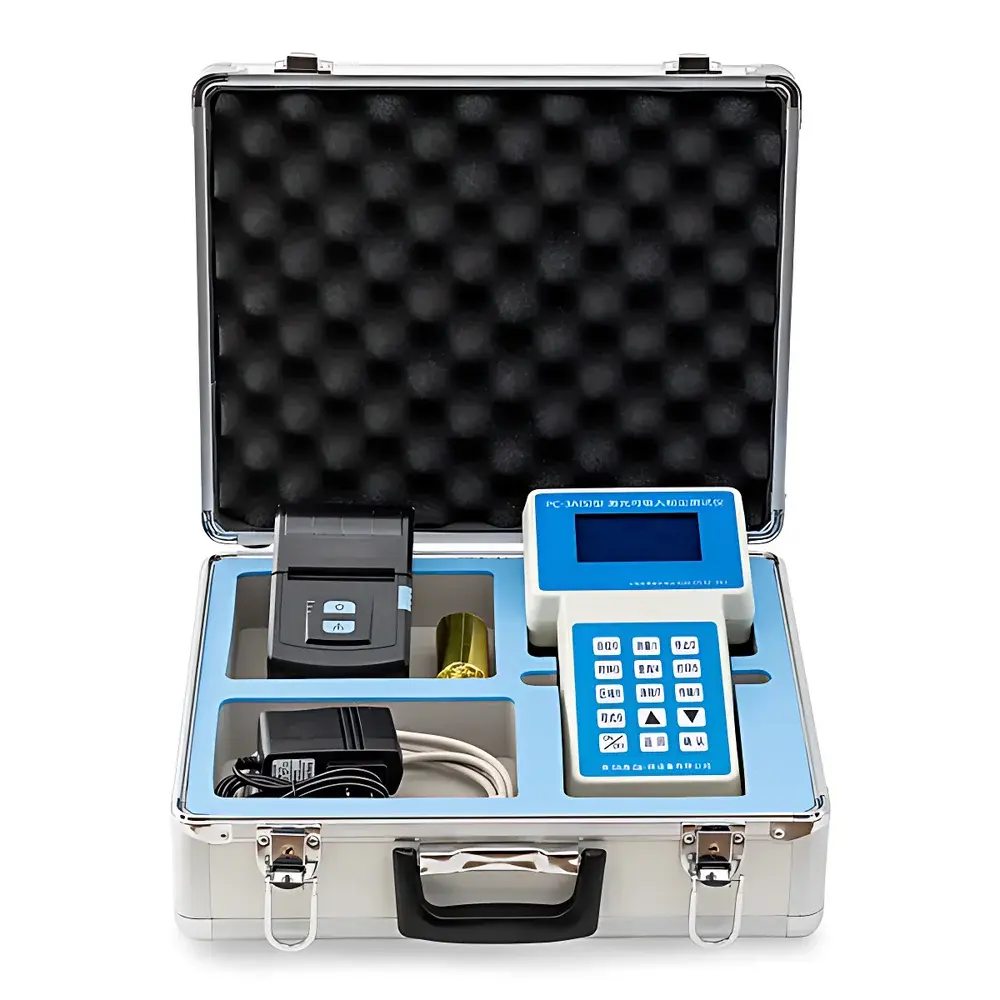
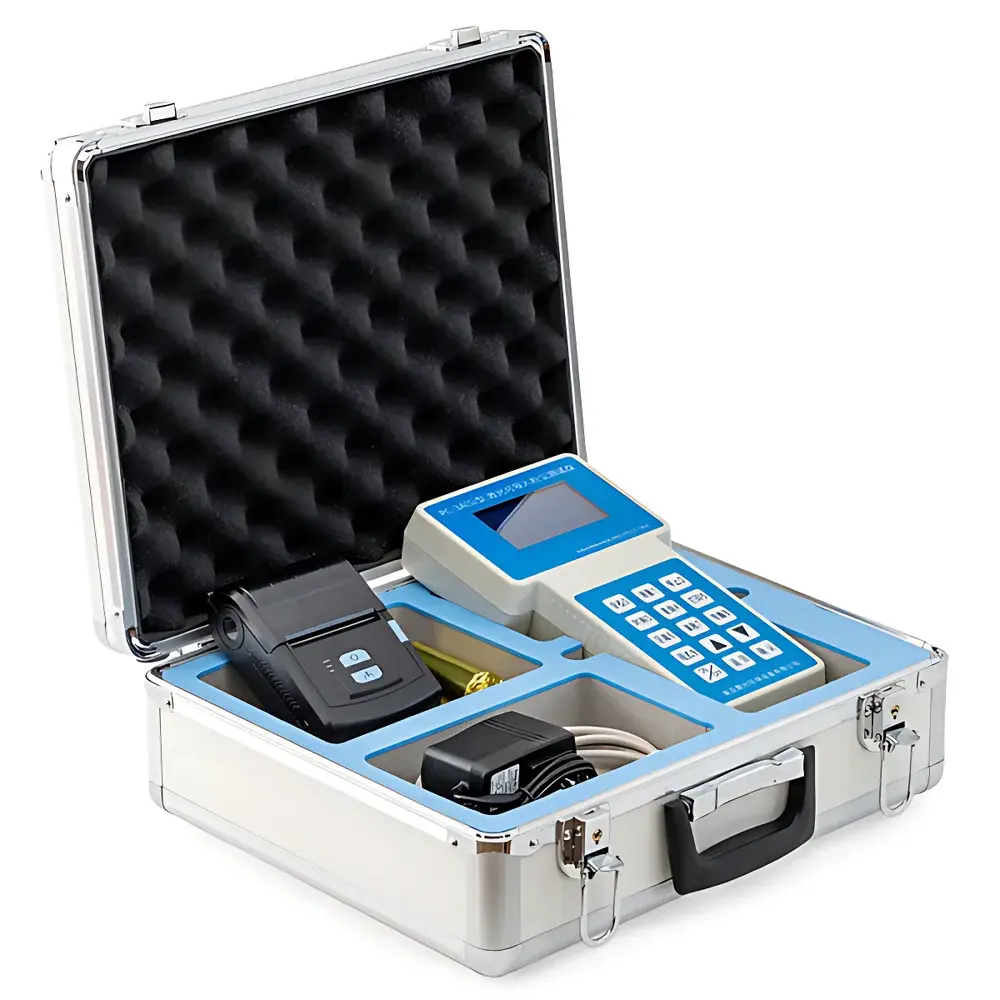
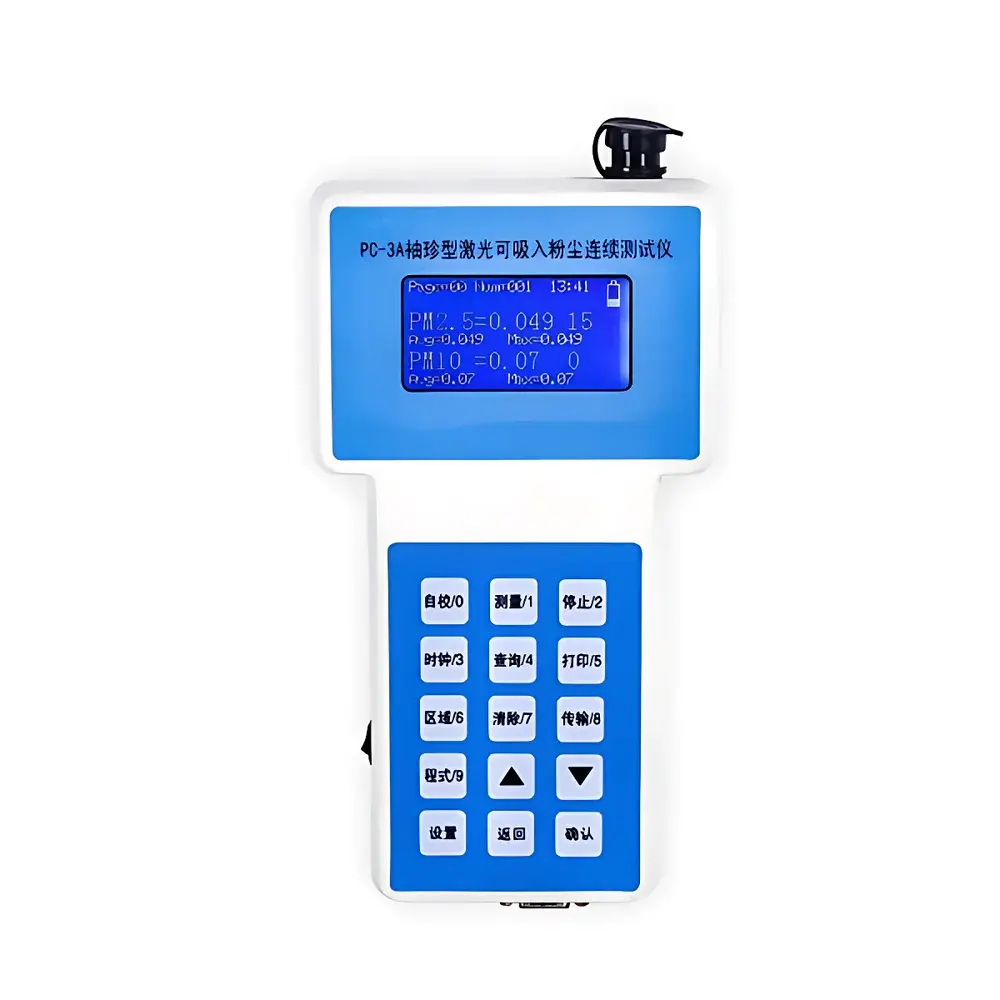
New Environmental Protection Industry PC-3A Portable Laser Dust Monitor for Inhalable Particulate Matter (PM10) with Built-in Printer and Data Export
| Brand | New Environmental Protection Industry in Qingdao |
|---|---|
| Origin | Shandong, China |
| Manufacturer Type | Manufacturer |
| Country of Origin | China |
| Model | PC-3A |
| Price | ¥2480 |
| Measurement Principle | Light Scattering |
| Safety Rating | Explosion-Proof |
| Measurement Range | 0.01–10 mg/m³ |
| Resolution | 0.001 mg/m³ |
| Accuracy | ±10% |
| Relative Error | ≤±2% |
| Particle Size Range | 0.3–10 µm |
| Counting Concentration Range | 350–999,999 particles/L |
| Storage Capacity | 500 data sets (10 zones) |
| Power Supply | Rechargeable 5V battery (4 h continuous operation) or 220 VAC/50 Hz via adapter |
| Operating Noise | ≤15 dB(A) |
| Humidity Correction Ranges | 90–85%, 85–75%, 75–60%, <60% |
| Calibration Factor Adjustment | 0.1–9.9 |
| Sampling Interval Options | 2 min, 5 min |
| Application Environments | Indoor, Outdoor, Public Spaces |
Overview
The New Environmental Protection Industry PC-3A Portable Laser Dust Monitor is a field-deployable, real-time instrument engineered for continuous measurement of inhalable particulate matter (PM10) mass concentration in ambient and occupational environments. It operates on the principle of forward light scattering—where aerosol particles suspended in sampled air pass through a focused laser beam, generating scattered light intensity proportional to particle size and concentration. This signal is converted via calibrated photodetector electronics into mass concentration (mg/m³), traceable to NIST-traceable reference aerosols under controlled calibration conditions. Designed for regulatory-grade field use—not laboratory-grade metrology—the PC-3A delivers repeatable PM10 data suitable for trend analysis, exposure assessment, and compliance screening in dynamic environments. Its explosion-proof housing (certified per GB 3836.1–2010 for Class II, Group C hazardous locations) enables safe deployment in industrial settings where combustible dusts or vapors may be present.
Key Features
- Integrated thermal printer for immediate hard-copy output of time-stamped concentration readings and statistical summaries (e.g., average, max, min, standard deviation)
- Dual-power architecture: 5 V rechargeable lithium-ion battery supporting ≥4 hours of continuous operation; AC adapter input (220 VAC/50 Hz) for extended stationary use
- Real-time correction algorithms for ambient humidity (four discrete correction bands: >90%, 85–90%, 75–85%, <75% RH), mitigating hygroscopic growth effects on optical response
- Configurable sampling intervals (2 min or 5 min) with automatic timestamping and internal clock synchronization
- On-device data storage capacity of 500 records distributed across 10 user-defined memory zones, enabling segmented logging for multi-site or multi-shift monitoring
- RS-232 serial interface (compatible with legacy industrial protocols) and standard parallel port for direct connection to dot-matrix or thermal printers
- Self-calibration function using internal reference scatter source to verify optical path integrity prior to measurement cycles
- Low-noise (<15 dB[A]) aspiration system with optimized laminar flow channel to minimize particle loss and electrostatic deposition
- Adjustable calibration factor (0.1–9.9) for site-specific aerosol density and refractive index compensation
Sample Compatibility & Compliance
The PC-3A is validated for use with airborne particulates exhibiting aerodynamic diameters between 0.3 µm and 10 µm—covering the full PM10 fraction as defined by ISO 7708:1995 and EPA Method IO-4. It meets Chinese national standards GB/T 20965–2007 (Instrumentation for Ambient Air Quality Monitoring) and JJG 846–2015 (Verification Regulation for Dust Meters). While not certified to IECEx or ATEX, its explosion-proof enclosure complies with GB 3836.1–2010 for non-mining Class II C-group hazardous areas. The device supports documentation workflows aligned with GLP principles: all stored data include embedded timestamps, zone identifiers, and operator-configurable metadata. Though lacking FDA 21 CFR Part 11-compliant electronic signature capability, audit-ready printouts satisfy basic record retention requirements under OSHA 1910.1200 and China’s Work Safety Law.
Software & Data Management
Data export is performed via physical interface only—no proprietary software or cloud connectivity is included. Raw measurement files (ASCII text format) can be retrieved from the device’s internal memory using the RS-232 port and parsed using generic terminal emulators (e.g., Tera Term, PuTTY) or custom Python/Excel scripts. Each record contains: date/time stamp, zone ID, PM10 concentration (mg/m³), particle count (particles/L), relative humidity band, and calibration factor applied. Printed reports include header information (model, serial number, firmware version), measurement parameters, and a checksum for data integrity verification. No firmware updates or remote diagnostics are supported; maintenance is limited to optical window cleaning, battery replacement, and annual factory recalibration.
Applications
- Ongoing occupational exposure monitoring in mining, construction, cement manufacturing, and woodworking facilities per GBZ 159–2004 (Workplace Air Sampling Specifications)
- Public health surveillance by CDC and municipal health inspection agencies in transportation hubs, commercial buildings, schools, and entertainment venues
- Source identification and emission characterization during environmental impact assessments and pollution source investigations
- Indoor air quality (IAQ) baseline studies in pharmaceutical cleanrooms (ISO 14644-1 Class 8 equivalent screening), food processing lines, and electronics assembly areas
- Field validation of HVAC filtration efficiency and cleanroom containment integrity
- Short-term epidemiological studies requiring spatially resolved PM10 gradients across urban or industrial zones
- Post-demolition or post-blast ambient dust dispersion mapping in accordance with local environmental ordinances
FAQ
What aerosol types is the PC-3A calibrated for?
The instrument is factory-calibrated using Arizona Test Dust (ISO 12103-1, A1) as a surrogate for general urban and occupational dust. Users must apply site-specific calibration factors when measuring highly reflective (e.g., TiO₂) or highly absorptive (e.g., carbon black) aerosols.
Does the device meet ISO 29463 or EN 1822 filter testing requirements?
No—it is not designed for fractional efficiency testing of HEPA/ULPA filters. Its optical design targets mass concentration, not particle counting resolution required for filter certification.
Can the PC-3A measure PM2.5 separately?
No. It provides total PM10 mass concentration only. It does not incorporate size-selective inlets or multi-channel scattering detection necessary for segregated PM2.5/PM10 reporting.
Is firmware upgrade possible via USB or SD card?
No. Firmware is read-only and cannot be modified in the field. Functional updates require return-to-factory service.
What is the recommended recalibration interval?
Annual recalibration against gravimetric reference samplers (e.g., TEOM or beta attenuation monitors) is advised per JJG 846–2015, especially after mechanical shock, prolonged high-humidity exposure, or optical window contamination.
Related Products







