
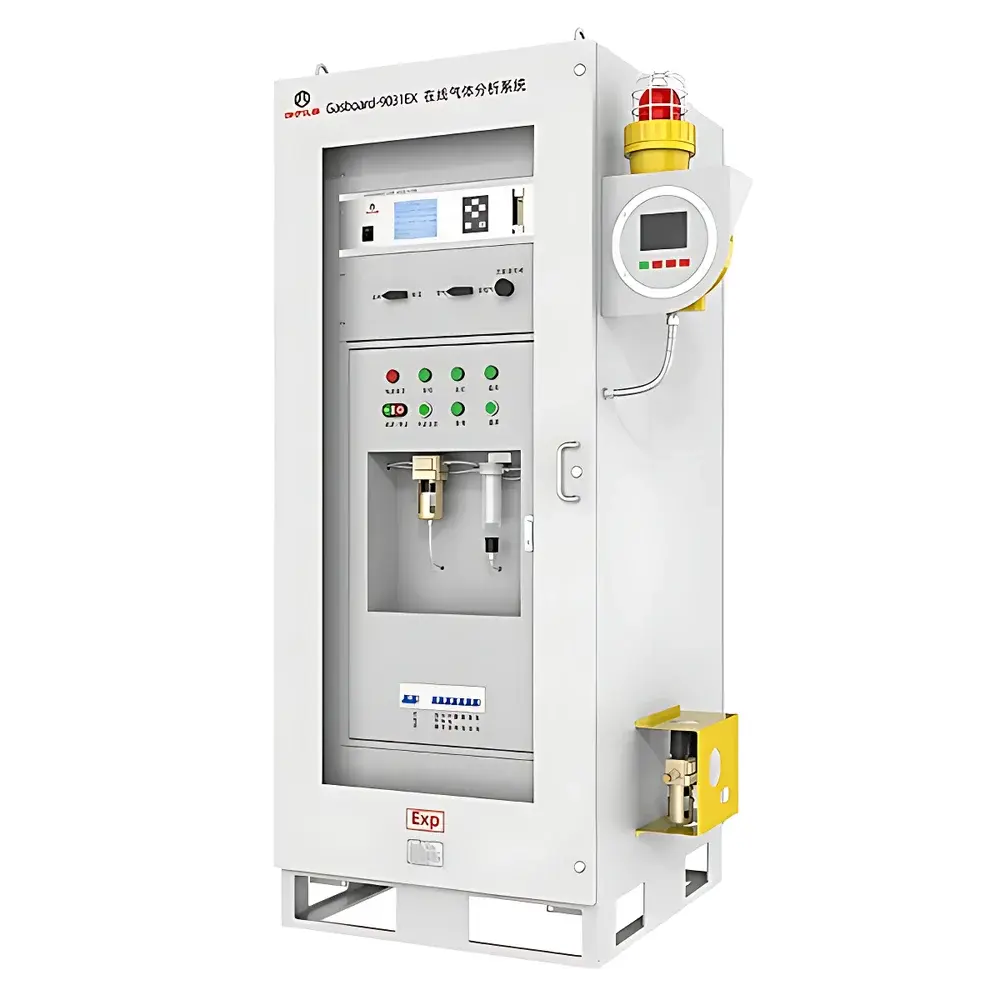
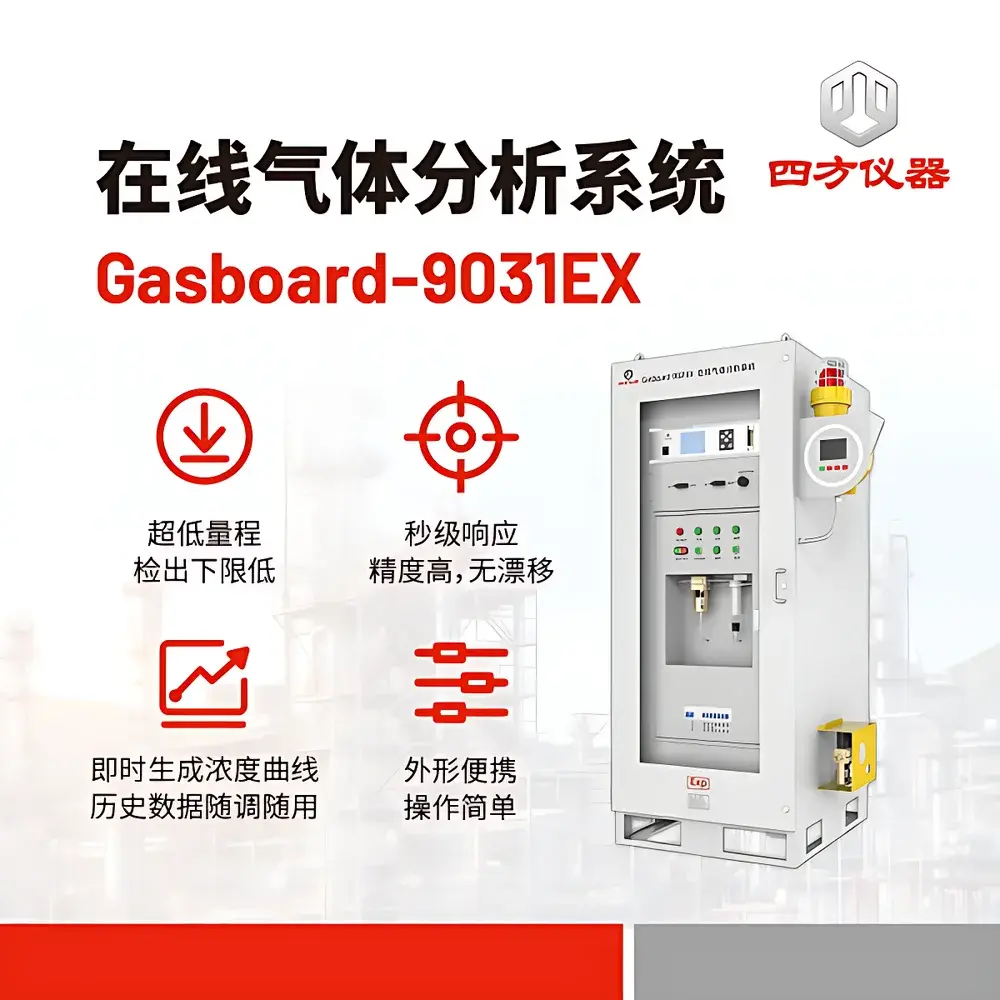
CUBIC INSTRUMENTS Gasboard-9031EX In-Line Blast Furnace Gas Analyzer
| Brand | CUBIC INSTRUMENTS |
|---|---|
| Origin | Hubei, China |
| Model | Gasboard-9031EX |
| Measurement Principle | NDIR + Electrochemical + Thermal Conductivity (TCD) |
| Response Time | 15 s (NDIR channels) |
| Measurement Range | CO/CO₂/CH₄/H₂: (0–100) % vol |
| O₂ | (0–25) % vol |
| CnHm (non-methane hydrocarbons) | (0–10) % vol (optional) |
| Resolution | CO/CO₂/CH₄/CnHm: ±1% FS |
| H₂/O₂ | ±2% FS |
| Explosion Protection Rating | Ex d IIC T4 Gb |
| Output Interfaces | RS-232 / RS-485 / (4–20) mA / Ethernet |
| Display | LCD |
| Auto-calibration | Integrated zero-air pump with automatic air zeroing |
Overview
The CUBIC INSTRUMENTS Gasboard-9031EX is an intrinsically robust, explosion-proof in-line gas analysis system engineered for continuous, real-time monitoring of blast furnace gas (BFG) and other industrial syngas streams. It operates on a hybrid sensing architecture integrating non-dispersive infrared (NDIR) spectroscopy for CO, CO₂, CH₄, C₂H₂, C₂H₄, and CnHm; electrochemical detection for O₂; and thermal conductivity detection (TCD) for H₂. This multi-principle approach ensures high selectivity, long-term stability, and immunity to cross-interference under variable gas matrix conditions typical of metallurgical off-gases. The system is specifically designed for low-dust, high-humidity, and thermally fluctuating sampling environments—common at BFG extraction points, hot blast stoves, dry-quenching coke oven circuits, and electric heating furnace inlets. By delivering simultaneous volumetric concentration data for up to eight gas components—including the critical combustibles (CO, H₂, CH₄) and oxidant (O₂)—the Gasboard-9031EX enables precise calculation of gross calorific value (GCV) via standardized stoichiometric algorithms, eliminating reliance on offline combustion calorimetry.
Key Features
- Explosion-proof design certified to Ex d IIC T4 Gb, suitable for Zone 1 hazardous areas per IEC 60079-0 and EN 60079-1.
- Integrated dry-gas sampling train featuring stainless-steel, electrically heated probe with programmable temperature control (up to 180 °C) to prevent condensation and tar deposition.
- Active reverse-purge mechanism mitigates particulate accumulation on the probe tip, significantly extending maintenance intervals and ensuring signal continuity.
- Single-stage thermoelectric cooler (TEC) combined with dual-stage particulate/moisture filtration (0.1 µm sintered metal + coalescing membrane) delivers clean, dry sample gas to analytical modules without chemical desiccants or refrigerated chillers.
- PLC-based control unit automates sequence operations: sampling, purge cycles, condensate drainage, and sensor diagnostics—enabling unattended 7×24 operation.
- Embedded self-diagnostic firmware continuously monitors sensor health, zero drift, span stability, and flow integrity, generating event logs compliant with ISO 17025 traceability requirements.
Sample Compatibility & Compliance
The Gasboard-9031EX is validated for use with raw and partially cleaned blast furnace gas, coke oven gas, converter gas, and circulating gases from dry quenching systems. Its NDIR optical path is optimized for high-CO, high-CO₂ matrices (up to 30% CO, 25% CO₂), while the TCD module maintains linearity across wide H₂ concentration gradients (0–100% vol). All wetted materials—including probe body, filter housings, and internal tubing—are constructed from 316L stainless steel or PTFE-lined components, ensuring resistance to acidic condensates (e.g., H₂S, SO₂ traces) and chloride-induced stress corrosion. The system meets electromagnetic compatibility (EMC) requirements per EN 61326-1 and carries CE marking for industrial instrumentation. While not pre-certified for FDA 21 CFR Part 11, its audit trail functionality—including timestamped calibration records, operator login logs, and parameter change history—supports GLP/GMP-aligned deployment when integrated into validated process control networks.
Software & Data Management
The analyzer supports native Modbus RTU/TCP protocol over RS-485/Ethernet and provides analog (4–20) mA outputs for each measured component and calculated GCV. Optional OPC UA server integration allows seamless connection to DCS, SCADA, or MES platforms (e.g., Siemens PCS7, Honeywell Experion, ABB Ability). Local LCD interface displays real-time concentrations, alarm status, system health indicators, and diagnostic codes. Historical data (12+ months at 1-min resolution) is stored internally and exportable via USB or network transfer in CSV format. All configuration changes, calibrations, and fault events are logged with ISO 8601 timestamps and user IDs—meeting minimum ALCOA+ data integrity criteria for regulated industrial applications.
Applications
- Blast furnace top gas and throat gas monitoring for energy recovery optimization and dust load estimation.
- Hot blast stove combustion air/gas ratio control to minimize fuel consumption and NOₓ formation.
- Dry quenching (CDQ) circulating gas composition tracking to prevent explosive limits (LEL monitoring) and optimize coke cooling efficiency.
- Electric heating furnace inlet gas qualification prior to ignition, ensuring safe start-up sequences.
- By-product gas blending control in integrated steel plants—balancing BFG, coke oven gas (COG), and converter gas (LDG) for stable boiler or power generation feedstock.
- Environmental compliance reporting for CO, CH₄, and NOₓ precursors under national emission standards (e.g., China’s GB 28663–2012, EU IED Annex VII).
FAQ
What gas components does the Gasboard-9031EX measure simultaneously?
It measures CO, CO₂, CH₄, H₂, O₂, C₂H₂, C₂H₄, and CnHm (sum of non-methane hydrocarbons) in real time, with optional extension to additional hydrocarbons upon request.
How is zero calibration performed?
The system includes an integrated zero-air pump and solenoid valve manifold to deliver ambient air for automatic zero calibration at user-defined intervals—no external gas cylinders required.
Is the system compatible with existing plant DCS networks?
Yes—it supports Modbus RTU (RS-485), Modbus TCP (Ethernet), and analog (4–20) mA outputs, enabling direct integration with major DCS vendors without gateway hardware.
What maintenance is required during continuous operation?
Filter elements require replacement every 3–6 months depending on dust loading; probe heating elements and TEC coolers are rated for >50,000 hours MTBF; NDIR sensors exhibit <0.5% drift/year under normal operating conditions.
Can the system calculate higher heating value (HHV) and Wobbe index?
Yes—using ASTM D3588-98 and ISO 6976 algorithms, it computes gross calorific value (GCV), net calorific value (NCV), and Wobbe index from measured component concentrations, with configurable fuel composition databases.





