
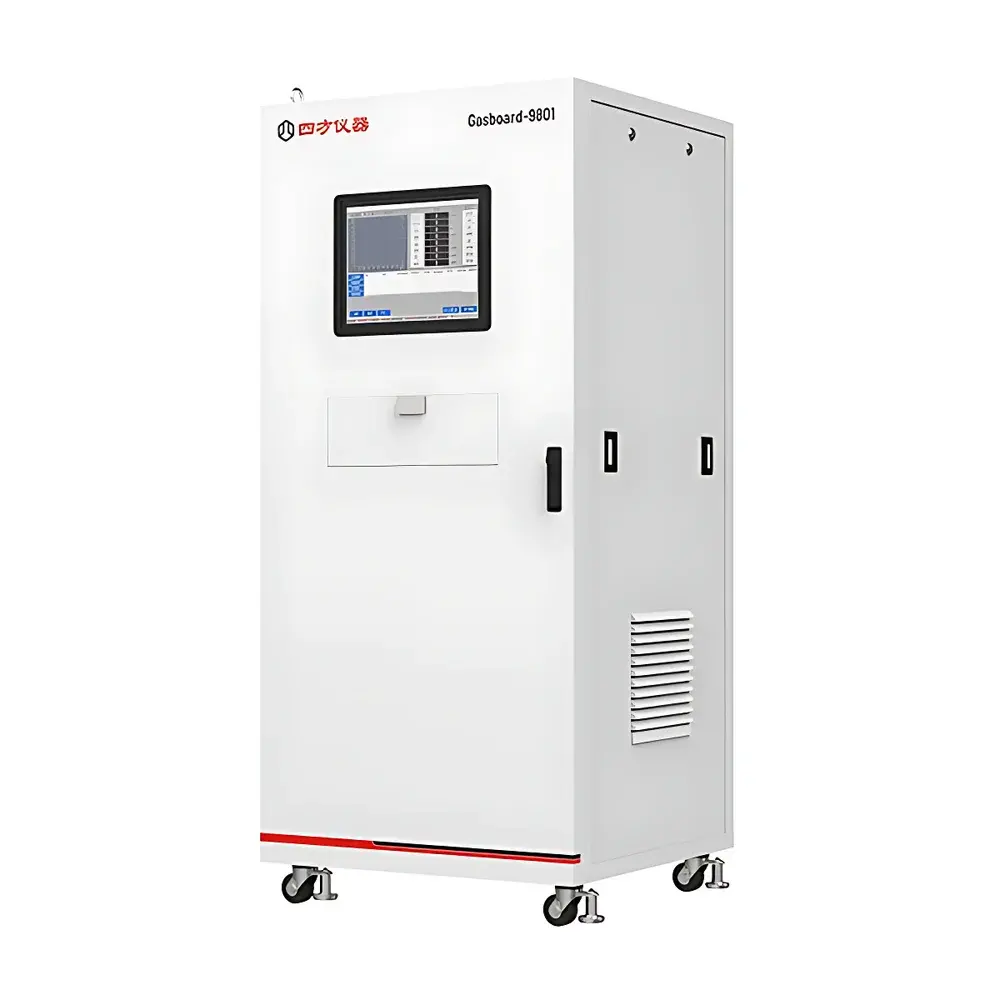

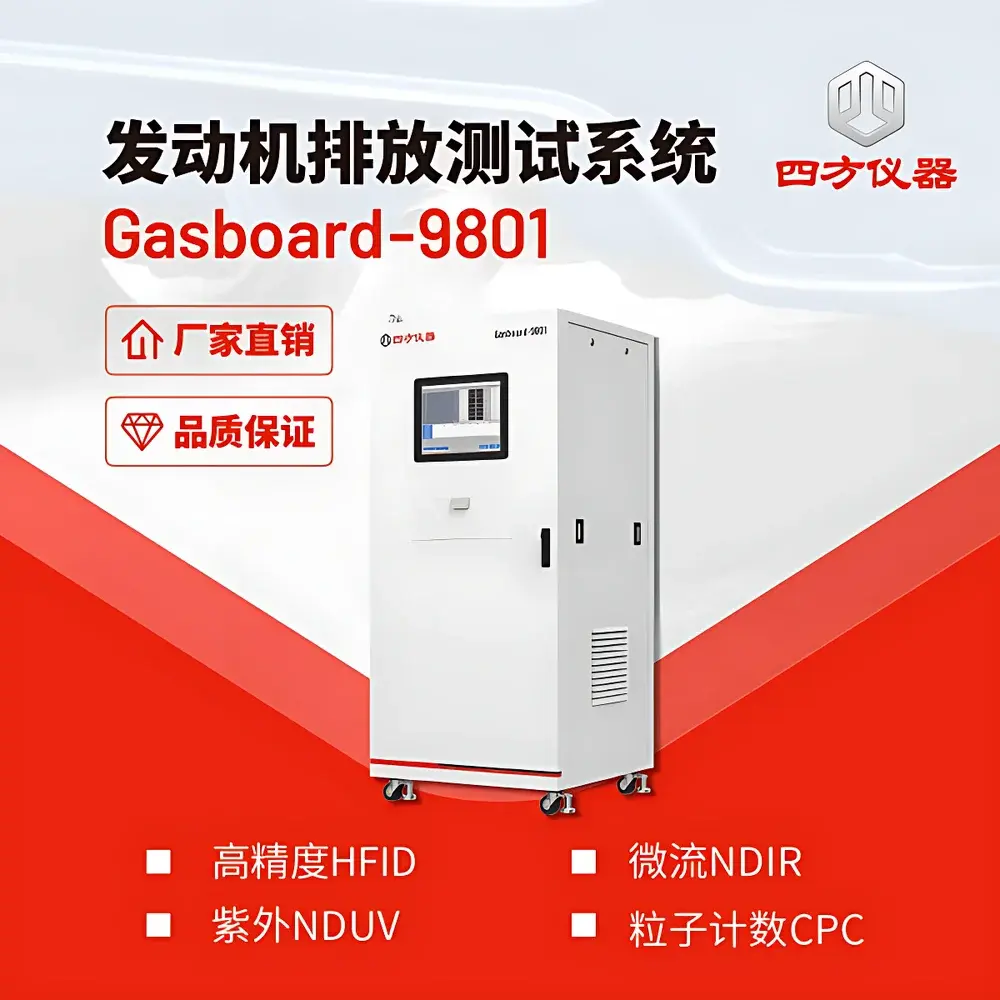
CUBIC INSTRUMENTS Gasboard-9801 Marine Engine Emission Monitoring System
| Brand | CUBIC INSTRUMENTS |
|---|---|
| Origin | Hubei, China |
| Model | Gasboard-9801 |
| Instrument Type | Online Continuous Emission Monitoring System (CEMS) |
| Detection Principle | Non-Dispersive Infrared (NDIR), Non-Dispersive Ultraviolet (NDUV), Chemiluminescence Detection (CLD), Flame Ionization Detection (FID) |
| Measured Gases | THC, CH₄, NOₓ, CO, CO₂, O₂ |
| Max. Permissible Error | ≤±2.0% R.S. or ≤±0.3% F.S. |
| Zero Drift | ≤±1% F.S./8 h |
| Span Drift | ≤±1% F.S./8 h |
| Repeatability | ≤±0.5% F.S. |
| Response Time (T₁₀–₉₀) | <2.5 s |
| Operating Temperature | 5–40 °C |
| Relative Humidity | ≤80% RH |
Overview
The CUBIC INSTRUMENTS Gasboard-9801 Marine Engine Emission Monitoring System is an integrated, online continuous emission measurement platform engineered for regulatory-compliant testing of marine, heavy-duty, and non-road diesel and gas engines. It implements multiple standardized optical and electrochemical detection principles—including Non-Dispersive Infrared (NDIR) for CO, CO₂, and CH₄; Non-Dispersive Ultraviolet (NDUV) and Chemiluminescence Detection (CLD) for NOₓ; and Flame Ionization Detection (FID) for Total Hydrocarbons (THC)—to deliver simultaneous, real-time quantification of six key exhaust constituents: THC, CH₄, NOₓ, CO, CO₂, and O₂. Designed for both raw exhaust and full-flow dilution tunnel applications, the system supports steady-state and transient engine test cycles per ISO 8178, ISO 8528, IMO MARPOL Annex VI, and EU Regulation (EU) 2016/1628. Its modular architecture integrates sampling probes, heated sample lines, particulate filtration, water removal, pressure/temperature conditioning, and multi-channel gas analyzers—ensuring traceable, reproducible data under dynamic flow and composition conditions typical of marine propulsion systems.
Key Features
- Multi-principle gas analysis: NDIR (CO, CO₂, CH₄), NDUV/CLD (NOₓ), FID (THC), and paramagnetic or electrochemical O₂ sensing—each calibrated and validated per ISO 12039, ISO 11562, and EPA Method 10.
- High-speed response with T10–90 < 2.5 s across all channels, enabling accurate capture of transient emissions during WHTC, WHSC, and IMO Tier III test cycles.
- Wide dynamic range: THC and CH₄ from 0–10 ppmC to 0–30,000 ppmC; NOₓ from 0–10 ppm to 0–10,000 ppm; CO from 0–50 ppm to 0–10%; CO₂ from 0–0.5% to 0–20%; O₂ from 0–1% to 0–25%.
- Stability-certified performance: zero and span drift ≤ ±1% F.S./8 h; repeatability ≤ ±0.5% F.S.; linearity verified by coefficient of determination (R²) ≥ 0.998, slope 0.99–1.01, intercept ≤ 0.5% F.S.
- Modular sampling interface supporting up to 8 independent probe ports, configurable for multi-point exhaust sampling, EGR ratio calculation, and bypass calibration gas injection.
- Ruggedized industrial enclosure rated IP54, with heated sample transport lines (191 ± 5 °C) and condensate management compliant with ISO 8178-4 and IMO MEPC.259(68).
Sample Compatibility & Compliance
The Gasboard-9801 is validated for use with diesel, LNG, LPG, methanol, and dual-fuel marine engines operating under ISO 8528-1, ISO 8178-4, and IMO NOₓ Technical Code requirements. It meets the metrological and functional specifications defined in EU Regulation (EU) 2016/1628 (Stage V), China GB 17691–2018 (China VI), and upcoming EU Euro VII draft standards for marine auxiliary engines. All gas analyzers are traceable to NIST or PTB reference standards, and system-level verification follows ISO/IEC 17025-accredited procedures. Data integrity complies with GLP principles and supports audit-ready electronic records aligned with FDA 21 CFR Part 11 requirements when integrated with compliant data acquisition software.
Software & Data Management
Built-in embedded firmware provides real-time signal processing, automatic baseline correction, cross-interference compensation (e.g., H₂O vapor correction for NDIR channels), and auto-zero/span validation. The optional Gasboard Control Suite (v4.x) offers Windows-based configuration, remote diagnostics, automated report generation (PDF/CSV), and direct export to AVL PUMA, ETAS INCA, or Horiba MEXA-Data formats. All measurement events—including calibration logs, maintenance alerts, and environmental condition stamps—are time-synchronized and stored with immutable timestamps, supporting full traceability for type approval submissions to classification societies (e.g., DNV, LR, ABS) and flag state authorities.
Applications
- Marine engine type approval testing per IMO MARPOL Annex VI Tier II/Tier III and EU MRV monitoring requirements.
- Development and validation of aftertreatment systems (SCR, DOC, DPF) on medium-speed and low-speed marine diesel engines.
- Production conformity testing (PCT) and in-service conformity (ISC) audits for shipboard auxiliary and main propulsion engines.
- Non-road mobile machinery (NRMM) certification under EU Stage V and China GB 20891–2014.
- Research into alternative fuels (ammonia blends, hydrogen-diesel co-combustion) requiring high-precision, low-range THC and NOₓ resolution.
FAQ
Does the Gasboard-9801 support real-time EGR rate calculation?
Yes—the system accepts simultaneous intake air and exhaust O₂/CO₂ signals via optional dual-stream sampling modules, enabling on-the-fly EGR ratio derivation using stoichiometric balance algorithms per ISO 11639.
Can it be integrated into existing engine test beds with third-party DAQ systems?
Yes—it provides analog (4–20 mA, 0–10 V) and digital (RS485 Modbus RTU, Ethernet TCP/IP) outputs, fully compatible with NI VeriStand, dSPACE SCALEXIO, and AVL EMCON platforms.
Is factory calibration traceable to international standards?
All analyzer modules undergo pre-delivery calibration using certified gas standards traceable to NIST SRM 1622 (CO), SRM 1623 (CO₂), and custom-mixed NOₓ/CH₄ blends certified to ISO 6141.
What maintenance intervals are recommended for long-term operational stability?
Optical windows require cleaning every 200 operational hours; FID jet inspection every 500 h; NDIR/NDUV lamp replacement every 12 months; full system verification annually per ISO 17025 guidelines.
Does the system meet IMO’s requirement for onboard NOₓ monitoring systems (NMS)?
While designed primarily for land-based certification labs, its hardware architecture and data logging capabilities align with the functional specifications of IMO MEPC.322(74) for NMS—subject to vessel-specific installation qualification and Class Society approval.
Related Products







