
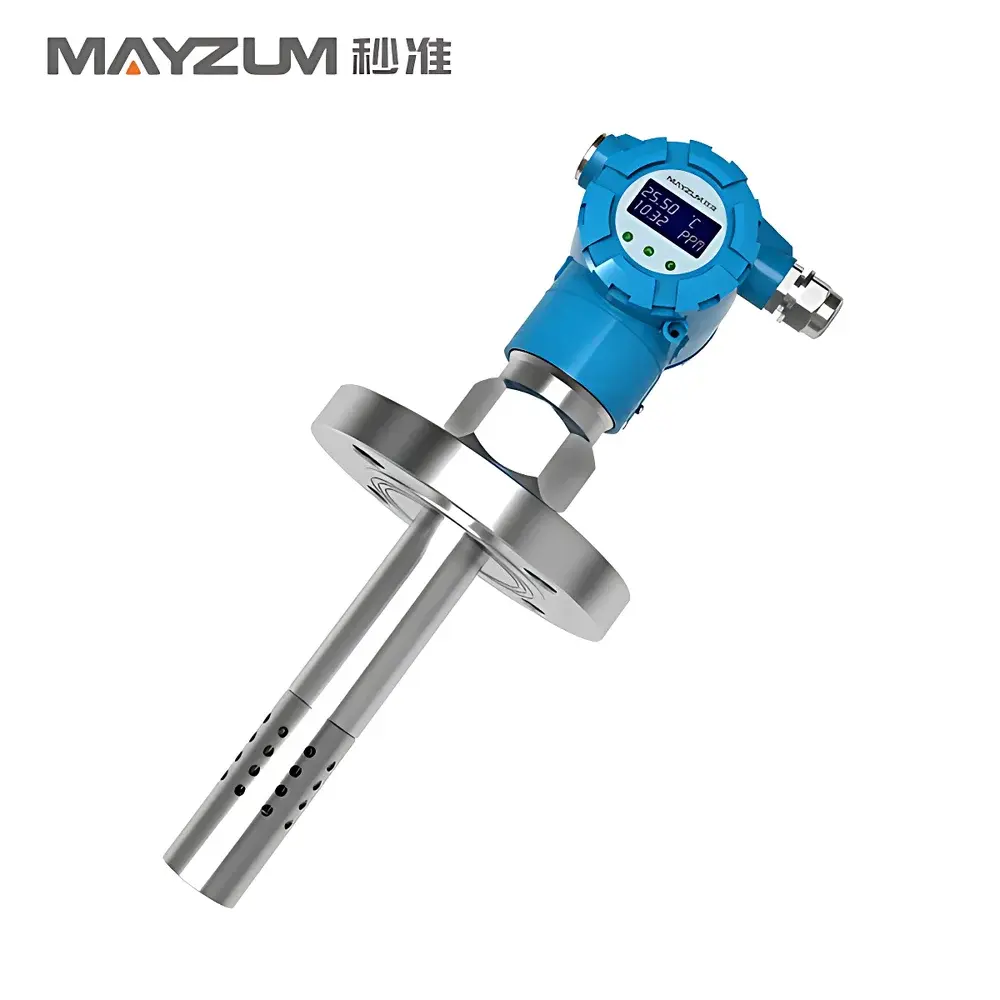
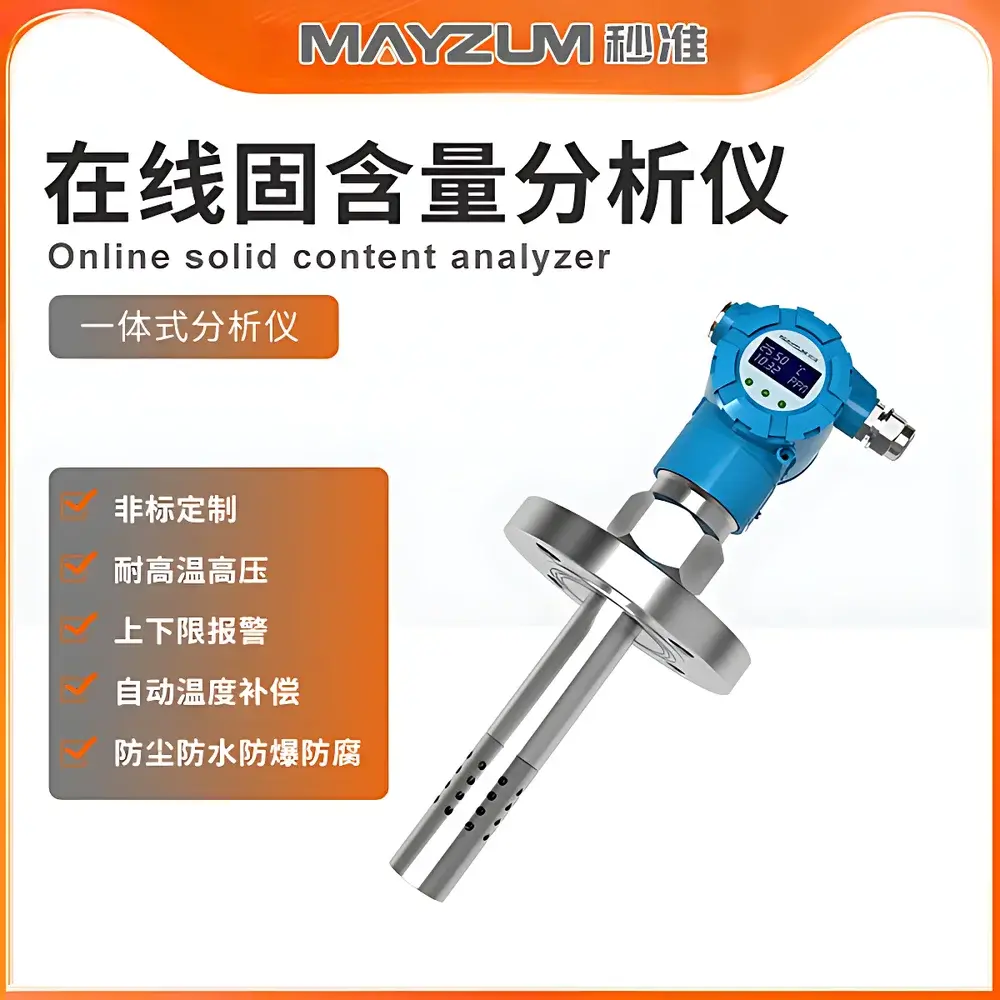
MAYZUM MAZ-Mw201 Online Microwave Moisture Analyzer
| Brand | MAYZUM |
|---|---|
| Model | MAZ-Mw201 |
| Origin | Guangdong, China |
| Manufacturer Type | Direct Manufacturer |
| Certifications | IP67 ingress protection, ATEX/IECEx optional (explosion-proof variants available) |
| Measurement Principle | Continuous-wave microwave transmission & attenuation analysis |
| Measurement Range | 0.1–99.9% moisture content (w/w) |
| Resolution | 0.1% |
| Typical Accuracy | ±0.01–±0.2% (material- and installation-dependent) |
| Output Signals | RS485 (Modbus RTU), 4–20 mA analog, TCP/IP Ethernet |
| Data Logging | Onboard non-volatile memory with timestamped records (≥1 year at 1-min intervals) |
| Process Connection Options | Flanged, sanitary clamp (DIN 11851), NPT threaded, insertion probe, or through-pipe dual-port transmission |
| Housing Material | 316L stainless steel with electropolished finish |
| Operating Temperature | −20 °C to +65 °C ambient |
| Compliance | Meets IEC 61326-1 (EMC), IEC 61000-6-2/6-4, ISO/IEC 17025 traceable calibration support, FDA 21 CFR Part 11 ready (audit trail & electronic signature enabled in software) |
Overview
The MAYZUM MAZ-Mw201 Online Microwave Moisture Analyzer is an industrial-grade, non-contact, real-time moisture measurement system engineered for continuous process monitoring across bulk solids, slurries, liquids, and semi-viscous materials. It operates on the principle of microwave transmission spectroscopy—measuring the dielectric loss and phase shift of a low-power, fixed-frequency (typically 2.45 GHz or 9.3 GHz, configurable per application) electromagnetic wave as it propagates through the material stream. Unlike near-infrared (NIR) or capacitance-based analyzers, microwave technology is insensitive to surface conditions, color, particle size distribution, or optical opacity, enabling stable, interference-free operation in dusty, humid, or steam-laden environments typical of cement kilns, sludge dewatering lines, or biomass conveyors. The MAZ-Mw201 is designed for permanent integration into production infrastructure—including belt conveyors, vertical chutes, horizontal pipelines, agitated tanks, and fluidized beds—delivering repeatable moisture data without sampling delays, manual intervention, or consumables.
Key Features
- IP67-rated rugged enclosure with optional ATEX/IECEx-certified explosion-proof configurations (Category 2G/2D) for hazardous area deployment (e.g., coal handling, solvent-based coating lines, pharmaceutical granulation)
- Multi-mode installation flexibility: flanged transmission path (for pipes ≥DN50), sanitary clamp insertion (for food/pharma compliance), direct-insertion probe (for silos or mixers), or dual-port through-belt geometry (for conveyor-mounted applications)
- High-stability microwave oscillator and temperature-compensated detector array ensure long-term drift <0.05% moisture/year under continuous operation
- Real-time compensation for bulk density fluctuations via integrated reference channel and dynamic baseline correction algorithm
- Field-replaceable sensor modules with hot-swap capability—no process shutdown required for maintenance or recalibration
- Self-diagnostic firmware with continuous signal integrity monitoring, fault logging, and predictive alerting for waveguide fouling or electronics degradation
Sample Compatibility & Compliance
The MAZ-Mw201 supports heterogeneous, multi-phase, and thermally variable matrices without performance compromise. Validated for use with coal fines (6–50 mm), activated sludge (1.5–12% DS), lithium iron phosphate (LFP) cathode slurries (viscosity 3,000–15,000 cP), PVDF battery separator films (thickness 12–25 µm), tobacco lamina (moisture 11–14%), paper pulp (consistency 3–8%), and N-methyl-2-pyrrolidone (NMP) solvent streams (<100 ppm water). All wetted parts comply with FDA 21 CFR 177.2600 (food contact), USP Class VI biocompatibility (for pharma intermediates), and ISO 8502-9 for chloride resistance. Calibration traceability follows ISO/IEC 17025 requirements, with documented uncertainty budgets available per installation. The analyzer meets EN 61000-6-2 (immunity) and EN 61000-6-4 (emission) for industrial electromagnetic environments.
Software & Data Management
The embedded firmware supports Modbus RTU over RS485, HART-compatible 4–20 mA output with digital superimposed diagnostics, and native TCP/IP Ethernet with HTTP/HTTPS RESTful API endpoints. Local HMI includes a 5.7″ sunlight-readable TFT display with touch interface for zero/span adjustment, trend visualization (up to 7-day rolling buffer), and alarm configuration (high/low limits, rate-of-change thresholds). Remote access is enabled via secure TLS 1.2 encrypted web portal or OPC UA server (compliant with IEC 62541). Data export supports CSV, PDF report generation, and direct integration with MES (e.g., Siemens Opcenter, Rockwell FactoryTalk) and LIMS platforms. Audit trails record all parameter changes, calibration events, and user logins with timestamps and operator IDs—fully compliant with FDA 21 CFR Part 11 and EU Annex 11 requirements for electronic records and signatures.
Applications
The MAZ-Mw201 is deployed in mission-critical control loops where moisture directly impacts product quality, energy efficiency, or regulatory conformance. In metallurgy, it maintains sinter feed consistency by regulating water addition prior to ignition; in wastewater treatment, it optimizes centrifuge polymer dosing based on real-time sludge cake moisture; in lithium-ion battery manufacturing, it ensures electrode coating uniformity by controlling slurry solid content within ±0.3% tolerance; in tobacco processing, it stabilizes cut filler moisture to prevent stem breakage during expansion; in food extrusion, it enables closed-loop feedback to dryer zone temperatures for consistent snack crispness. Additional validated use cases include real-time monitoring of MBR membrane biofilm hydration, lime slurry saturation in flue gas desulfurization, and solvent residual quantification in lyophilized APIs.
FAQ
What is the minimum detectable moisture change the MAZ-Mw201 can resolve?
The system provides 0.1% resolution across the full 0.1–99.9% range, with repeatability better than ±0.05% under controlled lab conditions.
Can the analyzer be calibrated without removing it from the process line?
Yes—field calibration is performed using certified reference standards (e.g., Karl Fischer titration samples) introduced upstream; the device supports multi-point span adjustment via Modbus or local HMI.
Is the microwave emission safe for personnel and nearby electronics?
Output power is <10 mW—well below ICNIRP public exposure limits—and fully shielded per IEC 62233; no special safety interlocks are required.
How does the MAZ-Mw201 handle material buildup on the waveguide windows?
Integrated ultrasonic transducers (optional) or air purge collars (standard on high-dust models) maintain optical path clarity; firmware auto-compensates for minor attenuation drift.
Does the system support integration with DCS or PLC systems?
Yes—native Modbus RTU, 4–20 mA with HART, and OPC UA protocols enable seamless connectivity to Emerson DeltaV, Honeywell Experion, Siemens PCS7, and Allen-Bradley ControlLogix platforms.




