
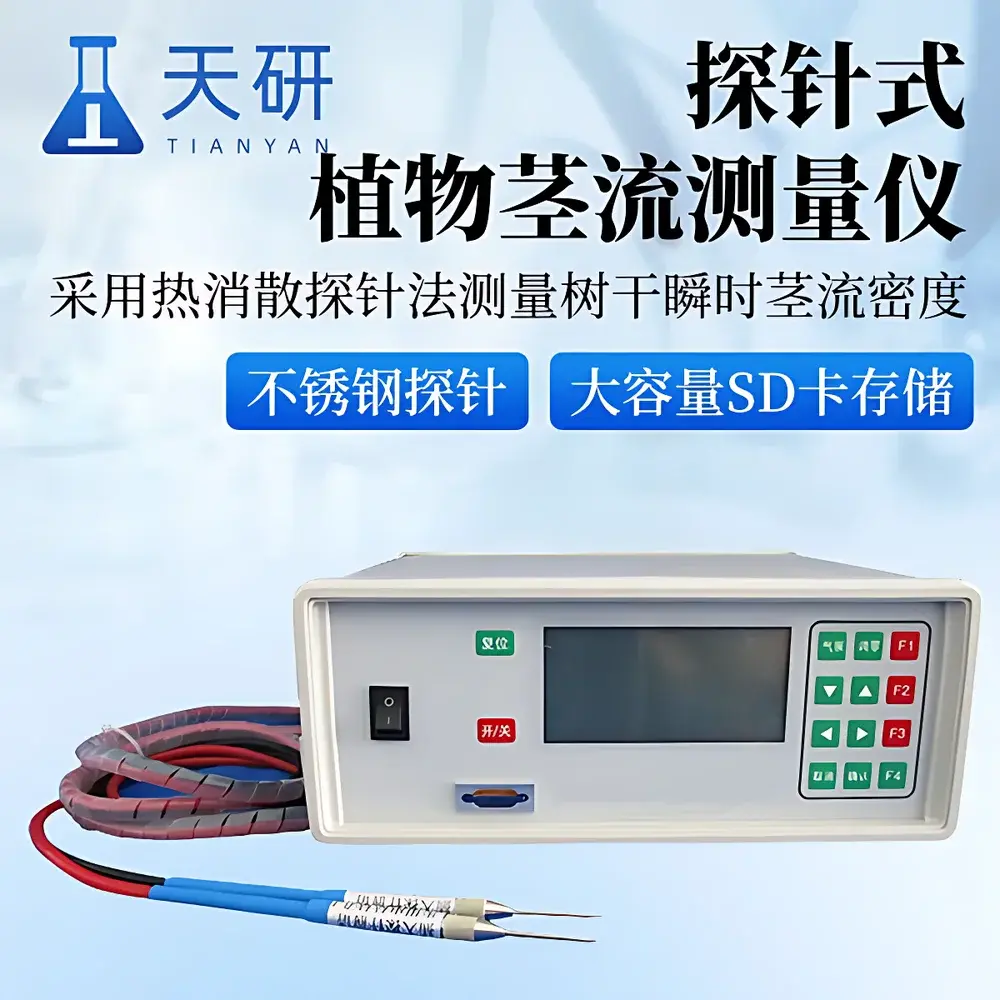
Tianyan TY-JL01 Thermal Dissipation Probe-Based Sap Flow Meter
| Brand | Tianyan (Shandong Tianyan Instrument Co., Ltd.) |
|---|---|
| Origin | Shandong, China |
| Manufacturer Type | Direct Manufacturer |
| Model | TY-JL01 |
| Measurement Principle | Constant-Heat Thermal Dissipation Method (Granier-type) |
| Probe Length | 33 mm |
| Inter-probe Spacing | 10–15 cm |
| Sensor Type | Paired T-type Thermocouples |
| Heating Element | DC-powered Constant-Current Resistive Heater |
| Data Storage | 2 GB SD Card |
| Sampling Interval | Adjustable from 1 to 99 minutes |
| Display | 320 × 160 LCD |
| Power Supply | 8.4 V Rechargeable Lithium Battery (Optional Solar Panel Integration) |
| Operating Temperature | 10–60 °C |
| Operating Humidity | 0–100 % RH |
| Material | Stainless Steel Probes with PTFE (Teflon) Coating |
| Channel Count | Single-Channel |
| Output | Instantaneous Sap Flux Density (g·m⁻²·s⁻¹ or mL·cm⁻²·h⁻¹, software-convertible) |
Overview
The Tianyan TY-JL01 Thermal Dissipation Probe-Based Sap Flow Meter is an engineered field instrument designed for long-term, in situ quantification of sap flux density in woody plant stems. It implements the Granier thermal dissipation method—a widely validated, physics-based technique developed in the 1980s for estimating transpiration-driven water movement through xylem tissue. By measuring the temperature differential between two axially aligned probes inserted into the active sapwood—where one probe is heated at a constant power and the other remains passive—the system calculates sap velocity based on the rate of heat dissipation, which correlates linearly with volumetric flow under steady-state conditions. This principle enables non-destructive, continuous monitoring of tree-level water use without requiring calibration against gravimetric or lysimeter-based reference methods. The TY-JL01 is optimized for deployment in forest ecology, agroforestry research, drought physiology studies, and climate–vegetation interaction modeling, delivering time-series data essential for scaling stomatal conductance to canopy transpiration and validating ecohydrological models.
Key Features
- Paired stainless-steel thermal dissipation probes (33 mm length), each fitted with precision T-type thermocouples for direct analog voltage output and high thermal responsiveness.
- PTFE (Teflon)-coated probe surfaces ensure corrosion resistance, reduced biofouling, and mechanical durability across repeated insertions in diverse wood anatomies—including hardwoods, conifers, and shrubs.
- Integrated constant-current heating circuit maintains stable thermal input to the upper probe, minimizing drift and enabling reproducible ΔT measurements under variable ambient conditions.
- Dedicated drilling jig included for standardized probe insertion depth and inter-probe spacing (10–15 cm), ensuring compliance with Granier protocol geometry requirements.
- Onboard 2 GB SD card supports autonomous logging for up to 12 months at 15-minute intervals—eliminating reliance on external telemetry during remote deployments.
- Backlit 320 × 160 LCD display provides real-time visualization of current ΔT, calculated sap flux density, battery status, and sampling countdown—enabling immediate field validation without laptop dependency.
- 8.4 V rechargeable lithium battery offers >6 months operational life under typical sampling (10-min intervals); optional solar charging module supports year-round unattended operation in high-irradiance environments.
Sample Compatibility & Compliance
The TY-JL01 is validated for use on trees and large shrubs with sapwood thickness ≥15 mm and diameter at breast height (DBH) ≥5 cm. It accommodates species with diffuse-porous, ring-porous, and tracheid-dominated xylem structures, provided probe placement avoids heartwood, decay zones, or vascular discontinuities. While not certified to ISO/IEC 17025 or ASTM D7281 (standard for sap flow sensor verification), the instrument adheres to the measurement geometry, probe thermal specifications, and data reduction algorithms outlined in Granier (1985, *Trees*) and subsequent peer-reviewed protocols adopted by the International Network on Soil–Plant–Atmosphere Continuum (SPACnet). Its passive analog signal architecture ensures compatibility with third-party dataloggers compliant with ±10 mV differential input ranges and 16-bit ADC resolution.
Software & Data Management
Raw thermocouple voltages (upper and lower probe outputs) and heater status are stored in timestamped binary format on the SD card. A cross-platform desktop utility (Windows/macOS/Linux) converts these files into CSV with columns for Julian date, UTC timestamp, raw ΔT (mV), calculated sap flux density (g·m⁻²·s⁻¹), and diagnostic flags (e.g., low battery, open-circuit detection). The software applies the standard Granier equation with user-configurable empirical coefficients (k-values) per species group—supporting traceable, auditable post-processing. Exported datasets include metadata headers compliant with FAIR principles (Findable, Accessible, Interoperable, Reusable), facilitating ingestion into ecological databases such as TRY Plant Trait Database or FLUXNET. No cloud synchronization or proprietary subscription services are required; all firmware updates and calibration utilities are distributed as signed offline packages.
Applications
- Long-term monitoring of stand-level transpiration responses to precipitation variability, vapor pressure deficit (VPD), and soil moisture depletion in temperate, subtropical, and Mediterranean forests.
- Evaluation of irrigation scheduling efficacy and root-zone water use efficiency in orchard systems and urban green infrastructure.
- Quantifying hydraulic redistribution and nocturnal sap flow in deep-rooted species under drought stress.
- Ground-truthing of satellite-derived evapotranspiration (ET) products (e.g., MOD16A2, SSEBop) at tower footprint scales.
- Assessing species-specific vulnerability to xylem embolism by coupling sap flow cessation thresholds with concurrent stem psychrometer or dendrometer data.
- Supporting GLP-aligned environmental impact assessments for afforestation/reforestation projects under UNFCCC reporting frameworks.
FAQ
What is the minimum sapwood thickness required for reliable measurements?
A minimum of 15 mm of intact, functional sapwood is recommended to ensure adequate thermal gradient development and avoid edge effects near cambium or heartwood boundaries.
Can the TY-JL01 be used on herbaceous or young seedlings?
No—it is not suitable for non-woody tissues or stems <5 cm DBH due to insufficient sapwood volume and thermal mass for stable Granier-type signal resolution.
Does the instrument comply with FDA 21 CFR Part 11 or ISO 13485?
No—these standards apply to medical devices and in vitro diagnostics; the TY-JL01 is a research-grade environmental sensor governed by ecological measurement best practices rather than clinical regulatory frameworks.
How often does the probe require recalibration?
The thermocouple pairs are factory-calibrated and exhibit negligible drift over time; however, annual verification against a NIST-traceable dry-block calibrator (−10 to 70 °C range) is advised for GLP-compliant studies.
Is the SD card data format compatible with R, Python, or MATLAB?
Yes—CSV exports are natively readable via base libraries (e.g., pandas.read_csv, read.csv, csvread) and include ISO 8601 timestamps for seamless time-series alignment with eddy covariance or meteorological datasets.





