
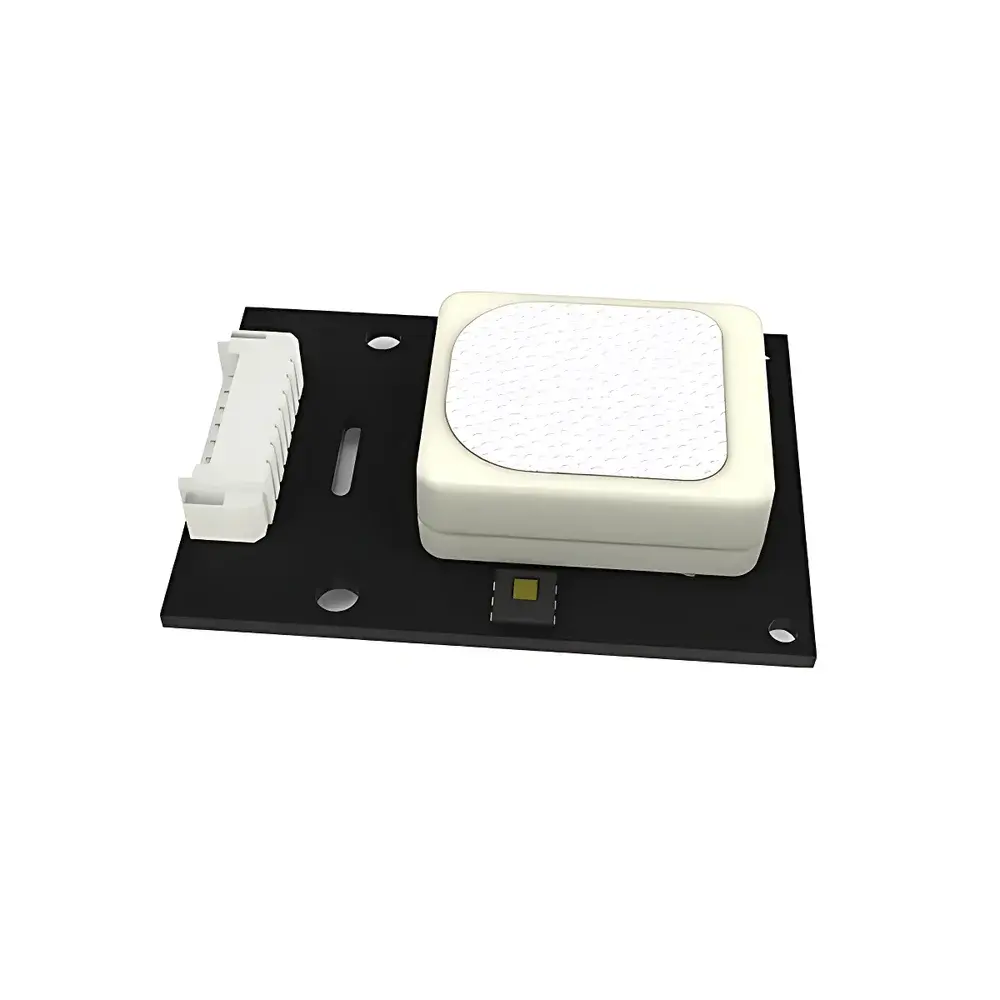
Cubic CB-HCHO-V4S Electrochemical Formaldehyde Sensor
| Brand | Cubic |
|---|---|
| Origin | Hubei, China |
| Manufacturer Type | Authorized Distributor |
| Country of Origin | China |
| Model | CB-HCHO-V4S |
| Price | Upon Request |
| Detection Principle | Electrochemical |
| Measurement Range | 0–1 ppm HCHO |
| Accuracy | ±25 ppb or ±25% (whichever is greater) @ 25±2°C, 50±10% RH |
| Resolution | 1 ppb HCHO |
| Response Time (T90) | 50 s @ 25±2°C, 50±10% RH |
| Warm-up Time | 100 s |
| Operating Temperature | −10 to +50 °C |
| Operating Humidity | 15–95% RH (non-condensing) |
| Storage Conditions | −20 to +60 °C, 15–95% RH (non-condensing) |
| Supply Voltage | DC 3.5–5.5 V |
| Current Consumption | <15 mA |
| Communication Interfaces | UART-TTL (3.3 V), PWM, I²C (pinout预留) |
| Dimensions | 23 × 32 × 8 mm (W × H × D) |
| Service Life | 6 years in ambient air |
| Integrated Sensors | Digital temperature & humidity sensor |
| Compensation | Full-range temperature & humidity compensation |
| Electrolyte Encapsulation | Proprietary hermetic sealing technology |
| Interference Resistance | Engineered for low cross-sensitivity to CO, NO₂, VOCs, and ethanol |
Overview
The Cubic CB-HCHO-V4S Electrochemical Formaldehyde Sensor is a fourth-generation, OEM-grade gas sensing module engineered for continuous, low-concentration formaldehyde (HCHO) monitoring in indoor air quality (IAQ), HVAC control, environmental health surveillance, and occupational safety applications. It operates on the principle of amperometric electrochemistry: formaldehyde diffuses through a selective hydrophobic membrane into an aqueous electrolyte layer, where it undergoes oxidation at a working electrode, generating a current linearly proportional to its concentration. This analog signal is conditioned and digitized internally, with real-time compensation applied using co-located digital temperature and relative humidity sensors. The sensor’s hermetically sealed cell architecture—combined with Cubic’s proprietary electrolyte encapsulation process—ensures long-term stability, minimal drift, and resistance to electrolyte evaporation or leakage under variable thermal and hygric loads. Designed for integration into fixed or portable gas detection systems, the CB-HCHO-V4S meets functional requirements aligned with ISO 16000-23 (indoor air—determination of formaldehyde), EN 15251 (indoor environmental input parameters), and supports traceability frameworks required for GLP-compliant environmental monitoring workflows.
Key Features
- Sub-ppb resolution (1 ppb HCHO) with full-range temperature and humidity compensation enabled by integrated digital T/RH sensor and adaptive algorithm
- Proprietary electrolyte encapsulation technology ensuring mechanical robustness, low baseline drift, and immunity to condensation-induced performance degradation
- Proven interference rejection against common indoor gases—including carbon monoxide (CO), nitrogen dioxide (NO₂), ethanol, and broad-spectrum volatile organic compounds (VOCs)—validated per ASTM D6196 and ISO 16017-1 test protocols
- Triple communication interface support: UART-TTL (3.3 V logic level), pulse-width modulated (PWM) output, and I²C (hardware pinout pre-configured; firmware-enabled)
- Extended operational lifetime of up to 6 years in typical ambient air conditions (25 °C, 50 %RH), verified via accelerated aging tests per IEC 60068-2 standards
- Compact footprint (23 × 32 × 8 mm) optimized for space-constrained embedded designs in smart thermostats, IAQ monitors, and building management system (BMS) nodes
Sample Compatibility & Compliance
The CB-HCHO-V4S is calibrated for gaseous formaldehyde in clean, non-corrosive, non-explosive air matrices. It is not intended for use in high-particulate, high-acid-gas (e.g., SO₂, HCl), or high-solvent-vapor environments without appropriate inlet filtration or dilution. The sensor complies with RoHS Directive 2011/65/EU and REACH Regulation (EC) No. 1907/2006. Its electrical interface design adheres to IEC 61000-4 immunity standards for electrostatic discharge (ESD), radiated RF fields, and fast transient bursts. While not intrinsically safe certified, it may be deployed in Class I, Division 2 hazardous locations when integrated within an appropriately rated enclosure per NEC Article 500.
Software & Data Management
The sensor outputs calibrated digital data via UART (ASCII protocol with checksum) or linear PWM duty cycle (0–100% corresponding to 0–1 ppm). I²C support enables multi-sensor daisy-chaining and register-level configuration (e.g., averaging window, alarm thresholds). Firmware includes non-volatile storage for calibration coefficients, serial number, and manufacturing date—supporting audit-ready data lineage. When integrated into networked monitoring platforms, raw and compensated values can be logged with timestamp, T/RH metadata, and diagnostic flags (e.g., low battery, sensor saturation, warm-up status), facilitating compliance with FDA 21 CFR Part 11 electronic record requirements where applicable.
Applications
- Real-time formaldehyde monitoring in residential, educational, and healthcare facilities per WHO IAQ guidelines and China’s GB/T 18883–2022 standard
- OEM integration into demand-controlled ventilation (DCV) systems for automatic airflow modulation based on HCHO load
- Portable exposure assessment tools for industrial hygiene professionals conducting workplace sampling per OSHA Method 1007
- Post-construction indoor air certification devices used during building commissioning and LEED IEQ credit verification
- Smart home air purifier feedback loops enabling adaptive filter scheduling and UV-C activation logic
FAQ
What is the recommended calibration interval for the CB-HCHO-V4S?
Annual zero and span calibration is advised under normal operating conditions; semi-annual calibration is recommended in high-humidity or high-pollutant environments.
Can this sensor operate continuously in 95% RH?
Yes—its sealed electrolyte cell and conformal-coated PCB enable stable operation up to 95% RH non-condensing, as verified per IEC 60068-2-78 testing.
Is factory calibration traceable to NIST standards?
Calibration is performed using NIST-traceable permeation tubes and dynamic dilution systems compliant with ISO 6145-5; certificate of conformance includes uncertainty budget per GUM (JCGM 100:2008).
Does the sensor require external signal conditioning?
No—the module integrates analog front-end, ADC, microcontroller, and digital compensation; only regulated DC power and a host MCU are required for operation.
How does the CB-HCHO-V4S handle cross-sensitivity to methanol or acetaldehyde?
The electrode catalyst formulation and diffusion barrier design reduce sensitivity to C1–C3 aldehydes and alcohols by >90% relative to formaldehyde, as confirmed in independent inter-laboratory studies (CEN/TC 264/WG 49).







