
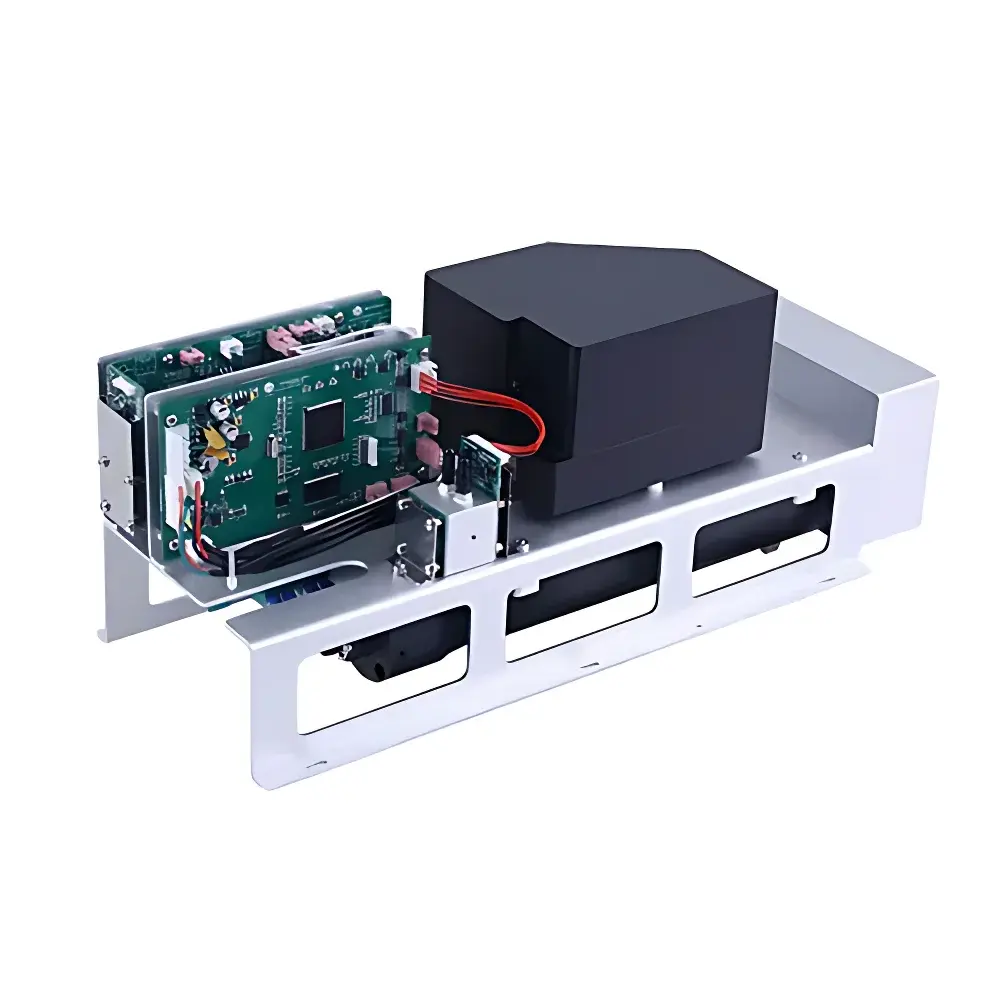
CUBIC INSTRUMENTS Gasboard-2201 UV-DOAS NOx Gas Sensor Module
| Brand | CUBIC INSTRUMENTS |
|---|---|
| Origin | Hubei, China |
| Manufacturer Type | Authorized Distributor |
| Country of Origin | China |
| Model | Gasboard-2201 |
| Pricing | Upon Request |
| Measurement Principle | UV Differential Optical Absorption Spectroscopy (UV-DOAS) |
| Target Gases | NO, NO₂ (direct measurement, no converter required) |
| Range | NO: 0–500 / 0–5000 ppm |
| NO₂ | 0–500 / 0–1000 ppm (customizable) |
| Resolution | 1 ppm |
| Accuracy | ±25 ppm or ±4% of reading (whichever is greater) |
| Repeatability | ±20 ppm or ±3% of reading (whichever is greater) |
| Response Time (T₉₀) | ≤4.5 s |
| Compensation | Automatic temperature & pressure compensation |
| Compliance | GB 3847–2018, GB 18285–2018 |
Overview
The CUBIC INSTRUMENTS Gasboard-2201 is a compact, high-performance gas sensor module engineered for selective, real-time detection of nitrogen monoxide (NO) and nitrogen dioxide (NO₂) in engine exhaust and ambient air streams. It employs ultraviolet differential optical absorption spectroscopy (UV-DOAS), a well-established, physics-based analytical technique that exploits the unique electronic absorption signatures of NO and NO₂ in the 200–300 nm spectral region. Unlike chemiluminescence or electrochemical methods, UV-DOAS enables direct, simultaneous quantification of both NO and NO₂ without catalytic conversion—eliminating cross-sensitivity, drift from converter aging, and water vapor interference. The optical path utilizes a stabilized pulsed xenon lamp as the broadband UV source and a high-resolution spectrometer with thermoelectrically cooled CCD detector, ensuring robust signal-to-noise ratio and long-term photometric stability. Designed for integration into portable analyzers, on-board diagnostic (OBD) systems, continuous emission monitoring systems (CEMS), and laboratory-grade gas analysis platforms, the Gasboard-2201 delivers metrologically traceable measurements under dynamic flow and variable environmental conditions.
Key Features
- Direct dual-gas measurement: Simultaneous, independent quantification of NO and NO₂ without external NOx converters or thermal denuders
- UV-DOAS core technology: High selectivity against common interferents including SO₂, CO, H₂O vapor, and hydrocarbons—no zero/span drift due to humidity fluctuations
- Integrated environmental compensation: Real-time, algorithm-driven correction for ambient temperature (−20 °C to +50 °C) and barometric pressure (60–110 kPa)
- Modular OEM architecture: Standard 32-pin D-sub interface with analog (4–20 mA, 0–5 V) and digital (RS-485 Modbus RTU) outputs; footprint optimized for space-constrained embedded systems
- Long operational lifetime: >24 months typical service life under continuous operation; xenon lamp lifetime exceeds 2 × 10⁹ flashes
- Low power consumption: <3.5 W average operating power, suitable for battery-powered field instruments and vehicle-mounted applications
Sample Compatibility & Compliance
The Gasboard-2201 is validated for use with hot, humid, and particulate-laden sample streams typical of diesel and gasoline engine exhaust (up to 180 °C inlet temperature with optional heated sampling line). Its optical design inherently rejects scattering effects from aerosols and condensable organics, maintaining accuracy without frequent optical cleaning. The sensor meets the performance requirements of Chinese national standards GB 3847–2018 (“Limits and measurement methods for exhaust pollutants from compression ignition engines and vehicles”) and GB 18285–2018 (“Limits and measurement methods for exhaust pollutants from spark ignition engines and vehicles”). While not certified to EU EN 15267 or US EPA CFR Title 40 Part 60 PS-17, its DOAS methodology aligns with the underlying physical principles referenced in ISO 15058:2021 (stationary source emissions — determination of NOx by UV absorption) and supports data integrity frameworks compatible with GLP and ISO/IEC 17025 quality management systems.
Software & Data Management
The sensor operates autonomously but is fully programmable via ASCII command set over RS-485. Host systems can configure measurement range, averaging time (1–60 s), alarm thresholds, and calibration intervals. Internal firmware implements linearization algorithms based on multi-wavelength least-squares fitting of absorption spectra, with factory calibration stored in non-volatile memory. Raw spectral data is accessible upon request for advanced diagnostics or third-party spectral modeling. For regulatory reporting, output signals comply with NIST-traceable calibration protocols; full audit trails—including timestamped calibration events, environmental compensation logs, and error flags—are retained in internal flash memory for ≥30 days. Optional firmware upgrade enables compatibility with FDA 21 CFR Part 11-compliant data acquisition software when deployed in pharmaceutical or biomanufacturing cleanroom air monitoring contexts.
Applications
- On-vehicle emissions testing: Integration into PEMS (Portable Emissions Measurement Systems) for RDE (Real Driving Emissions) compliance per UN Regulation No. 49 and China’s CN9 standard
- Stationary source CEMS: Monitoring NOx at power plant stacks, industrial boilers, and waste incinerators where wet-stack conditions prevail
- Environmental air quality networks: Urban and roadside monitoring stations requiring low-maintenance, high-reliability NO/NO₂ speciation
- Engine development laboratories: Real-time combustion optimization using crank-angle-resolved NOx feedback during dynamometer testing
- OEM system integration: Embedded modules for smart exhaust aftertreatment control (e.g., SCR dosing feedback) and predictive maintenance analytics
FAQ
Does the Gasboard-2201 require periodic calibration with certified gas standards?
Yes—initial factory calibration is traceable to NIM (National Institute of Metrology, China) reference gases. Field recalibration is recommended every 3–6 months depending on exposure severity; span checks with certified NO/NO₂ mixtures (e.g., 100 ppm in N₂) are sufficient for routine verification.
Can it operate in high-humidity exhaust without condensation damage?
The optical cell is sealed and temperature-controlled; however, inlet gas must be filtered and dried to dew point ≤5 °C prior to entry. Optional heated sample line kits (up to 180 °C) are available for raw exhaust applications.
Is analog output linear across the full measurement range?
Yes—4–20 mA and 0–5 V outputs are digitally linearized to match the full-scale range selected during configuration (e.g., 0–5000 ppm NO), with end-point nonlinearity <±0.5% FS.
What is the minimum detectable concentration (MDL) under typical lab conditions?
Based on 1σ noise analysis of 60-second averaged readings: MDL = 2.5 ppm for NO and 1.8 ppm for NO₂ at 25 °C, 101.3 kPa, and 50% RH.
How is firmware updated in the field?
Via RS-485 using CUBIC’s proprietary PC utility (Windows/Linux); updates preserve all user settings and calibration coefficients. Firmware version and build date are queryable via ASCII command “VER?”.
Related Products







