
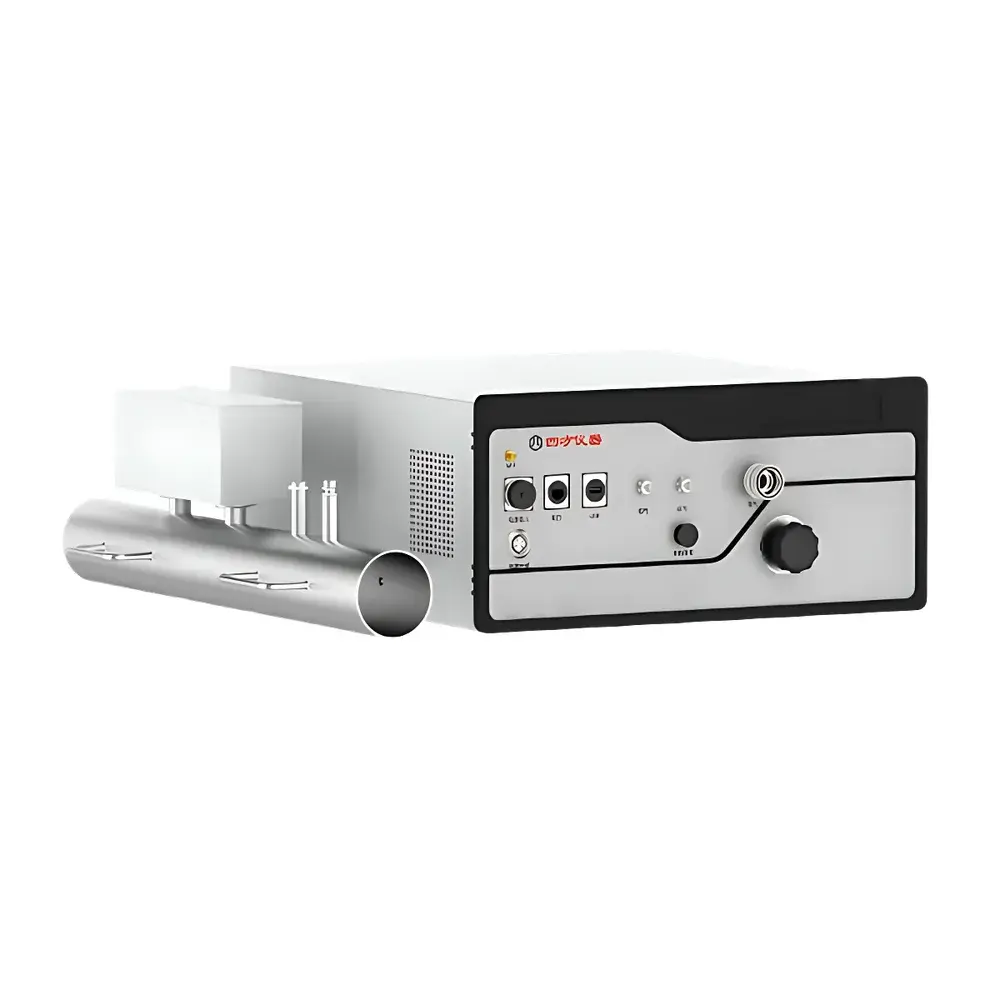
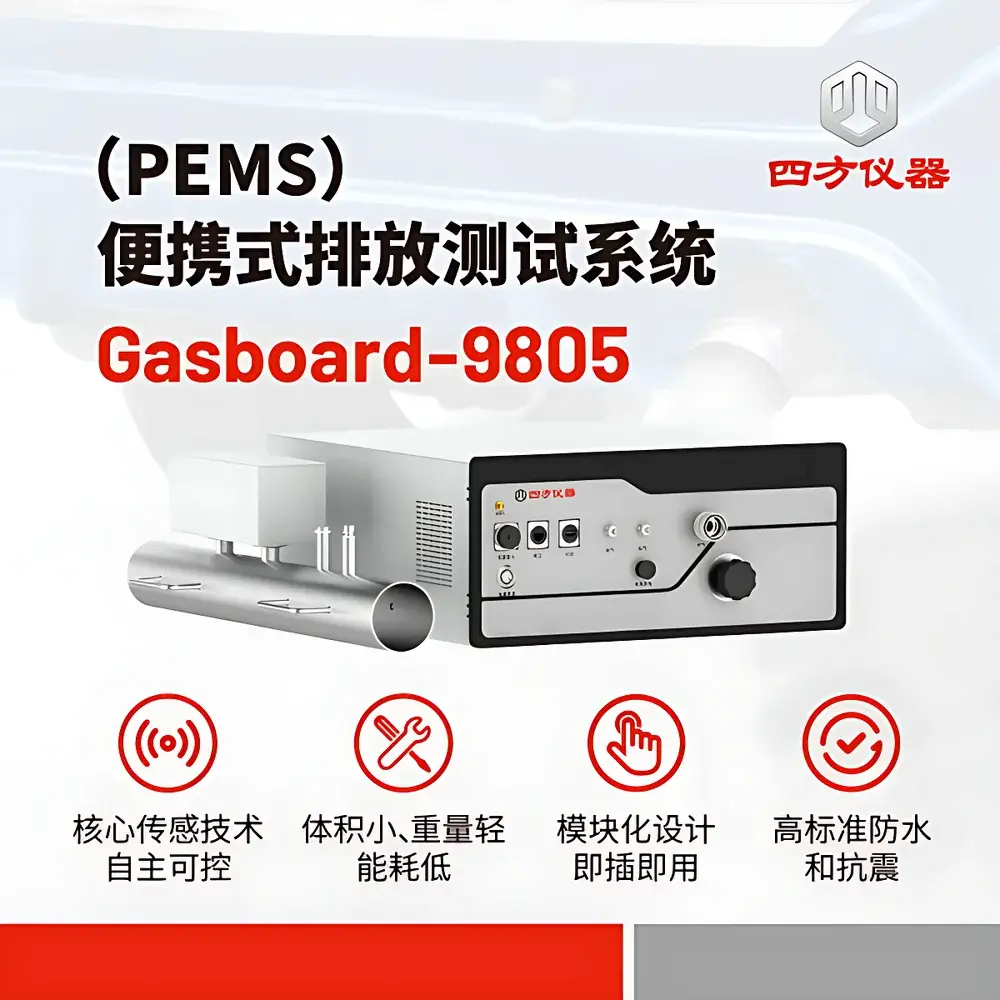
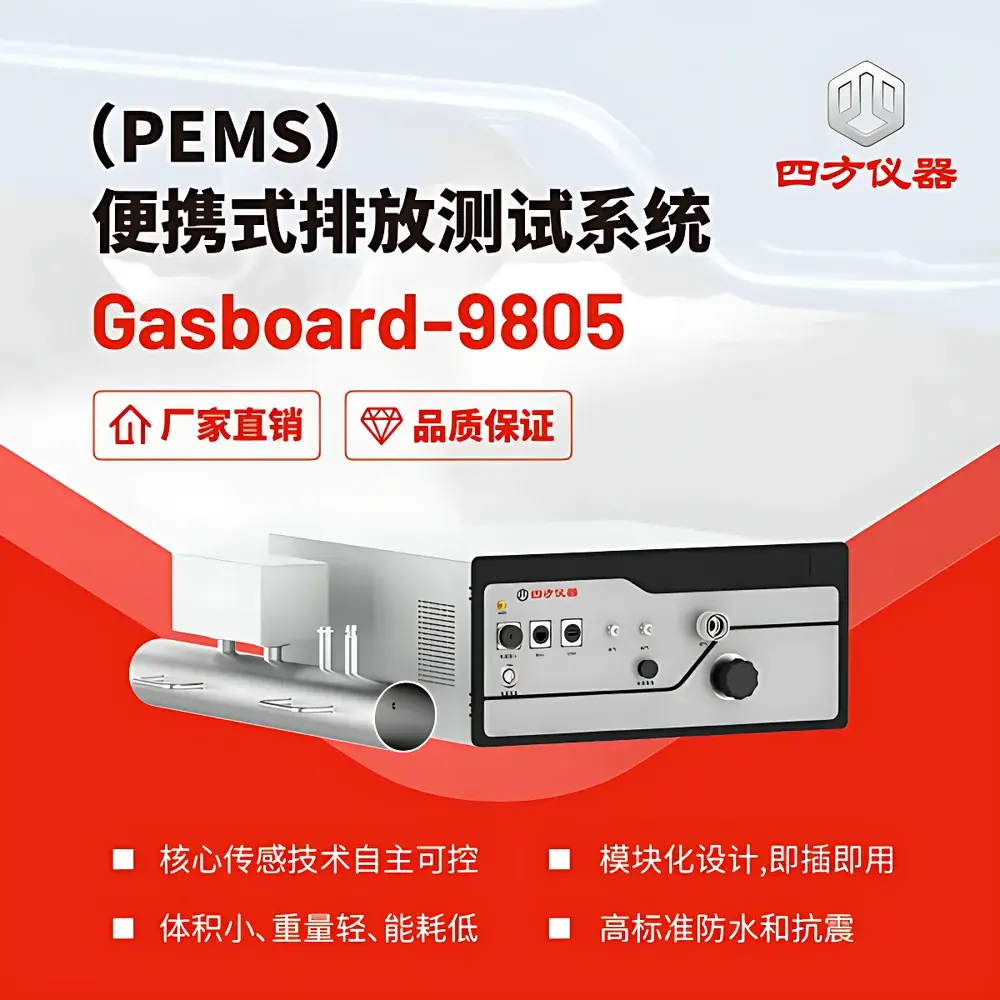
CUBIC INSTRUMENTS Gasboard-9805 Portable Emission Measurement System (PEMS)
| Brand | CUBIC INSTRUMENTS |
|---|---|
| Origin | Hubei, China |
| Model | Gasboard-9805 |
| Instrument Type | Portable |
| Measurement Principles | NDIR (CO, CO₂, O₂), Electrochemical (O₂), UV-LED Differential Optical Absorption Spectroscopy (DOAS) for NO/NO₂ |
| Measured Gases | CO, CO₂, O₂, NO, NO₂, NOₓ (calculated) |
| Zero Drift (CO) | ≤±50 ppm / 4 h |
| Span Drift (CO) | ≤±2% of reading or ≤±50 ppm / 4 h |
| Resolution | CO/NO/NO₂: 0.1 ppm |
| CO₂/O₂ | 0.01% |
| Response Time (T₉₀) | ≤2.5 s (gas module) |
| Repeatability | Not specified |
| Optional Modules | Particulate Number (PN) counter (6×10²–1.3×10⁹ #/cm³, 23 nm–2.5 µm), Total Hydrocarbons (THC), Exhaust Flow Meter (EFM) with thermal mass flow principle, integrated GPS and environmental sensors (T, RH, Pₐₜₘ) |
Overview
The CUBIC INSTRUMENTS Gasboard-9805 is a fully integrated, battery-powered Portable Emission Measurement System (PEMS) engineered for real-world emissions testing of non-road mobile machinery (NRMM), light- and heavy-duty vehicles, and off-cycle engine operation under dynamic driving conditions. Unlike traditional laboratory-based analyzers, the Gasboard-9805 employs field-deployable, multi-gas detection architecture grounded in validated physical principles: Non-Dispersive Infrared (NDIR) spectroscopy for CO, CO₂, and O₂; electrochemical sensing for redundant O₂ verification; and UV-LED-based Differential Optical Absorption Spectroscopy (DOAS) for direct, simultaneous quantification of NO and NO₂—eliminating reliance on catalytic NO-to-NO₂ converters and associated calibration drift. This direct-species measurement ensures long-term stability, reduced maintenance intervals, and compliance with regulatory traceability requirements for in-use conformity (IUC) and real-driving emissions (RDE) assessments.
Key Features
- Modular, field-upgradable architecture supporting independent integration of gas analysis, particulate number (PN), total hydrocarbon (THC), and exhaust flow meter (EFM) modules—all compliant with ISO 8716, ISO 20023, and UN R49 Annex 4B functional specifications.
- Built-in environmental monitoring suite: calibrated thermistor-based temperature sensor (–5 to 500 °C exhaust range), capacitive humidity sensor (10–90% RH, non-condensing), barometric pressure transducer (0–3000 m altitude), and GNSS receiver (GPS/GLONASS) with <5 m CEP positioning accuracy.
- Onboard data acquisition system sampling at 10 Hz, synchronized across all channels (gas concentrations, flow, OBD PID signals, GPS coordinates, environmental parameters) with microsecond-level timestamp alignment.
- Integrated power management: rechargeable Li-ion battery pack delivering ≥6 hours of continuous operation at full sensor load; dual-input capability (24 VDC vehicle supply or AC 220 V ±10%, 50 Hz) with automatic switchover and surge protection.
- Regulatory-grade metrology: zero and span drift performance verified per ISO 16183 Annex C protocols; response times validated against reference gas pulses per ISO 20023 Clause 7.3.2; linear calibration curves maintained with R² ≥ 0.990 and SEE ≤ 2% FS for EFM output.
Sample Compatibility & Compliance
The Gasboard-9805 is validated for use with diesel, gasoline, LNG, and dual-fuel engines operating across transient duty cycles including NRMM Stage IIIA/IIIB/IV (GB 20891–2014), China VI, and EU Stage V frameworks. Its ruggedized enclosure (IP54 rated) and shock-mounted internal optics withstand mechanical vibration per ISO 5073:2018 Class 3B. All gas measurement modules comply with EN 15058:2020 for portable analyzer performance criteria, while optional PN module meets PMP (Particle Measurement Programme) recommendations for solid particle number counting efficiency (≥99% for particles >23 nm). Data integrity conforms to GLP/GMP-aligned audit trails, with time-stamped calibration logs, sensor health diagnostics, and tamper-evident file encryption supporting FDA 21 CFR Part 11 readiness when deployed in certified test laboratories.
Software & Data Management
The embedded firmware supports automated test protocol execution—including pre-test stabilization, zero/span validation, dynamic warm-up compensation, and post-test leak-check routines—guided via intuitive touchscreen interface. Raw and processed data are stored in standardized .csv and .tdms formats, compatible with AVL PUMA, Horiba MEXA-Soft, and ETAS INCA workflows. The optional PC-based Gasboard Control Suite provides advanced features: real-time emission factor calculation (g/kWh, g/km), OBD parameter mapping (e.g., RPM, MAF, EGR %, DPF delta-P), GPS trajectory overlay on digital maps, and customizable report generation aligned with HJ 1014–2020 annex templates. All software modules undergo annual cybersecurity patching and maintain SHA-256 checksum integrity verification.
Applications
- In-service conformity (ISC) audits for construction, agricultural, and industrial NRMM fleets operating under GB 20891–2014 and HJ 1014–2020 mandates.
- Real-driving emissions (RDE) testing of light-duty vehicles on public roads, including cold-start, urban, rural, and motorway segments per EU Commission Regulation (EU) 2016/427.
- Engine development validation under transient motoring cycles (e.g., WHSC, WHTC) where portability enables rapid instrument repositioning between test cells and chassis dynos.
- Portable source apportionment studies in urban air quality monitoring networks, leveraging synchronized CO/NOₓ/CO₂ ratios and GPS-tagged spatial concentration mapping.
- Verification of aftertreatment system performance—including SCR conversion efficiency, DPF filtration efficacy, and DOC light-off behavior—under real-world thermal transients.
FAQ
Does the Gasboard-9805 meet U.S. EPA or EU type-approval requirements for PEMS use?
Yes—the system’s measurement uncertainty, response time, and drift specifications align with EPA 40 CFR Part 1065 Subpart J and EU Regulation (EU) 2017/1151 Annex IIIA Appendix 3 for portable emission analyzers used in RDE and ISC programs.
Can the PN module be used independently without the gas analyzer?
Yes—each module operates as a standalone unit with its own power input, data interface (RS-485/Ethernet), and firmware; modular decoupling allows field replacement and independent calibration.
Is OBD data acquisition limited to SAE J1979 PIDs?
No—the system supports both standardized SAE J1979 and manufacturer-specific UDS (Unified Diagnostic Services) protocols over CAN 2.0B, enabling retrieval of proprietary engine control parameters critical for emission root-cause analysis.
What is the calibration interval recommendation for field deployment?
Initial zero/span calibration before each test day is required; full multi-point calibration every 30 days or after 200 operational hours—whichever occurs first—using NIST-traceable gas standards certified to ISO 6141.
How is data security ensured during remote telemetry transmission?
All wireless data transfer (via optional 4G LTE module) uses TLS 1.2 encryption; local storage employs AES-256 disk encryption with role-based access control (RBAC) enforced through IEEE 802.1X authentication.
Related Products







