
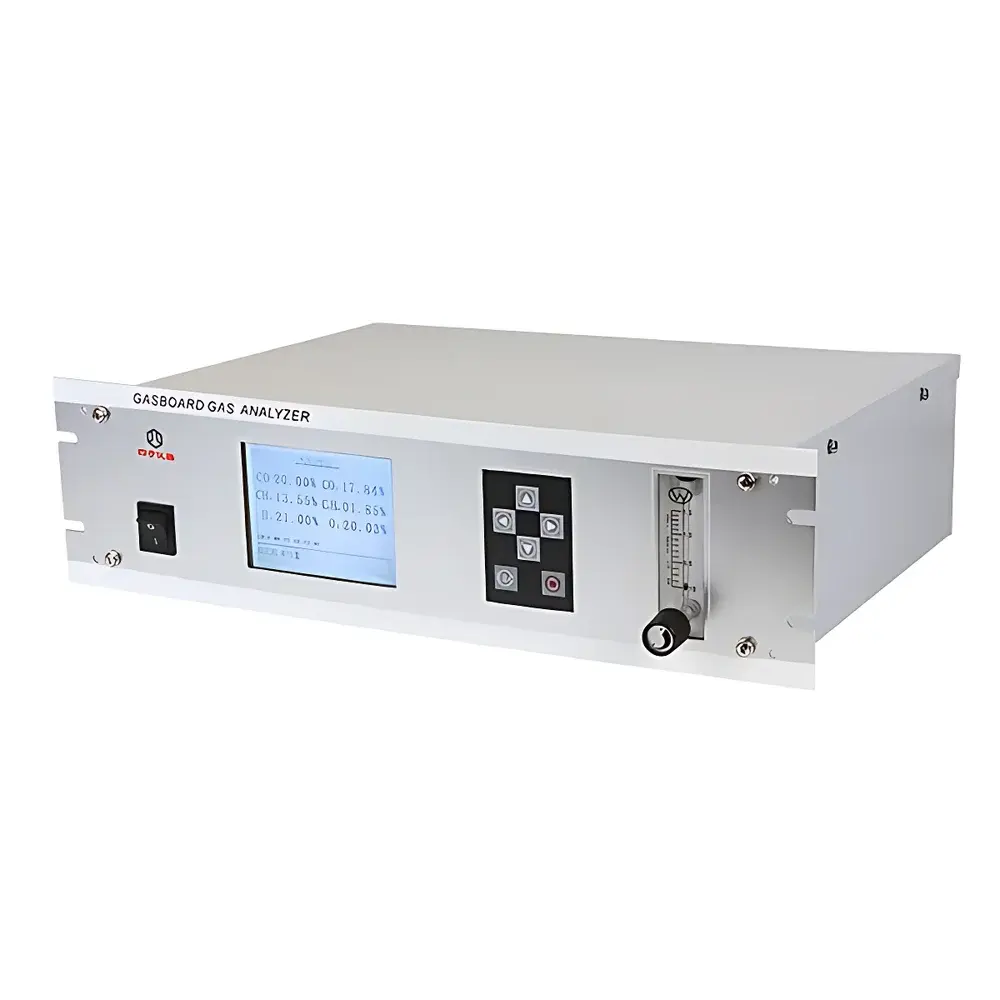


CUBIC INSTRUMENTS Gasboard-3100 Multicomponent Industrial Gas Analyzer
| Brand | CUBIC INSTRUMENTS |
|---|---|
| Origin | Hubei, China |
| Model | Gasboard-3100 |
| Detection Principle | Non-Dispersive Infrared (NDIR), Electrochemical (ECD), Thermal Conductivity (TCD) |
| Configuration | Online Fixed-Mount Analyzer |
| Measured Gases | CO, CO₂, CH₄, H₂, O₂, C₂H₂, C₂H₄, CnHm (total non-methane hydrocarbons), Calorific Value |
| Range | CO/CO₂/CH₄/H₂: (0–100) % vol |
| O₂ | (0–25) % vol |
| C₂H₂/C₂H₄/CnHm | (0–10) % vol (optional) |
| Linearity Error | ±1 % FS (NDIR channels) |
| Resolution | 0.01 % vol |
| Repeatability | ≤1 % |
| Response Time (T90) | <15 s (NDIR) |
| Sample Flow Rate | (0.7–1.2) L/min |
| Inlet Pressure | (2–50) kPa |
| Power Supply | 100–240 VAC, 100 W |
| Output | RS-485 / RS-232, (4–20) mA |
| Display | LCD with local interface |
| Calibration | Built-in zero-air pump for automatic air zeroing |
| Thermal Value Units | kcal/m³ and MJ/m³ (switchable) |
| Materials of Construction | 316L stainless steel, PTFE-wetted components |
| Compliance | Designed for continuous emission monitoring (CEM) and process control in industrial environments per ISO 14001-aligned operational practices |
Overview
The CUBIC INSTRUMENTS Gasboard-3100 is an online multicomponent gas analyzer engineered for continuous, real-time measurement of composition and calorific value in industrial fuel gases—including coke oven gas, blast furnace gas, producer gas, biogas, and syngas. It integrates three complementary analytical technologies within a single robust platform: non-dispersive infrared (NDIR) spectroscopy for CO, CO₂, CH₄, C₂H₂, C₂H₄, and CnHm; electrochemical detection (ECD) for O₂; and micro-electromechanical systems (MEMS)-based thermal conductivity detection (TCD) for H₂. This hybrid architecture eliminates cross-sensitivity between key analytes—e.g., CnHm does not interfere with CH₄ quantification, and CO/CO₂/CH₄ variations do not affect H₂ readings—ensuring metrological integrity under dynamic process conditions. The analyzer computes gross calorific value (GCV) in real time using ASTM D3588-17–derived algorithms, eliminating the need for offline bomb calorimetry or empirical correction factors.
Key Features
- Simultaneous quantification of up to eight gas species plus real-time calorific value calculation (kcal/m³ and MJ/m³ units selectable)
- NDIR modules with temperature-stabilized optical cells and long-life IR sources ensure drift-free operation over 24/7 deployment
- H₂ measurement via MEMS-TCD maintains accuracy across variable sample flow rates (0.7–1.2 L/min), independent of flow fluctuations
- Full sensor conditioning: integrated zero-air pump enables automated daily air-zero calibration without external gas cylinders
- Corrosion-resistant wetted path constructed from 316L stainless steel and PTFE seals, rated for aggressive coal-derived and biomass-derived syngas streams
- Onboard diagnostics continuously monitor sensor health, optical path integrity, and flow/pressure compliance—alerts logged with timestamps
- Dual analog (4–20 mA) and digital (RS-485/RS-232) outputs support integration into DCS, SCADA, and MES platforms with Modbus RTU protocol
Sample Compatibility & Compliance
The Gasboard-3100 is designed for direct connection to hot, humid, and particulate-laden industrial gas streams following appropriate pretreatment (e.g., heated sampling line, cyclonic filtration, condensate trap, and Nafion® dryer). It meets material compatibility requirements for gases containing H₂S (<50 ppm), NH₃ (<10 ppm), and tar vapors typical in biomass gasification and coke oven off-gas applications. While not certified to ATEX or IECEx standards out-of-the-box, its enclosure rating (IP65) and intrinsic safety-compatible output options facilitate deployment in Zone 2 hazardous areas when installed with approved barriers. The analyzer supports GLP-aligned data integrity through timestamped calibration logs, sensor diagnostic records, and configuration change tracking—enabling traceability required for ISO 50001 energy management systems and EPA Method 3A-compliant reporting workflows.
Software & Data Management
The embedded firmware provides a web-accessible configuration interface (HTTP/HTTPS) for remote setup, alarm threshold definition, and historical trend review (7-day onboard storage). Data export is supported via CSV over USB or Ethernet. For enterprise integration, optional PC-based software (Gasboard Control Suite) offers audit-trail-enabled user access control, automated report generation (PDF/Excel), and alignment with FDA 21 CFR Part 11 requirements—including electronic signatures, operator-level permissions, and immutable event logging. All measurements are time-synchronized to UTC via NTP, ensuring coherence across distributed plant-wide monitoring nodes.
Applications
- Metallurgical plants: Continuous monitoring of blast furnace gas (BFG), basic oxygen furnace gas (BOFG), and coke oven gas (COG) for combustion optimization and energy accounting
- Biomass and waste-to-energy facilities: Real-time biogas composition tracking (CH₄, CO₂, H₂S-corrected CnHm) to adjust anaerobic digester loading and predict engine efficiency
- Chemical synthesis units: Feed gas verification for ammonia, methanol, and Fischer–Tropsch processes where H₂/CO ratio stability is critical
- Research laboratories: Quantitative analysis of pyrolysis, gasification, and catalytic reforming effluents under controlled thermal and stoichiometric conditions
- Utility-scale gas blending stations: Verification of natural gas/biogas mix ratios and Wobbe index compliance prior to grid injection
FAQ
What gas pretreatment is required before sample introduction?
A heated sample line (≥180 °C), particulate filter (≤1 µm), and condensate separator are mandatory; optional Nafion® dryer recommended for high-humidity biogas.
Can the analyzer measure H₂S or NH₃?
No—H₂S and NH₃ are not part of the standard configuration; dedicated electrochemical sensors for these species require hardware modification and are available as OEM add-ons.
Is factory calibration traceable to NIST standards?
Yes—each unit ships with a certificate of calibration referencing NIST-traceable gas standards (e.g., Scott Specialty Gases CRM blends) for all NDIR and ECD channels.
How often is recalibration recommended under continuous operation?
Quarterly span calibration using certified multi-gas standards is advised; automatic air-zeroing occurs every 24 hours to correct baseline drift.
Does the system support redundant power or network failover?
Not natively—the unit operates on single-phase AC; however, it accepts 24 VDC backup input (optional PSU module) and supports dual Ethernet ports for ring-topology redundancy when paired with managed switches.







