
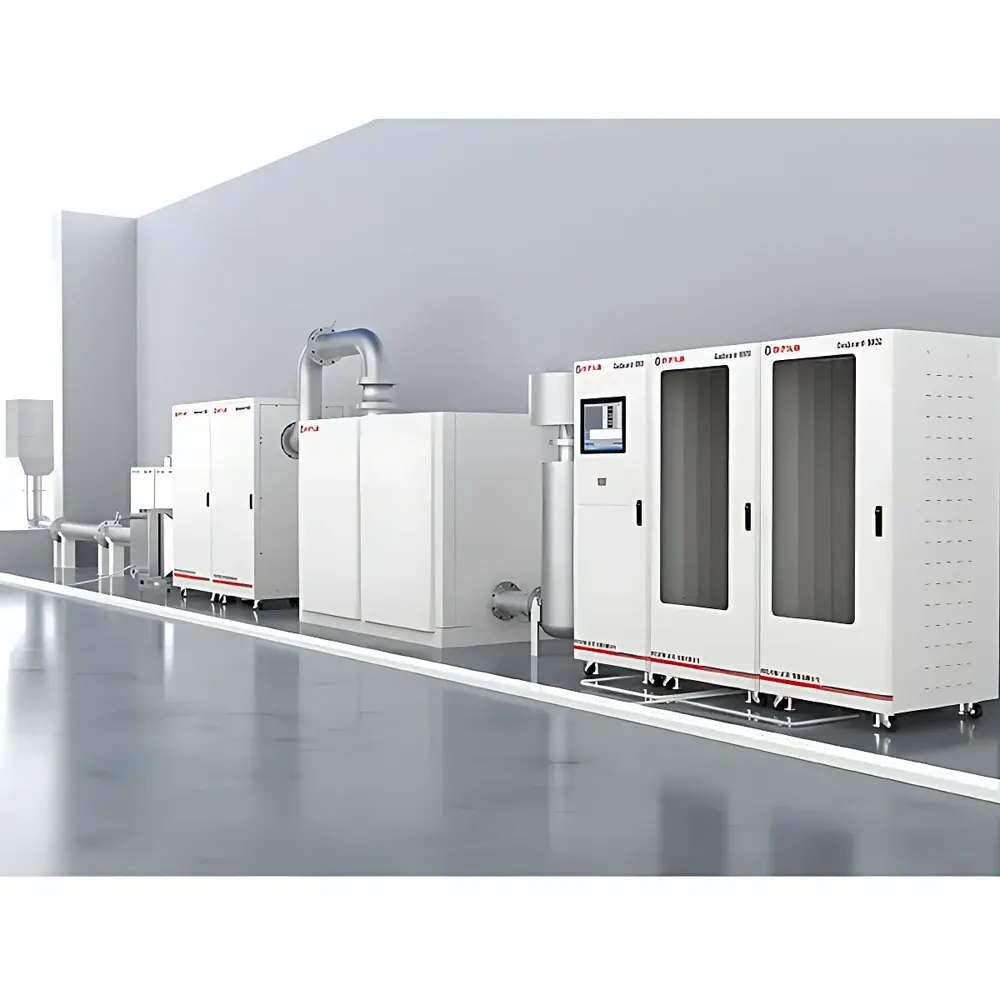
CUBIC INSTRUMENTS Gasboard-9802 Full-Flow Dilution Constant Volume Sampling (CVS) System
| Brand | CUBIC INSTRUMENTS |
|---|---|
| Origin | Hubei, China |
| Model | Gasboard-9802 |
| Instrument Type | Online |
| Measurement Principle | Constant-volume dilution sampling with gravimetric and volumetric flow control |
| Max. Permissible Error | ±2% (propane spike verification) |
| Measured Species | Diluted exhaust emissions from vehicles and engines |
| Dilution Exhaust Flow Ranges | 1–12 m³/min |
| Diluted Exhaust Temperature Control | 40 ± 5 °C |
| Bag Sampling Flow Rates | 3 / 6 / 9 L/min |
| Sample Bag Configuration | 3 diluted air bags + 3 diluted exhaust bags |
| Bag Chamber Temperature Control | 35 ± 5 °C |
| Particulate Sampling Flow | 35–65 L/min |
| Particulate Sampling Channels | 3 diluted exhaust + 1 diluted air |
| Particulate Sampling Chamber Temp. | 47 ± 5 °C |
| Dilution Air Filtration | Activated carbon + pre-filter + H13 HEPA filter |
| Operating Environment | 5–35 °C ambient temperature |
Overview
The CUBIC INSTRUMENTS Gasboard-9802 Full-Flow Dilution Constant Volume Sampling (CVS) System is an engineered solution for laboratory-based regulatory emission testing of internal combustion engines and light- to heavy-duty vehicles. Designed in accordance with ISO 8178, ISO 16183, SAE J1094, and EPA 40 CFR Part 1065 requirements, the system implements a gravimetrically calibrated constant-volume sampling architecture—where raw exhaust is mixed with conditioned dilution air in a precisely controlled ratio, then passed through a heat exchanger and venturi-based flow metering train to maintain stoichiometric stability and thermal equilibrium. The CVS ensures traceable mass-based quantification of gaseous pollutants (CO, CO₂, NOₓ, THC, NMHC) and solid-phase particulate matter (PM), supporting Type I (cold-start) certification tests required under Euro 6d, Euro 7, U.S. Tier 3, and China VIb standards. Its modular design enables integration with high-sensitivity analyzers—including FTIR, CLD, NDIR, and TEOM-based PM monitors—while maintaining full compliance with GLP and GMP data integrity expectations.
Key Features
- Multi-range dilution exhaust flow capability (1–12, 3–24, 9–60, and 30–150 m³/min) accommodates engine displacements from 0.5 L to >16 L, supporting gasoline, diesel, natural gas, and hybrid powertrain configurations.
- High-stability thermal management system comprising dual-stage heat exchangers and PID-controlled cabinet environments (exhaust at 40 ± 5 °C; bag chamber at 35 ± 5 °C; PM sampling box at 47 ± 5 °C) prevents condensation-induced measurement bias and ensures reproducible phase-state conditions across repeated test cycles.
- Dilution air purification train featuring activated carbon (VOC removal), G3-grade pre-filters (particulate pre-cleaning), and H13-class HEPA filters (≥99.95% efficiency at 0.3 µm) delivers ultra-clean background air essential for sub-1 mg/km PM and sub-1 ppm NOₓ validation.
- Triple-bag sampling configuration (3 diluted exhaust + 3 diluted air) supports parallel analysis, blank correction, and method validation per ISO 16183 Annex D and EPA Method 214 protocols.
- Integrated volumetric flow calibration using NIST-traceable propane spike verification ensures long-term accuracy within ±2%—validated daily or per test sequence as required by ISO 16183 Clause 7.4 and EU Regulation (EU) 2017/1151 Annex IIIA.
Sample Compatibility & Compliance
The Gasboard-9802 is validated for use with transient and steady-state engine dynamometer cycles (e.g., WLTC, FTP-75, RDE, ESC, ETC) and supports both raw and dilute sampling modes. It meets mechanical and metrological requirements specified in ISO 16183:2022 (Reciprocating internal combustion engines — Determination of particulate mass emissions), ISO 8178-4:2019 (Exhaust emission measurement procedures), and SAE J1094_202105 (Engine exhaust emission sampling and analysis). All temperature control zones are equipped with redundant PT100 sensors and automated logging compliant with FDA 21 CFR Part 11 audit trail requirements when paired with validated third-party acquisition software.
Software & Data Management
While the Gasboard-9802 operates as a hardware platform without embedded proprietary firmware, its analog/digital I/O interfaces (4–20 mA, RS-485, Modbus TCP) enable seamless integration into existing laboratory data acquisition ecosystems (e.g., AVL PUMA, Horiba MEXA, ETAS INCA, or custom LabVIEW/Python-based DAQ). Real-time flow, temperature, pressure, and valve status signals are timestamped and logged at ≥10 Hz resolution. All calibration records, environmental logs, and test metadata are structured to support automated report generation aligned with UN/ECE R83, R49, and GB 18352.6–2016 documentation templates.
Applications
The system serves as a core infrastructure component in university emissions laboratories, national metrology institutes, and OEM R&D centers conducting development-level durability testing, aftertreatment catalyst evaluation, and low-emission technology benchmarking. Typical use cases include: evaluation of SCR and GPF performance under real-world driving conditions; assessment of ethanol/gasoline blend effects on PN formation; comparative studies of ammonia slip under lean-burn operation; and validation of portable emission measurement systems (PEMS) against chassis-dyno reference methods.
FAQ
Does the Gasboard-9802 include integrated gas analyzers?
No—the Gasboard-9802 is a dedicated CVS hardware platform. It must be coupled with external certified analyzers (e.g., NDIR for CO/CO₂, CLD for NOₓ, FID for THC) and gravimetric or tapered element oscillating microbalance (TEOM) PM instrumentation.
Is the system compatible with RDE testing protocols?
Yes—when configured with optional mobile-certified flow meters and GPS-synchronized data logging, it supports laboratory-based RDE correlation studies per UN GTR 15 Annex 8B.
What maintenance intervals are recommended for the H13 filter?
Filter replacement frequency depends on ambient air quality and test volume; typical service life is 500–1,000 hours under ISO Class 8 cleanroom-equivalent lab conditions.
Can the system be upgraded to meet future Euro 7 particle number (PN) requirements?
Yes—its 3-channel particulate sampling architecture and thermally stabilized ductwork provide foundational readiness for PN measurement when interfaced with CPCs meeting UNECE R83 Amendment 10 specifications.
Is third-party calibration certification available?
CUBIC INSTRUMENTS provides factory calibration reports traceable to CNAS-accredited labs; end-user calibration may be performed using ISO/IEC 17025-accredited service providers.







