
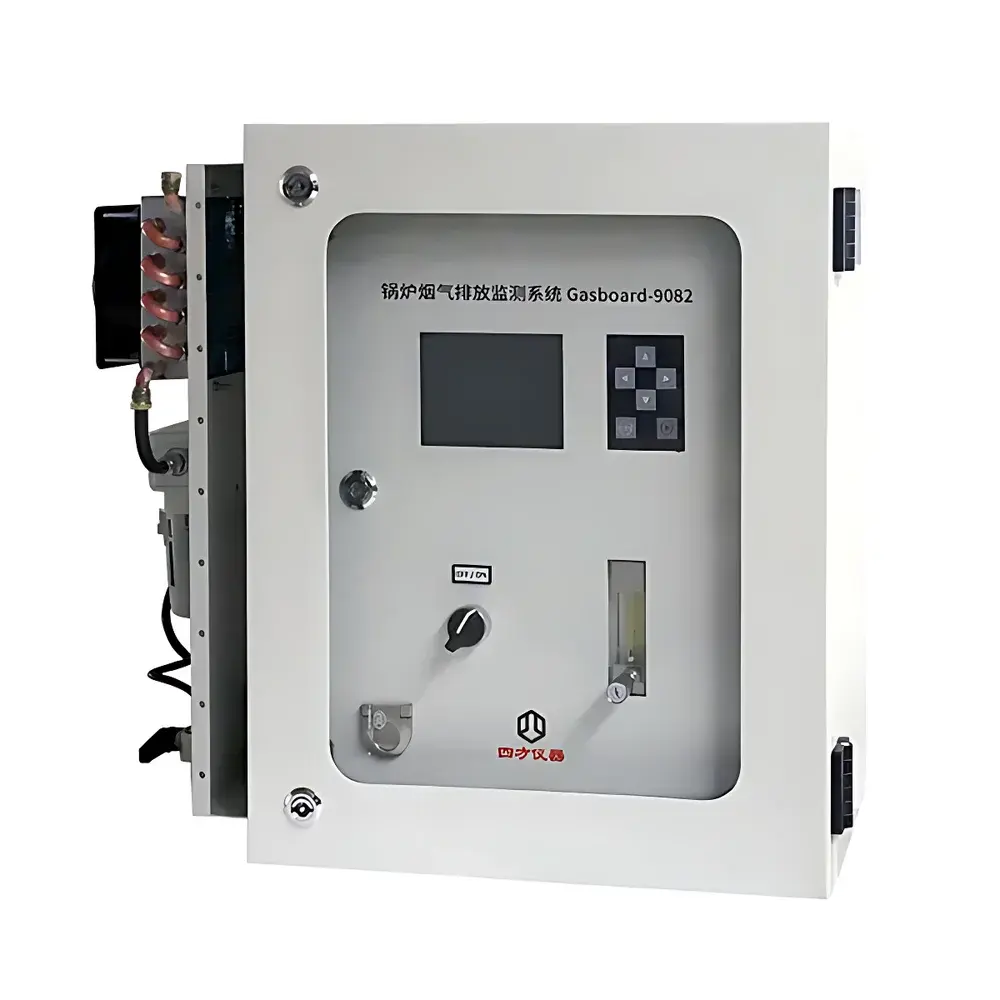
CUBIC INSTRUMENTS Gasboard-9082 Standard Edition Online Boiler Flue Gas Emission Monitoring System
| Brand | CUBIC INSTRUMENTS |
|---|---|
| Origin | Hubei, China |
| Model | Gasboard-9082 (Standard Edition) |
| Principle | Electrochemical Detection (NO, O2, CO) & Non-Dispersive Infrared (NDIR) for CO₂ |
| Type | Online Fixed-Mount Analyzer |
| Measurement Range | NO: 0–100 mg/m³ |
| O₂ & CO₂ | 0–25% vol |
| CO | 0–5% vol |
| Response Time | ≤30 s |
| Repeatability | ±2% FS (NO, O₂, CO, CO₂) |
| Accuracy | ≤±3% FS |
| Power Supply | 220 V AC ±20%, 50 Hz ±1 Hz |
| Output Interfaces | RS232, RS485, 4–20 mA analog output, audible/visual alarm relay |
| Data Storage | Internal flash memory supporting ≥3 years of minute-interval historical data |
Overview
The CUBIC INSTRUMENTS Gasboard-9082 Standard Edition is an integrated, continuous emission monitoring system (CEMS) engineered for real-time, in-situ analysis of key combustion gases in boiler flue streams. It employs a hybrid optical and electrochemical sensing architecture: electrochemical detection (ECD) for nitric oxide (NO), oxygen (O₂), and carbon monoxide (CO); and non-dispersive infrared (NDIR) spectroscopy for carbon dioxide (CO₂). Unlike single-principle analyzers, this multi-technology platform ensures high selectivity, minimal cross-interference, and long-term stability under variable stack conditions—including fluctuating temperature, humidity, and particulate load. Designed specifically for small- to medium-capacity gas-fired boilers, the system meets baseline performance requirements outlined in China’s HJ 75–2017 and HJ 76–2017 technical specifications for CEMS, while maintaining compatibility with international operational frameworks such as ISO 14064-1 (greenhouse gas quantification) and EN 15267-3 (performance certification of automated measuring systems).
Key Features
- Multi-parameter simultaneous measurement: NO, O₂, CO, and CO₂—enabling comprehensive combustion efficiency assessment (e.g., excess air ratio, stoichiometric balance, and thermal loss estimation).
- Electrochemical sensor module optimized for ultra-low-range NO detection (0–100 mg/m³), delivering enhanced resolution critical for low-NOₓ burner verification and post-retrofit compliance validation.
- Integrated sample conditioning unit featuring heated sampling probe, PTFE-lined transport line, condensate removal trap, and automatic zero/span calibration capability—reducing maintenance frequency and mitigating signal drift from moisture or acid condensates.
- Embedded industrial-grade controller with local LCD interface, supporting standalone operation without external PC dependency.
- Robust mechanical architecture rated IP65 for outdoor cabinet installation; operating ambient temperature range: −20 °C to +50 °C.
- Compliance-ready data handling: timestamped records with audit trail metadata, configurable averaging intervals (1-min, 5-min, hourly), and built-in data integrity safeguards against power interruption.
Sample Compatibility & Compliance
The Gasboard-9082 is validated for use with dry, filtered flue gas streams from natural gas, liquefied petroleum gas (LPG), and biogas-fired boilers operating at typical stack temperatures (60–200 °C) and negative pressure (−5 to −20 kPa). It excludes applications involving high-sulfur fuels, unfiltered fly ash >10 mg/m³, or chlorine-rich combustion byproducts that may poison ECD electrodes. The system conforms to national regulatory reporting formats per China’s “Technical Guidelines for Automatic Monitoring of Pollutant Sources” (HJ 353–2019), and supports traceability through GLP-aligned calibration logs, including certified span gas certificates (NIST-traceable NO, CO, O₂ standards). While not pre-certified to EPA PS-11 or MCERTS, its modular sensor design allows third-party verification per EN 14181 (QAL2/QAL3) when deployed with accredited calibration protocols.
Software & Data Management
Data acquisition and configuration are managed via the onboard embedded firmware (v3.2+), accessible through local keypad navigation or remote serial command set (ASCII protocol over RS232/RS485). All measurements are logged with UTC timestamps and stored in non-volatile flash memory—capable of retaining >15 million records (equivalent to >3 years at 1-minute sampling). Export is supported via USB mass storage mode or Modbus RTU polling. The system generates automated daily summary reports (CSV format) containing min/max/avg values, alarm event logs, and calibration history. For enterprise integration, optional OPC UA gateway modules enable secure ingestion into SCADA, DCS, or cloud-based environmental dashboards—fully compliant with IEC 62443-3-3 cybersecurity profiles for industrial control systems.
Applications
- Continuous compliance monitoring for municipal and commercial gas-fired boilers subject to local environmental protection bureau (EPB) reporting mandates.
- Post-installation verification of low-NOₓ burner performance and selective catalytic reduction (SCR) system efficacy.
- Real-time combustion optimization—using O₂/CO/CO₂ ratios to dynamically adjust air-fuel stoichiometry and reduce thermal losses.
- Supporting VOC abatement projects where thermal oxidation or catalytic oxidation processes generate NOₓ as a secondary emission—requiring concurrent tracking alongside primary pollutants.
- Baseline data collection for energy management systems (ISO 50001) and carbon accounting workflows aligned with GHG Protocol Scope 1 boundary definitions.
FAQ
What calibration gases are required for routine maintenance?
Certified NO (in N₂), CO (in N₂), O₂ (in N₂), and CO₂ (in N₂) standard mixtures traceable to NIST or equivalent national metrology institutes; typical concentrations: 50% FS for span, zero gas (high-purity N₂).
Can the system operate without external data logging hardware?
Yes—the internal memory provides full autonomous data retention for ≥3 years; external logging is optional for redundancy or centralized aggregation.
Is the Gasboard-9082 compatible with Modbus TCP networks?
Not natively; it supports Modbus RTU over RS485. A protocol converter (e.g., RS485-to-Ethernet bridge) is required for Modbus TCP integration.
How often does the electrochemical sensor require replacement?
Typical service life is 24 months under continuous operation at <80% RH and <150 °C stack temperature; replacement intervals are tracked automatically and signaled via maintenance alert codes.
Does the system support remote firmware updates?
Firmware updates must be performed locally via USB drive; remote update capability is disabled by default for security and regulatory audit integrity.







