
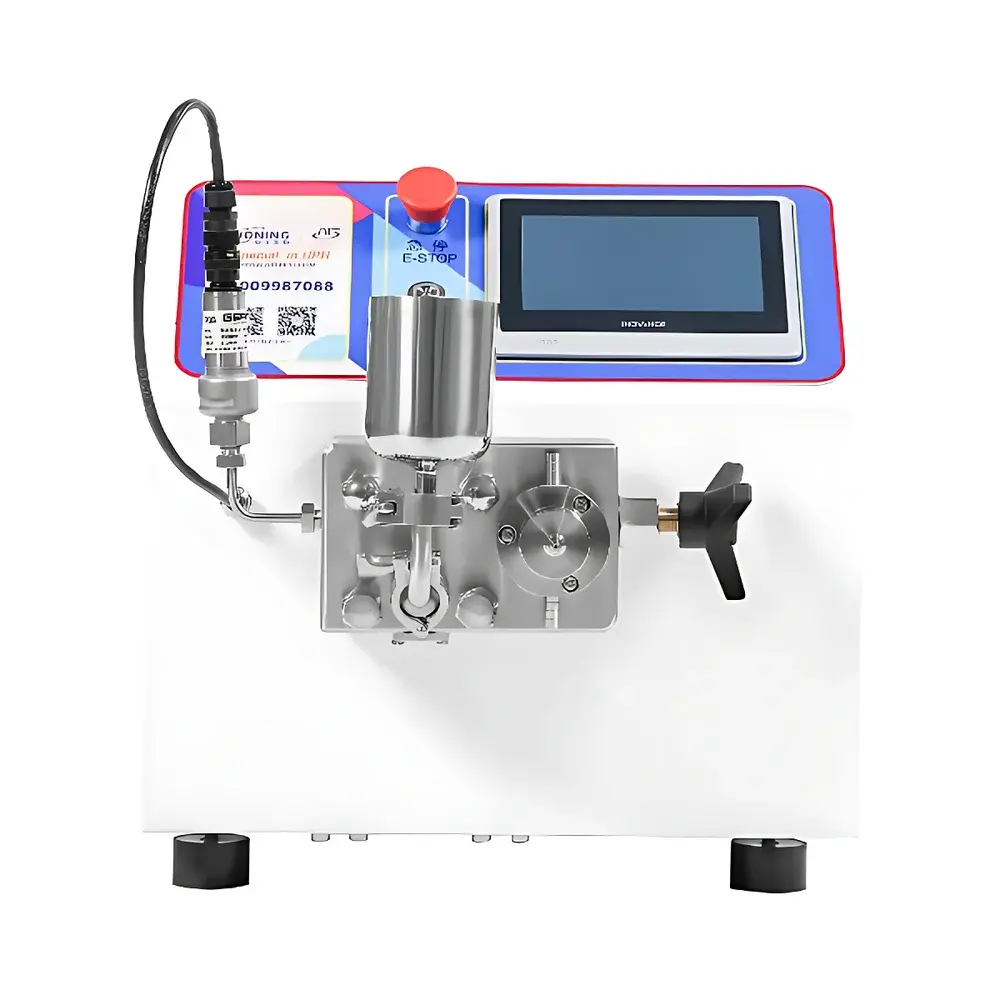
ATS AH-1500 Laboratory-Scale High-Pressure Homogenizer for Biological Applications
| Brand | ATS |
|---|---|
| Origin | Jiangsu, China |
| Manufacturer Type | Authorized Distributor |
| Country of Manufacture | China |
| Model | AH-1500 |
| Instrument Type | High-Pressure Homogenizer |
| Dimensions (W×D×H) | 795×450×490 mm |
| Net Weight | 140 kg |
| Power Rating | 1.5 kW |
| Maximum Design Pressure | 1800 bar |
| Maximum Operating Pressure | 1500 bar |
| Flow Rate Range | 5–15 L/h |
| Minimum Sample Volume | 25 mL |
| Temperature Control Range | 5–10 °C |
| Display | Integrated Digital Interface with Overpressure Protection |
| Structural Design | Modular, Benchtop-Compatible Architecture |
| Compliance | Designed to Support GLP-compliant workflows and ISO 22442-1 (biological safety) considerations for lab-scale bioprocessing |
Overview
The ATS AH-1500 is a laboratory-scale high-pressure homogenizer engineered specifically for biological sample processing, including cell lysis, submicron emulsion formation, liposome extrusion, and nanoparticle dispersion. It operates on the principle of controlled high-pressure fluid dynamics: a precision reciprocating plunger pump pressurizes liquid samples up to 1500 bar, forcing them through an adjustable, geometrically optimized homogenization valve. Within this narrow clearance zone, samples undergo simultaneous cavitation, turbulent shear, and impact forces—mechanisms collectively responsible for disrupting cellular membranes, deagglomerating nanomaterials, and achieving uniform particle size distribution (PSD) in suspensions and emulsions. Unlike rotor-stator or ultrasonic systems, the AH-1500 delivers reproducible, scalable mechanical energy input independent of sample viscosity or particulate load—making it suitable for early-stage formulation development in biopharmaceutical, nutraceutical, and advanced material research.
Key Features
- Benchtop footprint (795 × 450 × 490 mm) optimized for standard fume hoods and biosafety cabinets
- Modular valve assembly with calibrated gap adjustment—enabling precise control over shear intensity and residence time
- Integrated thermoelectric cooling module maintaining sample temperature between 5–10 °C during extended operation, critical for heat-sensitive biomolecules (e.g., enzymes, plasmids, exosomes)
- Digital touchscreen interface with real-time pressure monitoring, runtime logging, and programmable pressure ramping profiles
- Electronic overpressure protection system compliant with IEC 61000-4-5 surge immunity standards
- Stainless-steel wetted parts (316L) meeting USP Class VI biocompatibility requirements for pharmaceutical process development
- Low minimum processing volume (25 mL) supports precious sample conservation in preclinical studies
Sample Compatibility & Compliance
The AH-1500 accommodates aqueous, organic, and biphasic systems across diverse viscosities (up to 5000 cP at 20 °C). It has been validated for Gram-negative and Gram-positive bacterial lysis (E. coli, Bacillus subtilis), yeast disruption (S. cerevisiae), mammalian cell membrane fragmentation, and lipid nanoparticle (LNP) formulation. Its design aligns with key regulatory expectations: pressure transducers are traceable to NIST standards; data logs support ALCOA+ principles (Attributable, Legible, Contemporaneous, Original, Accurate); and firmware architecture permits audit trail configuration per FDA 21 CFR Part 11 guidelines when paired with validated third-party LIMS integration. While not certified as GMP equipment, its operational consistency and documentation capabilities make it appropriate for Stage 1–2 process characterization under ICH Q5A and Q5D frameworks.
Software & Data Management
The embedded controller records pressure, flow rate, temperature, and cycle count with timestamped metadata. Export options include CSV and PDF formats compatible with electronic lab notebooks (ELNs) such as LabArchives and IDBS E-WorkBook. Optional RS-485/Modbus RTU output enables centralized SCADA integration for multi-instrument labs. All firmware updates are digitally signed and version-controlled; configuration changes trigger automatic log entries—including user ID, timestamp, and parameter delta—for full traceability. No cloud connectivity is built-in, preserving data sovereignty—a requirement for many academic and contract research organizations handling proprietary biological materials.
Applications
- Biopharmaceutical R&D: Preparation of viral vector suspensions, monoclonal antibody aggregates, and mRNA-LNP complexes
- Nutraceutical formulation: Stabilization of omega-3 emulsions, curcumin nano-dispersions, and probiotic encapsulation matrices
- Advanced materials: Exfoliation of graphene oxide, dispersion of carbon nanotubes in polymer precursors, and homogenization of ceramic slurries for solid-state battery electrodes
- Cosmetic science: Development of non-ionic surfactant-free microemulsions and sustained-release dermal delivery systems
- Academic research: Mechanistic studies of shear-induced protein denaturation, membrane fluidity modulation, and colloidal stability thresholds
FAQ
What is the recommended maintenance interval for the homogenization valve?
Valve inspection is advised after every 200 hours of cumulative operation or following processing of abrasive suspensions (e.g., silica, metal oxides); replacement intervals vary by application but typically range from 500–1000 hours under standard biological use.
Can the AH-1500 be used for sterile processing?
The unit itself is not autoclavable, but all wetted components (valve seat, plunger seals, inlet/outlet manifolds) are sterilizable via ethylene oxide (EtO) or vaporized hydrogen peroxide (VHP) protocols—validated per ISO 14937.
Is third-party calibration support available?
Yes—ATS partners with ISO/IEC 17025-accredited metrology laboratories in Europe and North America for annual pressure transducer recalibration and flow verification.
Does the system meet CE or UL safety certification?
The AH-1500 complies with EN 61000-6-2 (EMC immunity) and EN 61000-6-4 (EMC emission) standards; UL listing is available upon request for specific regional deployments.
How does temperature control affect homogenization efficiency?
Maintaining 5–10 °C mitigates thermal degradation of labile analytes and reduces post-homogenization aggregation—particularly critical for extracellular vesicle isolation and recombinant protein formulations.



