
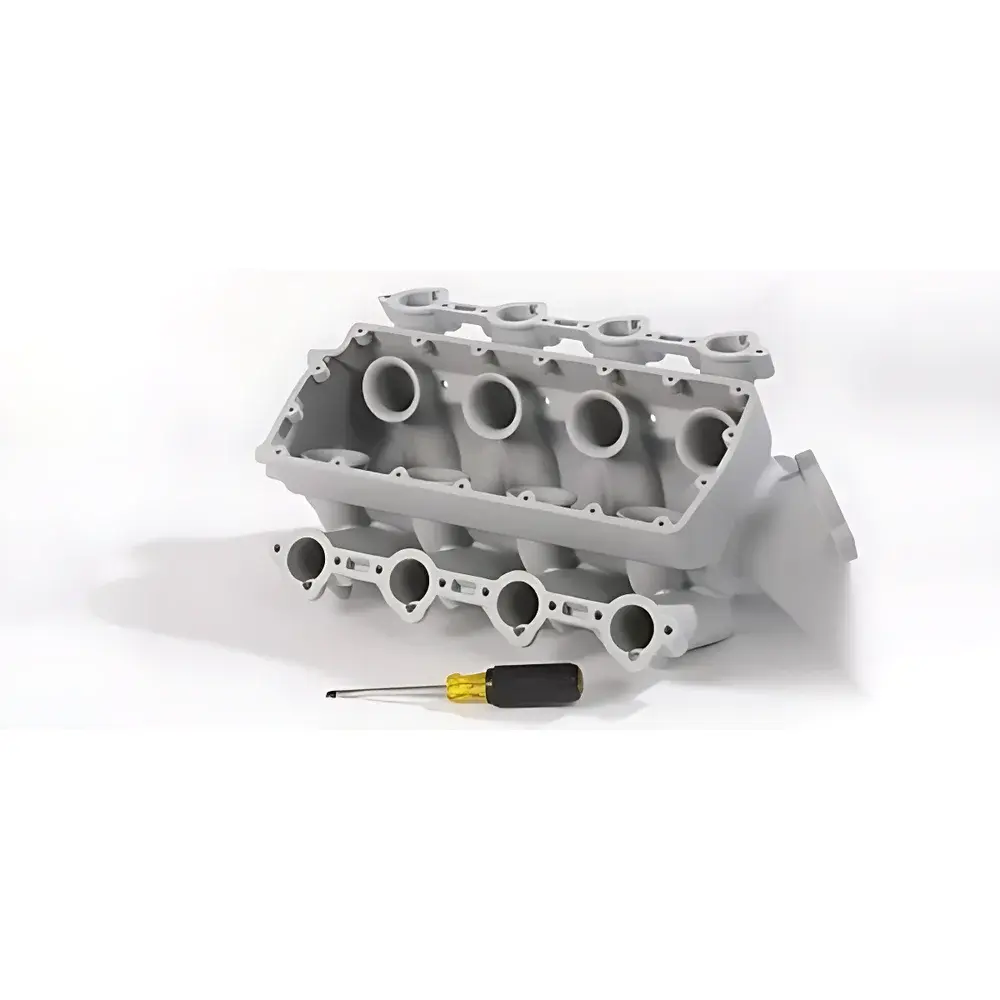
3D Systems ProJet® 860Pro High-Resolution Full-Color 3D Printer
| Brand | 3D Systems |
|---|---|
| Origin | Imported |
| Manufacturer Type | Authorized Distributor |
| Quotation | Upon Request |
| Print Technology | Color Jet Printing (CJP) |
| Max Build Volume | 508 × 381 × 229 mm |
| Layer Thickness | 0.1 mm |
| Resolution | 600 × 540 DPI |
| Color Gamut | >6 million colors |
| Build Speed | 5–15 mm/h (vertical) |
| Print Head Count | 5 |
| Nozzle Count | 1520 |
| Material | VisiJet® PXL™ powder |
| Supported Formats | STL, VRML, PLY, 3DS, FBX, ZPR |
| Operating Temp | 13–24 °C |
| Humidity | 20–55% non-cond. |
| Power | 100–240 V, 7.5–15 A |
| Noise Level | ≤57 dB (build), ≤66 dB (core recycle), ≤86 dB (vacuum open) |
| Certifications | CE, CSA |
| Software | 3D Sprint™ with remote monitoring via tablet/desktop/smartphone |
| Post-Processing | Integrated powder removal system |
| Safety | Enclosed vacuum-assisted particulate containment, no solvents or hazardous waste |
Overview
The 3D Systems ProJet® 860Pro is a production-grade full-color 3D printer engineered for high-fidelity, high-throughput prototyping and functional model fabrication in professional design, architecture, engineering, and education environments. Utilizing Color Jet Printing (CJP) technology—a binder jetting process—it selectively deposits colored binders onto layers of VisiJet® PXL™ polymer powder to build parts layer-by-layer without thermal stress or support structures. Unlike laser-based sintering systems, CJP operates at ambient temperature, eliminating warping risks and enabling consistent dimensional stability across large-format builds up to 508 × 381 × 229 mm. Its 5-print-head architecture with 1520 nozzles delivers precise color registration and uniform pigment distribution, supporting photorealistic surface rendering with over six million distinguishable hues per part. Designed for integration into ISO-compliant lab and office workflows, the system meets CE and CSA safety standards and incorporates continuous negative-pressure containment to prevent airborne particulate release—ensuring compliance with occupational health guidelines (e.g., OSHA 1910.1200) and indoor air quality requirements.
Key Features
- Full CMYK+ white color capability with >6 million color combinations per model, enabling accurate brand-color replication and photorealistic texture mapping.
- High-resolution output at 600 × 540 DPI and 0.1 mm layer thickness, capturing fine geometric detail down to 0.1 mm features.
- Five independently controlled print heads ensure repeatable color fidelity across multi-part batches and extended production runs.
- Integrated vacuum-assisted powder recycling system recovers unused VisiJet® PXL™ material with >95% reuse efficiency—reducing consumable cost per part and minimizing material waste.
- No support structures required; parts are self-supported by surrounding powder bed, eliminating post-build machining, chemical dissolution, or manual support removal.
- Quiet operation (<57 dB during printing) and zero VOC emissions make it suitable for shared office, classroom, or QA lab environments without ventilation retrofitting.
- Touch-enabled control panel and cloud-connected 3D Sprint™ software enable intuitive job setup, real-time status monitoring, and remote queue management from desktop, tablet, or mobile devices.
Sample Compatibility & Compliance
The ProJet® 860Pro accepts standard additive manufacturing file formats including STL, VRML, PLY, 3DS, FBX, and native ZPR archives. It is compatible with legacy CAD outputs and supports mesh repair, orientation optimization, and nesting algorithms within 3D Sprint™ to maximize build-chamber utilization. All VisiJet® PXL™ materials are classified as non-hazardous under GHS and REACH Annex XIV criteria, with no listed carcinogens, mutagens, or reproductive toxins. The system’s enclosed architecture and HEPA-filtered vacuum path comply with ISO 14644-1 Class 8 cleanroom air handling requirements when operated in controlled environments. For regulated industries, audit trails, user access logs, and version-controlled print job records align with GLP documentation expectations and can be exported for FDA 21 CFR Part 11–aligned validation protocols.
Software & Data Management
3D Sprint™ serves as the primary preprocessing and fleet management platform, offering automated part orientation, lattice generation, color mapping tools, and batch processing for heterogeneous models. Job histories—including slice parameters, material usage, environmental sensor logs (temperature/humidity), and operator IDs—are timestamped and exportable in CSV or PDF format. Remote monitoring enables real-time alerts for powder level thresholds, chamber seal integrity, or vacuum pressure deviations. All software modules undergo annual penetration testing and are updated in accordance with NIST SP 800-53 Rev. 5 security controls. Data residency remains on-premise unless explicitly configured for encrypted cloud backup via AWS GovCloud or Azure Government endpoints.
Applications
- Architectural scale modeling: Fabrication of detailed urban mockups, interior layout studies, and façade prototypes with true-to-life material representation and branding elements.
- Industrial design validation: Rapid iteration of ergonomic components, consumer product enclosures, and assembly-fit verification models with functional color-coding for subassemblies.
- Educational visualization: Creation of anatomical, geological, or mechanical teaching aids with embedded labels, cross-sectional annotations, and layered transparency effects.
- Foundry pattern production: Direct printing of investment casting patterns in VisiJet® PXL™, compatible with standard burnout cycles and ceramic shell processes per ASTM F2921–19.
- Marketing and sales collateral: On-demand generation of photorealistic product demonstrators for trade shows, client presentations, or digital twin synchronization workflows.
FAQ
What file formats does the ProJet® 860Pro support?
STL, VRML, PLY, 3DS, FBX, and ZPR files are natively supported. Mesh healing and unit conversion utilities are embedded in 3D Sprint™.
Is post-processing required after printing?
Yes—parts require depowdering using the integrated vacuum system, followed by infiltration with cyanoacrylate or epoxy sealants for enhanced durability and moisture resistance.
Can the printer operate unattended overnight?
Yes—automated job queuing, low-powder alerts, and thermal-stable build chamber design allow for scheduled, lights-out operation within temperature- and humidity-controlled rooms.
How is material waste managed?
Unused VisiJet® PXL™ powder is recovered, sieved, and reintegrated into the feed system with no degradation in print quality across ≥10 reuse cycles.
Does the system meet regulatory requirements for use in pharmaceutical or medical device labs?
While not FDA-cleared as a medical device, its traceability features, audit log retention, and material biocompatibility documentation (ISO 10993-5 cytotoxicity tested) support QSR-aligned internal prototyping workflows.



