
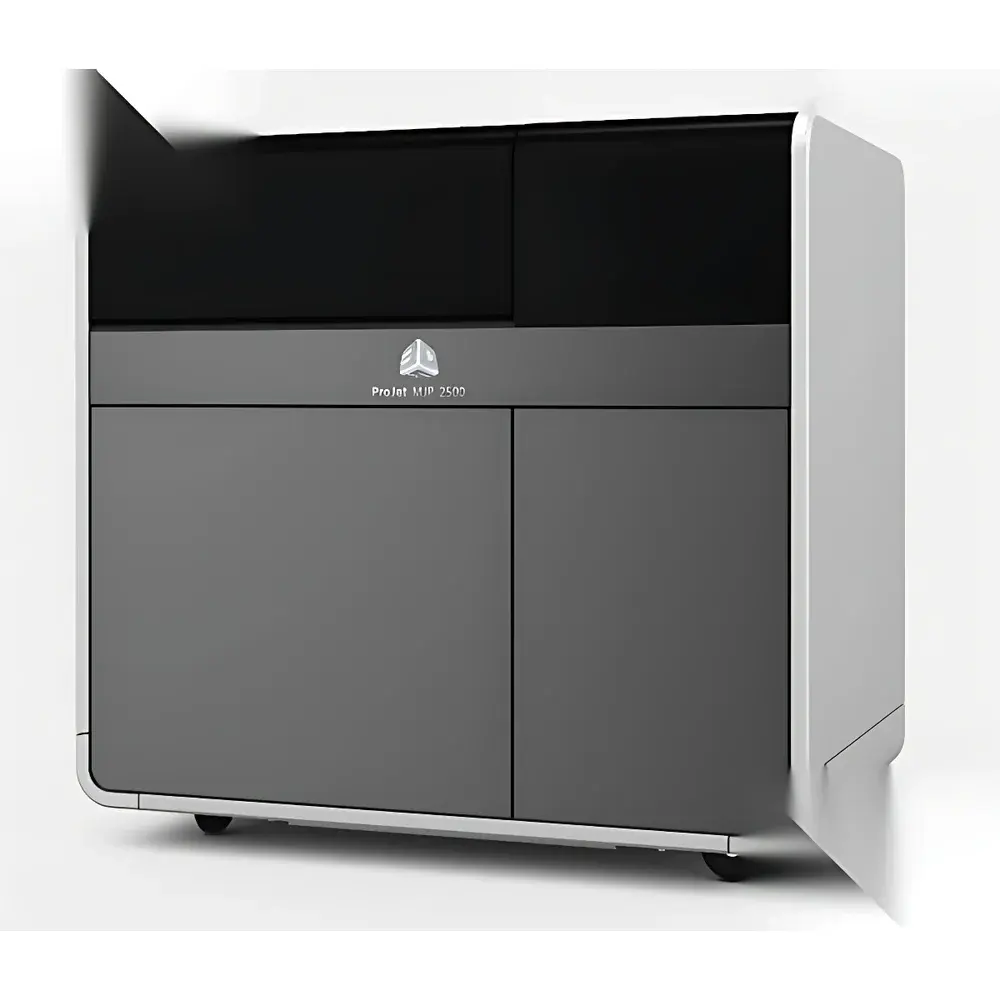
3D Systems ProJet MJP 2500 / 2500 Plus Multi-Jet Printing 3D Printer
| Brand | 3D Systems |
|---|---|
| Technology | Multi-Jet Printing (MJP) |
| Build Volume (W×D×H) | 294 × 211 × 144 mm |
| Resolution | Up to 1600 × 900 × 790 DPI |
| Minimum Feature Size | ≤ 300 µm |
| Material Compatibility | VisiJet Rigid, Elastic, High-Temp, Biocompatible (USP Class VI / ISO 10993 compliant), Transparent & Opaque Resins |
| Software | 3D Sprint v2.0+ |
| Post-Processing | MJP EasyClean System (optional) |
| Cloud Connectivity | 3D Connect™ with Predictive Support & Remote Diagnostics |
| Compliance | FDA 21 CFR Part 11 ready (with audit trail configuration), GLP/GMP-aligned workflow documentation |
Overview
The 3D Systems ProJet MJP 2500 and MJP 2500 Plus are production-grade multi-jet printing (MJP) 3D printers engineered for laboratories, R&D centers, and regulated manufacturing environments requiring high-fidelity functional prototypes, biocompatible medical devices, and precision tooling. Unlike fused deposition modeling (FDM) or stereolithography (SLA), MJP employs piezoelectric inkjet printheads to deposit ultra-thin layers (down to 16 µm) of photopolymer resin and support material simultaneously—enabling true CAD-to-part fidelity, isotropic mechanical properties, and edge definition at ≤300 µm feature resolution. The system operates on a dual-material deposition principle: build material is cured under UV light immediately after jetting, while wax-based support is thermally removable—eliminating aggressive chemical baths and preserving surface integrity. Designed for benchtop integration without external ventilation or chilled water, the MJP 2500 series delivers industrial throughput in a compact footprint (0.9 m² floor space), supporting 24/7 operation with automated job queuing and remote monitoring.
Key Features
- Multi-Jet Printing architecture with dual-head precision jetting for simultaneous build/support deposition and sub-300 µm feature resolution
- Build envelope of 294 × 211 × 144 mm—optimized for medium-complexity functional assemblies, anatomical models, and injection mold patterns
- True isotropic mechanical performance across X/Y/Z axes due to uniform layer fusion and minimal thermal stress
- Integrated 3D Sprint software suite enabling automatic support generation, lattice optimization, nesting, and DICOM-to-STL conversion for medical workflows
- 3D Connect™ cloud platform providing encrypted remote diagnostics, predictive maintenance alerts, firmware updates, and service ticket escalation—fully auditable per FDA 21 CFR Part 11 requirements when configured with user authentication and electronic signature modules
- MJP EasyClean System (optional) automating post-processing via heated wax removal chamber—reducing manual labor by >70% and accelerating time-to-part by up to 4× versus manual support removal
Sample Compatibility & Compliance
The ProJet MJP 2500 Plus supports a validated portfolio of VisiJet resins—including rigid engineering plastics (e.g., VisiJet M3 Crystal for optical clarity), elastomeric materials (VisiJet M3 Flex), high-heat formulations (VisiJet M3 HT), and USP Class VI / ISO 10993–certified biocompatible resins (VisiJet M3 Dental SG, VisiJet M3 Bio). All certified materials undergo full extractables/leachables testing per ISO 10993-12 and cytotoxicity screening per ISO 10993-5. The printer’s closed-loop material handling, inert nitrogen purge during curing, and traceable batch logging (via 3D Sprint material tracking) align with GLP and GMP documentation standards. Regulatory documentation packages—including Design History File (DHF) excerpts, Installation Qualification (IQ) templates, and Operational Qualification (OQ) test protocols—are available upon request for validation in pharmaceutical, diagnostic, or Class I/II medical device settings.
Software & Data Management
3D Sprint v2.x serves as the native preprocessing and fleet management interface, supporting STL, OBJ, 3MF, and native CAD formats (STEP, IGES). It includes advanced tools for part orientation optimization, support structure minimization using physics-based simulation, and automated tolerance compensation based on material shrinkage profiles. Audit trails log all user actions—including file import, parameter changes, print initiation, and material lot assignment—with timestamped, immutable records exportable as PDF or CSV. When deployed with 3D Connect, the system generates machine health reports, consumables usage analytics, and calibration drift alerts—feeding into enterprise quality management systems (QMS) via RESTful API. Data encryption at rest (AES-256) and in transit (TLS 1.2+) ensures compliance with HIPAA, GDPR, and internal IT security policies.
Applications
- Functional prototyping of snap-fit assemblies, fluidic manifolds, and pressure-sealed housings requiring dimensional stability and surface finish < 2.5 µm Ra
- Rapid tooling for silicone molding, investment casting patterns, and thermoforming dies with heat-deflection temperatures up to 200°C (HT-grade resins)
- Medical device development—including surgical guides, anatomical replicas from CT/MRI data, and USP Class VI–compliant jigs for sterile packaging validation
- Automotive and aerospace component verification—such as ducting, brackets, and ergonomic interfaces—under thermal cycling and vibration testing
- Academic and industrial research in soft robotics, microfluidics, and biomaterial scaffolds leveraging elastic and transparent resin formulations
FAQ
What regulatory certifications apply to the ProJet MJP 2500 Plus?
The system itself is CE-marked and FCC-compliant. Material certifications—including USP Class VI and ISO 10993 biocompatibility—are assigned per resin formulation, not the printer hardware. Full certification dossiers are provided with each material lot.
Can the printer be integrated into a validated quality system per ISO 13485 or 21 CFR Part 820?
Yes—when paired with documented IQ/OQ/PQ protocols, 3D Sprint audit trail configuration, and 3D Connect logging, the system supports QMS integration. Validation support services are available through 3D Systems’ Regulatory Affairs team.
Is nitrogen purging standard or optional?
Nitrogen inerting during UV curing is standard on the MJP 2500 Plus to minimize oxygen inhibition and ensure consistent crosslinking—critical for high-strength and biocompatible parts.
What is the typical lead time for VisiJet material replenishment?
Standard resins ship within 3–5 business days from regional distribution hubs in North America, EMEA, and APAC; biocompatible grades may require additional logistics coordination due to sterilization validation requirements.
Does the system support DICOM-to-print workflows for clinical applications?
Yes—3D Sprint includes native DICOM import with segmentation, thresholding, and hollowing tools optimized for radiographic data, compliant with ASTM F2792-21 for medical additive manufacturing.



