
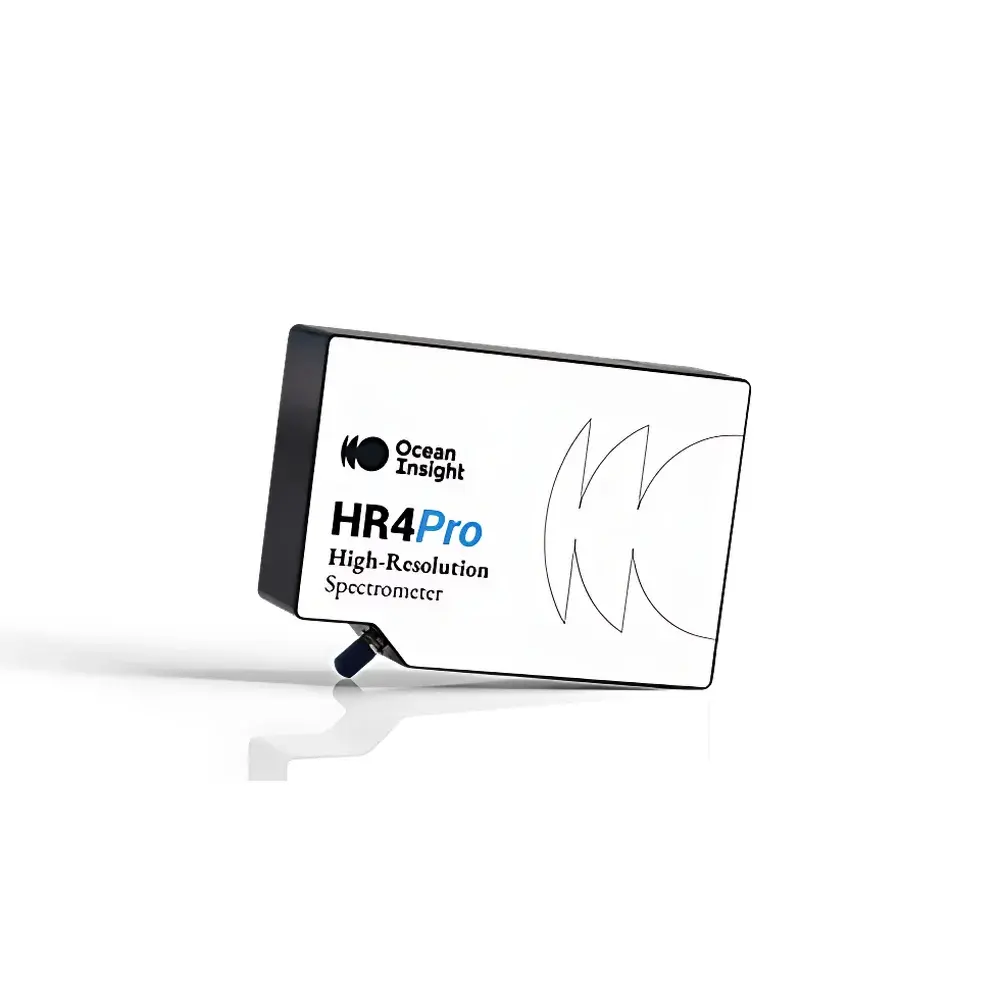
Ocean Optics HR4 Pro High-Resolution Fiber Optic Spectrometer
| Brand | Ocean Optics |
|---|---|
| Origin | USA |
| Model | HR4 Pro |
| Spectral Range | 190 nm – 1100 nm |
| Detector Type | CCD |
| Optical Resolution (FWHM) | 0.42 nm (typical), 0.72 nm (typical) |
| Sensitivity | 6 counts/photon |
| Signal-to-Noise Ratio | 250:1, 290:1, and 300:1 (full signal, configuration-dependent) |
| Dynamic Range | 1500:1, 2000:1, and 2500:1 (integration-time dependent) |
| Stray Light | <0.05% at 600 nm |
| Configuration Options | UV-Vis (200–875 nm), Vis-NIR (350–1025 nm), Full Range (200–1100 nm) |
Overview
The Ocean Optics HR4 Pro is a high-resolution, compact fiber optic spectrometer engineered for precision spectral characterization in demanding analytical environments. Based on Czerny-Turner optical architecture with optimized collimating and focusing optics, the HR4 Pro delivers robust wavelength discrimination through high-line-density gratings and thermally stabilized optical bench design. Its core measurement principle relies on dispersive spectroscopy: incident light—delivered via SMA 905-compatible optical fiber—is diffracted by a ruled or holographic grating, spatially separated by wavelength, and detected by a linear CCD array. The resulting digital spectrum enables quantitative analysis of emission peaks, absorption features, and spectral line profiles with sub-nanometer resolution. Designed for laboratory validation, field-deployable monitoring, and inline process control, the HR4 Pro operates reliably across temperature fluctuations common in non-climate-controlled settings—achieving up to 10× improved thermal stability versus prior-generation compact spectrometers.
Key Features
- High optical resolution: Configurable down to <0.1 nm FWHM (full width at half maximum) depending on grating selection, slit width, and detector pixel binning—enabling resolution of closely spaced atomic emission lines (e.g., Hg 435.8 nm / 436.0 nm doublet) and narrow laser linewidths.
- Thermally stable optical bench: Monolithic aluminum housing with low-coefficient-of-thermal-expansion (CTE) mounting and passive thermal management ensures wavelength calibration drift <0.02 nm/°C over operating range (5–40 °C), critical for long-duration spectral monitoring.
- Low stray light performance: Optimized baffling, order-sorting filters (where configured), and high-quality coated gratings reduce stray light to <0.05% at 600 nm—essential for accurate quantification of weak emission bands adjacent to intense spectral features.
- Flexible triggering and synchronization: Hardware TTL trigger input/output supports precise temporal alignment with pulsed sources (e.g., Q-switched lasers), external shutters, or PLC-controlled processes—enabling gated acquisition and pump-probe experiments.
- High-speed spectral acquisition: Minimum integration time of 3.8 ms allows real-time capture of transient phenomena such as plasma decay, LED turn-on dynamics, or fast chemical reaction kinetics.
- Modular configuration options: Pre-aligned, factory-optimized variants include UV-Vis (200–875 nm), Vis-NIR (350–1025 nm), and extended-range (200–1100 nm) models—each calibrated with NIST-traceable standards and delivered with full spectral response characterization data.
Sample Compatibility & Compliance
The HR4 Pro interfaces seamlessly with standard 200 µm or 400 µm core diameter silica optical fibers (SMA 905 connector), supporting direct coupling to lamps, LEDs, lasers, plasma sources, and flow cells. It complies with IEC 61326-1:2013 for electromagnetic compatibility in laboratory and industrial environments and meets RoHS 2011/65/EU directives. While not certified as a medical device, its spectral data output supports method development aligned with ASTM E308 (computing colorimetric quantities), ISO 13406-2 (display spectral analysis), and USP (spectrophotometric system suitability). Data integrity protocols—including timestamped spectral metadata, detector temperature logging, and dark/reference scan tagging—are compatible with GLP/GMP documentation workflows when integrated with validated software platforms.
Software & Data Management
The HR4 Pro is fully supported by OceanView v2.4+ and OceanInsight’s SDK (C/C++, Python, MATLAB, LabVIEW), enabling automated spectral acquisition, batch processing, and custom algorithm deployment. Raw spectra are exported in industry-standard formats (CSV, ASCII, JCAMP-DX) with embedded calibration coefficients and uncertainty estimates. Built-in real-time peak detection, centroid calculation, and spectral ratioing support quantitative applications such as gas concentration estimation (via Beer-Lambert fitting), plasma electron temperature derivation (from Boltzmann plot slope), and LED chromaticity coordinate tracking (CIE 1931 xy). Audit trail functionality—including user login, parameter change history, and acquisition log timestamps—is available when deployed with OceanInsight’s compliant software package meeting FDA 21 CFR Part 11 requirements for electronic records and signatures.
Applications
- Laser and LED characterization: Wavelength center, FWHM, side-mode suppression ratio (SMSR), and spectral stability under thermal or current modulation.
- Atomic emission spectroscopy: Identification and quantification of elemental lines in arc/spark sources, ICP plasmas, and flame photometers.
- Gas phase monitoring: Detection of O2, NO, NH3, CH4, and CO via characteristic rovibrational absorption bands in UV-Vis-NIR regions.
- Process analytical technology (PAT): Real-time monitoring of chemical reactions, crystallization endpoints, and polymer curing via in-situ transmission or reflectance probes.
- Environmental sensing: Field-deployable water quality assessment (nitrate, nitrite, organic matter absorbance) and atmospheric pollutant screening using portable fiber-coupled probe assemblies.
- Educational laboratories: Teaching core concepts in optical dispersion, quantum transitions, and instrumental analysis with reproducible, publication-grade spectral data.
FAQ
What spectral calibration standards are used for factory calibration?
Each HR4 Pro unit is calibrated using NIST-traceable mercury-argon and tungsten-halogen sources across its specified range; calibration files include polynomial coefficients and pixel-to-wavelength mapping with residual error <±0.05 nm.
Can the HR4 Pro operate in continuous scanning mode for kinetic studies?
Yes—using streaming acquisition mode with hardware triggering, users can achieve sustained frame rates up to 260 spectra per second (at minimum integration time), with full spectral data buffered to host memory or SSD storage.
Is the detector cooled, and how does temperature affect dark current?
The CCD operates uncooled but includes on-chip correlated double sampling (CDS) and programmable offset correction; dark current remains stable below 10 e⁻/pixel/sec at 25 °C, supporting low-light measurements without active cooling.
How is stray light characterized, and what configurations minimize it?
Stray light is measured per ISO 17025-accredited procedures using a monochromator-based reference source; configurations with order-sorting filters (e.g., UV-blocking for Vis-NIR models) and 50-µm slits further suppress out-of-band contributions.
Does the HR4 Pro support OEM integration into custom instrumentation?
Yes—mechanical drawings, electrical interface schematics, and USB/UART communication protocols are provided under NDA; units ship with OEM firmware options including custom boot logos and simplified command sets.





