
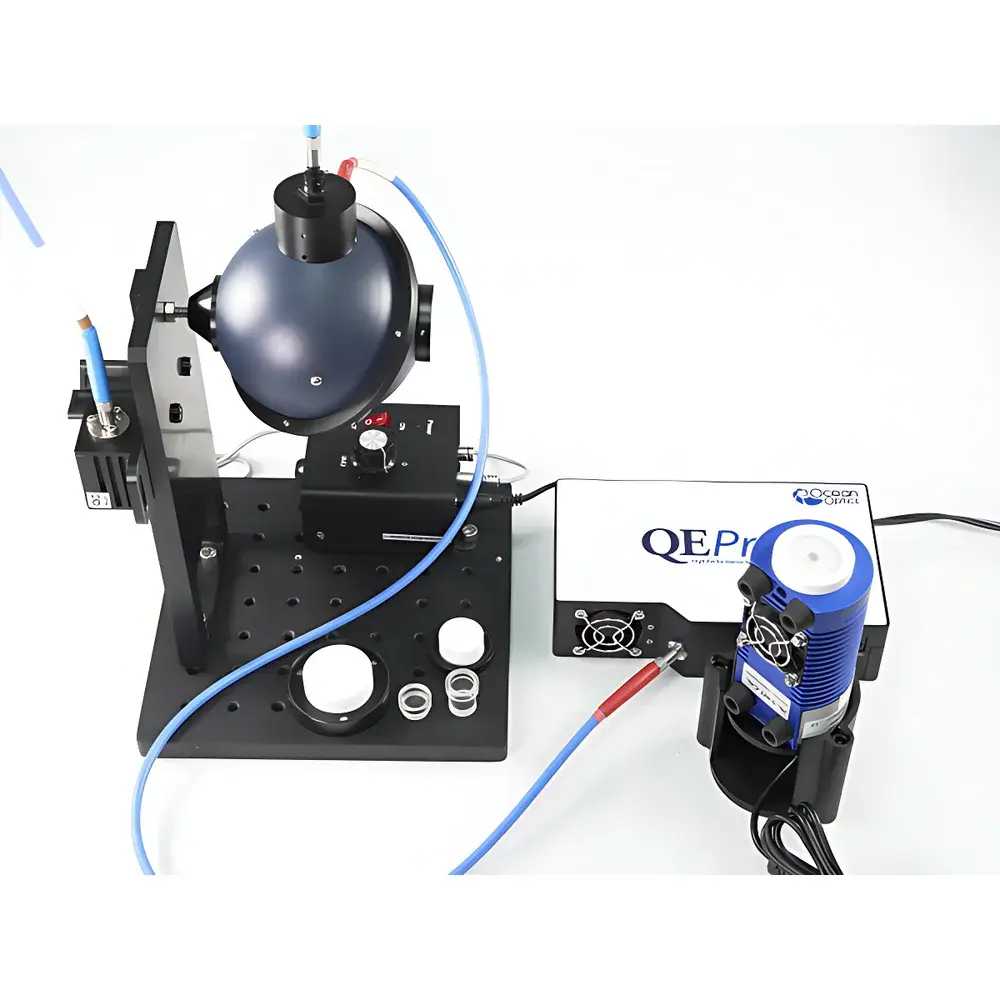
Ocean Optics SpectrumTEQ-PL Photoluminescence Quantum Yield Measurement System
| Brand | Ocean Optics |
|---|---|
| Origin | USA |
| Manufacturer Type | Authorized Distributor |
| Product Category | Imported Instrument |
| Model | SpectrumTEQ-PL |
| Pricing | Upon Request |
| Spectrometer Options | QE Pro / QE65 Pro (350–1100 nm) or NIRQuest+ (900–1700 nm / 900–2200 nm) |
| SNR | 1000:1 (QE Pro, 100 ms) / 15,000:1 (NIRQuest+, 100 ms) |
| Optical Resolution (FWHM) | 2.5 nm (QE Pro) / 3.4–10.8 nm (NIRQuest+) |
| Dynamic Range | 85,000:1 (QE Pro, single acquisition) / 15,000:1 (NIRQuest+, single scan) |
| ADC | 18-bit (QE Pro) / 16-bit (QE65 Pro, NIRQuest+) |
| Integrating Sphere Diameter | 3.3″ (standard), 1.5″ (optional) |
| Sphere Coating | Spectralon® (PTFE-based, >99% reflectance, 250–2500 nm) |
| Light Source | HL-3-INT-CAL calibrated halogen lamp (5 W electrical power) |
| Excitation Source Compatibility | External CW or pulsed LEDs/lasers (user-supplied) |
| Fiber Core | 1000 µm (quartz, SMA 905, interchangeable) |
| Source Measure Unit | Keithley 2400 or 2450 (for electroluminescent mode) |
| Software | Ocean QY v3.x (Windows-based, guided workflow, ASTM E2758-compliant reporting) |
| Sample Environment | Glovebox-compatible (O₂/H₂O < 0.1 ppm), ambient or controlled atmosphere |
| Measurement Modes | Absolute photoluminescence quantum yield (PLQY), electroluminescence quantum yield (ELQY), spectral radiance, luminance, chromaticity (CIE 1931), dominant wavelength, radiant/photometric flux |
| Repeatability | PLQY ±5%, ELQY ±2%, dominant wavelength ±0.5 nm, luminance >98% (Lambertian reference) |
Overview
The Ocean Optics SpectrumTEQ-PL Photoluminescence Quantum Yield Measurement System is an engineered solution for the absolute, traceable quantification of photoluminescence quantum yield (PLQY) and electroluminescence quantum yield (ELQY) under controlled inert atmospheres. Based on the integrating sphere method per ASTM E2758–22 and ISO 11664-1:2019, the system employs dual-spectrometer architecture—combining a high-sensitivity visible-NIR spectrometer (QE Pro or QE65 Pro, 350–1100 nm) with an optional extended-range NIR spectrometer (NIRQuest+, 900–2200 nm)—to capture full spectral response across both excitation and emission domains. Its compact, modular design enables direct integration into nitrogen- or argon-purged gloveboxes (O₂/H₂O < 0.1 ppm), eliminating sample exposure to ambient conditions and preserving air-sensitive phosphors, perovskites, and organometallic emitters during measurement. The system operates on first-principles radiometric calibration: using a NIST-traceable HL-3-INT-CAL tungsten-halogen lamp and Spectralon®-coated integrating spheres (3.3″ standard, 1.5″ optional), it delivers absolute radiant and photometric quantities without reliance on relative references or empirical correction factors.
Key Features
- Glovebox-integrated architecture: Fully assembled and aligned inside inert-atmosphere enclosures; no sample transfer required post-synthesis or device fabrication.
- Dual-spectral coverage: Simultaneous or sequential acquisition from 350–1100 nm (QE Pro/QE65 Pro) and 900–2200 nm (NIRQuest+) ensures complete characterization of wide-bandgap emitters, NIR-II fluorophores, and quantum dot systems.
- High-fidelity radiometry: Spectralon® PTFE coating (>99% diffuse reflectance, 250–2500 nm), 18-bit digitization (QE Pro), and low-stray-light optical design (<0.05% at 600 nm) enable accurate separation of excitation scatter and weak emission signals.
- Traceable calibration chain: Factory-calibrated against NIST-traceable standards; supports user-performed validation per ISO/IEC 17025 requirements for accredited labs.
- Modular source integration: Compatible with external CW/pulsed LEDs, lasers, or monochromators (355 nm–1550 nm); optional fiber-coupled excitation ports with UV-grade quartz delivery fibers.
- Electroluminescent capability: Integrated Keithley 2400/2450 SMU enables current-controlled driving of OLEDs, PeLEDs, and micro-LEDs with synchronized spectral acquisition and voltage/current logging.
Sample Compatibility & Compliance
The SpectrumTEQ-PL accommodates solid-state powders, spin-coated films, encapsulated devices, and wafer-level microstructures (up to Ø25 mm). Sample holders are customizable—including multi-position trays and electrical contact fixtures—for high-throughput screening of material libraries or process optimization. All optical and electronic components comply with IEC 61000-4 electromagnetic compatibility standards. Data acquisition and reporting conform to FDA 21 CFR Part 11 requirements via Ocean QY’s audit-trail-enabled software: electronic signatures, immutable metadata logging (timestamp, operator ID, instrument configuration, calibration status), and export-ready PDF/CSV reports aligned with GLP and GMP documentation frameworks. The system meets ASTM E2758–22 for PLQY determination and supports validation against USP photometric testing protocols for pharmaceutical luminescent markers.
Software & Data Management
Ocean QY v3.x provides a validated, wizard-driven interface designed for routine operation by QC technicians and research scientists alike. Workflow stages—system initialization, dark/background acquisition, reference measurement, sample measurement, and quantum yield calculation—are sequentially enforced with real-time QA prompts. The software automatically applies sphere correction factors, accounts for detector responsivity non-uniformity, and computes absolute PLQY as ηPL = (Nem − Nsc) / (Nabs), where Nem, Nsc, and Nabs are measured photon counts for emission, scattered excitation, and absorbed photons respectively. Radiometric outputs include spectral radiance (mW·sr−1·m−2·nm−1), luminance (cd·m−2), CIE 1931 xy chromaticity coordinates, and dominant wavelength (nm). Raw data is stored in HDF5 format with embedded calibration metadata; exports support ASTM E2758-compliant tabular reports and spectral overlays in industry-standard formats (JDX, CSV, SPC).
Applications
- Characterization of perovskite nanocrystals and metal-halide perovskites for display and lighting applications.
- Quantitative PLQY mapping of phosphor-in-glass (PiG) and remote-phosphor LED packages pre-encapsulation.
- Stability assessment of air-sensitive emitters (e.g., TADF, triplet-harvesting complexes) under inert gas flow or sealed glovebox environments.
- ELQY benchmarking of solution-processed OLEDs and PeLEDs under constant-current or pulse-width-modulated drive conditions.
- Development of NIR-emitting bio-probes (e.g., IR-26, PbS QDs) requiring extended spectral coverage beyond 1100 nm.
- Process control in thin-film optoelectronics manufacturing, supporting ISO 9001-compliant yield analysis and DOE studies.
FAQ
Does the SpectrumTEQ-PL require external excitation sources?
Yes. The system does not include a built-in excitation source; users supply tunable lasers, LEDs, or broadband lamps appropriate for their sample’s absorption profile. Fiber-coupled excitation ports accept standard SMA 905 connectors.
Can PLQY be measured for scattering or highly reflective samples?
Yes. The dual-sphere configuration (sample-in vs. reference-in modes) and Spectralon® coating minimize angular dependence. For non-Lambertian samples, the system supports iterative correction using measured bidirectional reflectance distribution function (BRDF) data.
Is calibration transferable between instruments?
No. Each SpectrumTEQ-PL undergoes individual factory calibration. Field recalibration requires the HL-3-INT-CAL lamp and Ocean Optics’ certified calibration service; end-users may perform verification checks but not full recalibration.
What environmental conditions are required for stable operation?
Ambient temperature stability ±1°C is recommended. No active cooling is required; all spectrometers feature thermoelectric stabilization. Humidity should remain below 60% RH when operated outside gloveboxes.
How is data integrity ensured for regulatory submissions?
Ocean QY v3.x implements role-based access control, electronic signatures, and time-stamped audit logs compliant with 21 CFR Part 11 Annex 11 and ISO/IEC 17025:2017 clause 7.11. Raw spectral data and processing parameters are cryptographically hashed and archived with each report.




