
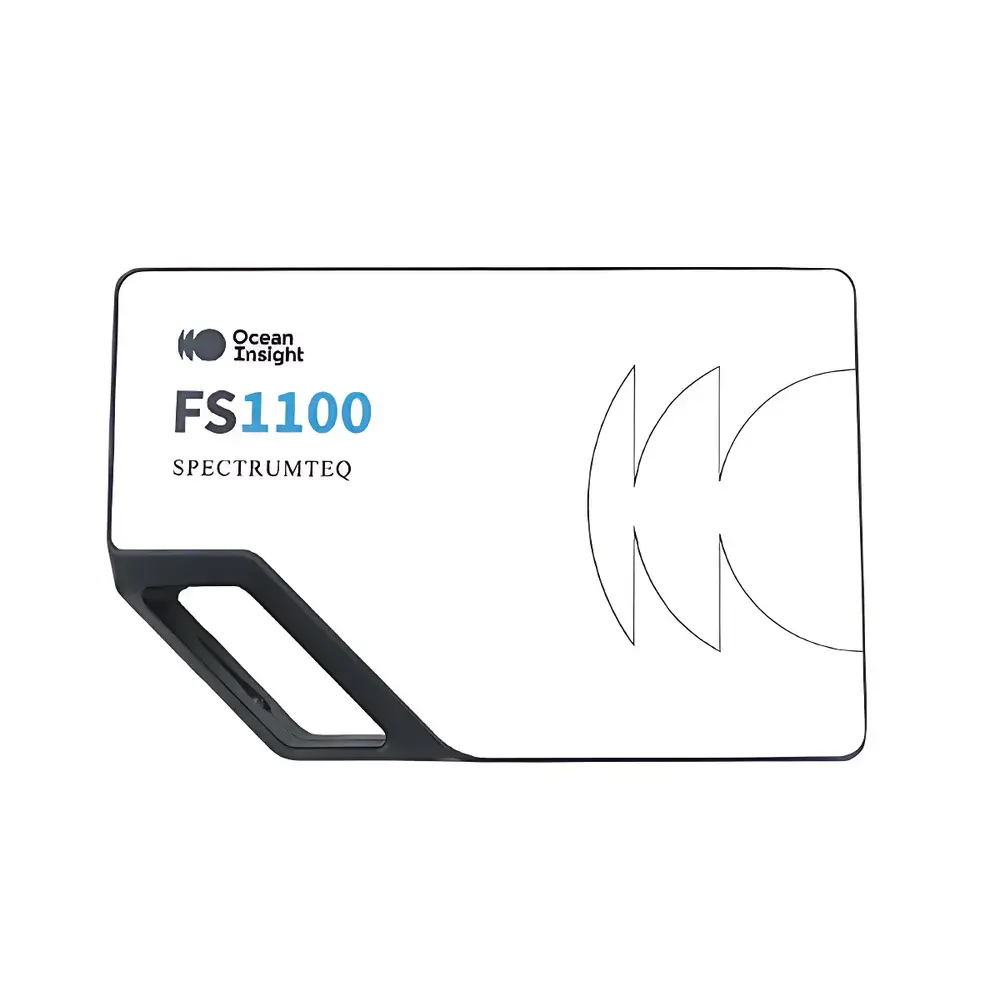
Ocean Optics FS1100 Handheld Field Spectroradiometer
| Brand | Ocean Optics |
|---|---|
| Origin | USA |
| Model | FS1100 |
| Spectral Range | 300–1100 nm |
| Detector | CCD |
| Optical Resolution (FWHM) | 1.3 nm |
| Signal-to-Noise Ratio | 450:1 |
| Dynamic Range | 8000:1 |
| Stray Light | <0.05% at 600 nm |
Overview
The Ocean Optics FS1100 is a handheld, fiber-coupled field spectroradiometer engineered for high-fidelity reflectance spectroscopy in the solar-reflective region (300–1100 nm). Unlike thermal emission-based instruments, the FS1100 operates on passive reflectance measurement principles—capturing sunlight reflected from terrestrial or aquatic surfaces without illumination source integration. Its optical architecture leverages a fixed-grating monochromator with a linear CCD array detector, optimized for robust field deployment under variable ambient lighting, temperature, and humidity conditions. Designed specifically for in situ Earth observation, the FS1100 delivers laboratory-grade spectral fidelity in a portable form factor weighing less than 1.2 kg, enabling rapid acquisition of calibrated reflectance spectra (e.g., %R/λ) with traceable radiometric stability. The system conforms to foundational principles outlined in ASTM E275, ISO 13406-2 (for detector uniformity), and supports spectral calibration traceability to NIST-traceable standards.
Key Features
- High-resolution spectral sampling: 1.3 nm full-width-at-half-maximum (FWHM) resolution across the entire 300–1100 nm range, enabling discrimination of narrow absorption features (e.g., chlorophyll-a at 680 nm, water absorption at 970 nm).
- Low-stray-light optical design: <0.05% stray light at 600 nm ensures accurate quantification of deep spectral valleys critical for vegetation indices (e.g., NDVI, PRI) and mineral identification.
- Dual-platform software compatibility: Native support for OceanView (Windows) and OceanInsight Mobile (Android), allowing real-time preview, spectral averaging, dark/reference correction, and on-device export in CSV, TXT, and SPX formats.
- Field-optimized ergonomics: Integrated adjustable tripod mount, ruggedized housing (IP54-rated), and low-power electrophoretic (e-ink) display with >12-hour battery life per charge—enabling extended deployments without external power.
- Modular fiber-optic interface: Compatible with Ocean Optics’ suite of cosine correctors (e.g., CC-3-UV-VIS), contact probes, and irradiance-calibrated reference panels (e.g., SRS-99-020) for absolute reflectance computation.
Sample Compatibility & Compliance
The FS1100 is designed for non-contact, non-destructive measurement of heterogeneous natural surfaces—including vegetation canopies, soil substrates, inland and coastal water bodies, snow/ice cover, and geological outcrops—under ambient solar illumination. It does not require internal light sources or sample preparation, making it suitable for time-series monitoring (e.g., phenological tracking, post-disturbance recovery). Radiometric calibration is performed using NIST-traceable tungsten-halogen and deuterium lamps; factory calibration certificates include wavelength accuracy (±0.2 nm) and radiometric linearity (R² > 0.9998). The instrument complies with data integrity requirements for environmental monitoring programs aligned with EPA Method IO-3.2 and supports audit-ready metadata logging (GPS, timestamp, integration time, lamp status, temperature) required under GLP-compliant field studies.
Software & Data Management
OceanView desktop software provides advanced spectral processing tools including Savitzky-Golay smoothing, derivative spectroscopy, band depth analysis, and custom index calculation (e.g., Red Edge Position, Water Band Index). All raw and processed spectra are stored with embedded EXIF-like metadata (instrument ID, calibration date, operator ID, GPS coordinates via Bluetooth pairing). Exported datasets conform to the Spectral Data Interchange Format (SDIF) v2.1 specification, ensuring interoperability with ENVI, QGIS, R (hyperSpec), and Python (spectral, scikit-learn) workflows. For regulated environments, OceanView supports 21 CFR Part 11-compliant user authentication, electronic signatures, and immutable audit trails when deployed with optional enterprise license modules.
Applications
- Remote Sensing Ground Truthing: Acquisition of reference spectra for atmospheric correction validation and sensor cross-calibration (e.g., Sentinel-2, Landsat 9, PRISMA).
- Plant Phenotyping & Stress Detection: Quantification of pigment ratios (Chl a/b, carotenoids), leaf water content (970 nm feature), and nitrogen status via continuum-removed absorption depths.
- Aquatic Optics & Water Quality: In-field determination of CDOM (colored dissolved organic matter), chlorophyll-a concentration, and suspended sediment load using established semi-analytical algorithms.
- Soil Characterization: Discrimination of clay mineralogy (Al-OH, Fe-OH features near 700–900 nm), organic carbon content, and iron oxide abundance.
- Ecological Restoration Monitoring: Long-term spectral time series to assess successional trajectories, invasive species encroachment, and fire recovery dynamics.
FAQ
Is the FS1100 suitable for underwater measurements?
No—the FS1100 is designed for above-water reflectance measurements only. Submerged operation requires pressure-rated housings and water-specific calibration protocols not supported by this platform.
Can I perform absolute irradiance measurements with the FS1100?
Yes, when paired with an Ocean Optics calibrated irradiance probe (e.g., CC-3-UV-VIS + LS-1-CAL) and configured in irradiance mode, the FS1100 reports µW/cm²/nm with ±5% uncertainty (k=2) across 350–1050 nm.
What spectral calibration options are available?
Factory calibration includes wavelength and relative intensity calibration. NIST-traceable absolute irradiance and radiance calibrations are available as optional services with documented uncertainty budgets per ISO/IEC 17025.
Does the FS1100 support automated time-lapse acquisition?
Yes—OceanView’s scripting engine (via Python API) enables programmable sequences including GPS-triggered capture, solar zenith angle gating, and cloud-cover thresholding based on broadband sky radiance readings.





