
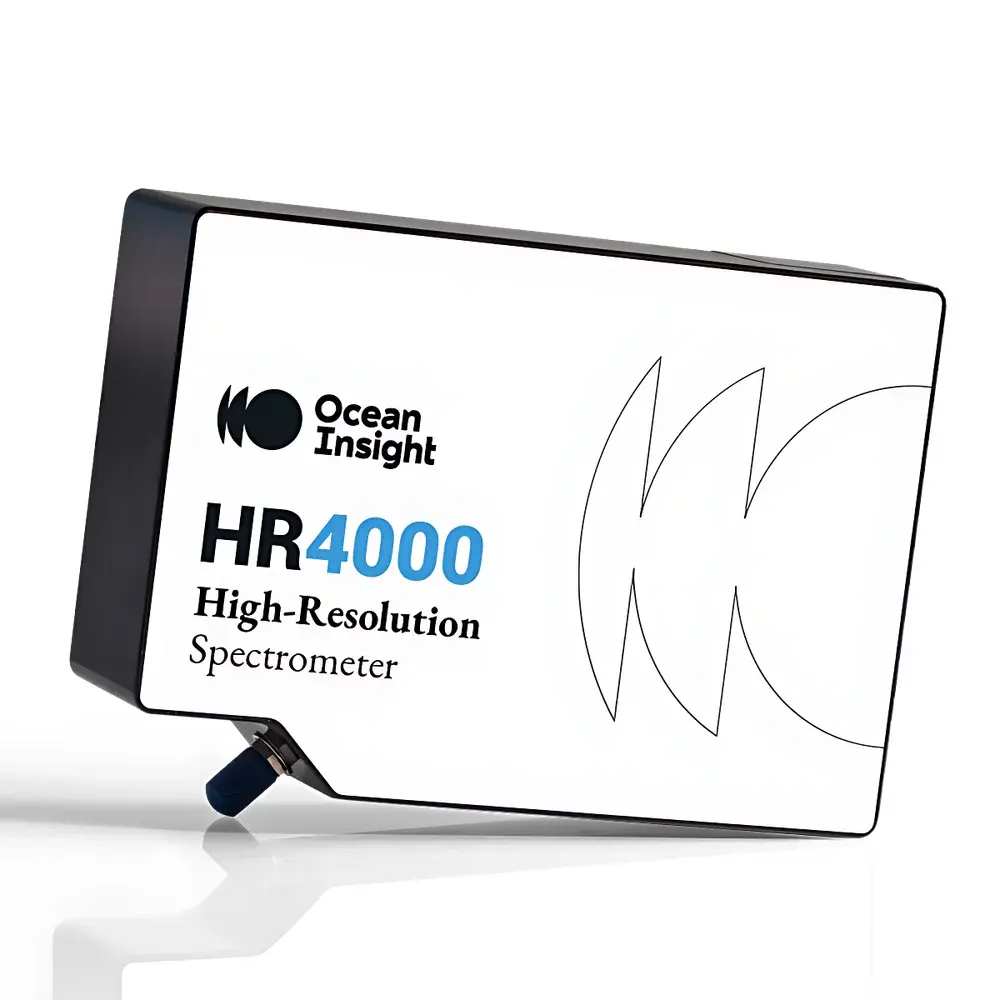
Ocean Optics HR4000 High-Resolution Transmission Spectrometer
| Brand | Ocean Optics |
|---|---|
| Origin | USA |
| Model | HR4000 |
| Optical Configuration | Single-beam |
| Detector | 3648-pixel linear CCD array |
| Wavelength Range | 200–1100 nm |
| Optical Resolution | ~1.0 nm FWHM |
| Slit Width | 25 µm |
| Grating | HC-1 holographic concave grating, 300 lines/mm |
| Stray Light | <0.05% at 600 nm |
| Focal Length | f/4, 101 mm |
| Dynamic Range | 2 × 10⁸ (system) |
| 2000 | 1 (single acquisition) |
| Data Transfer | 4 ms (USB 2.0 full spectrum) |
| Input/Output | 10 programmable GPIOs |
Overview
The Ocean Optics HR4000 High-Resolution Transmission Spectrometer is a compact, USB-powered spectrometer engineered for precision UV-Vis-NIR spectral acquisition in transmission mode. Based on Czerny-Turner optical architecture with a concave holographic grating and a 3648-pixel linear CCD detector, the HR4000 delivers high signal-to-noise ratio and exceptional wavelength fidelity across a broad 200–1100 nm range. Its core design emphasizes reproducible photometric accuracy in benchtop and field-deployable transmission measurements—particularly where sample pathlengths vary (e.g., liquid cuvettes, thin films, or solid slabs up to 100 mm thickness). The instrument operates as a single-beam system optimized for integration with external broadband light sources and fiber-coupled optical accessories, enabling modular configuration for standardized transmittance, absorbance, and spectral attenuation analysis in compliance with ASTM E308, ISO/CIE 11664, and USP spectroscopic validation frameworks.
Key Features
- High-resolution optical engine: HC-1 composite grating (300 lines/mm) with OFLV-200-1100 order-sorting filter ensures minimal higher-order diffraction and optimal quantum efficiency from deep UV to NIR.
- 25 µm entrance slit provides a balance between resolution (~1.0 nm FWHM) and throughput—critical for low-light transmission applications such as dilute aqueous solutions or optically dense polymers.
- UV-enhanced CCD detector (DET4 configuration with UV2 upgrade) extends responsivity below 250 nm, supporting rigorous quantification of aromatic compounds, nucleic acids, and transition metal complexes per EPA Method 415.3 and APHA Standard Methods 5910B.
- Integrated 10-channel GPIO interface enables hardware-synchronized triggering of external components—including shutter control, lamp power modulation, or motorized stage positioning—facilitating automated multi-sample workflows under GLP-compliant audit trails.
- Low-power, fanless design (450 mA @ 5 VDC) and compact footprint (148.6 × 104.8 × 45.1 mm; 570 g) support integration into OEM systems, portable analytical platforms, and regulated QC environments where thermal drift and electromagnetic interference must be minimized.
Sample Compatibility & Compliance
The HR4000 is routinely deployed in transmission configurations using standardized 10 mm pathlength quartz cuvettes (for liquids), free-standing thin-film substrates (e.g., ITO-coated glass), and bulk solids mounted via the adjustable 74-ACH collimating lens holder—capable of accommodating samples up to 100 mm thick. When paired with the DT-MINI-2 deuterium-halogen broadband source (200–2000 nm continuous output), the system satisfies spectral uniformity requirements defined in ISO 17025 Clause 5.4.2 for calibration traceability. All firmware and driver-level communication adhere to USB Device Class Definition for Communications Devices (CDC), ensuring deterministic latency and compatibility with validated software environments compliant with FDA 21 CFR Part 11 Annex 11 requirements for electronic records and signatures.
Software & Data Management
Data acquisition and processing are supported through Ocean Insight’s SpectraSuite desktop application (Windows/macOS/Linux), which provides real-time spectral display, dark/baseline correction, transmittance-to-absorbance conversion, and export to CSV, XML, or HDF5 formats. For integration into LIMS or MES platforms, the instrument is fully compatible with OmniDriver SDK (C/C++, Python, LabVIEW, MATLAB) and supports SCPI-like command syntax over USB virtual COM port. All spectral acquisitions include embedded metadata: timestamp (UTC), integration time, detector temperature (monitored via on-board thermistor), and hardware configuration hash—enabling full data lineage tracking required under GMP Annex 11 and ISO/IEC 17025:2017 Clause 7.7.2.
Applications
- Quantitative analysis of pharmaceutical excipients and active ingredients via UV-Vis absorbance (e.g., paracetamol assay per USP ).
- In-line monitoring of polymer film thickness and refractive index homogeneity during extrusion processes.
- Environmental water quality assessment: nitrate, nitrite, and dissolved organic carbon (DOC) quantification using multi-wavelength regression models.
- Photovoltaic R&D: spectral transmittance mapping of anti-reflective coatings and transparent conductive oxides (TCOs) across AM1.5G-relevant wavelengths.
- Academic research in photochemistry: real-time kinetic profiling of photocatalytic degradation reactions under controlled irradiance conditions.
FAQ
Is the HR4000 suitable for regulatory-compliant absorbance measurements?
Yes—the instrument’s documented linearity (R² > 0.9999 over 0–3 AU), stray light performance (<0.05% at 600 nm), and firmware-controlled integration time stability meet minimum criteria outlined in USP , EP 2.2.25, and JP 17 General Test 2.03.
Can the HR4000 operate without a PC?
No—it requires host-based control for spectral acquisition and does not feature onboard memory or autonomous logging. However, it supports USB On-The-Go (OTG) via compatible embedded Linux hosts (e.g., Raspberry Pi 4) when deployed in edge-analytical systems.
What is the recommended calibration frequency for routine QC use?
NIST-traceable wavelength and irradiance calibration is advised before each measurement series or at least daily in high-throughput labs; Ocean Insight provides certified holmium oxide and neutral density filters for verification per ISO/IEC 17025 Clause 6.4.10.
Does the HR4000 support time-resolved transmission measurements?
Yes—minimum integration time is 3.8 ms, and hardware triggering via GPIO allows synchronization with pulsed light sources or mechanical choppers for kinetic studies with sub-millisecond temporal resolution.
Are there OEM integration options for embedding the HR4000 into custom instrumentation?
Yes—Ocean Insight offers mechanical mounting kits, custom firmware builds, and extended temperature-range variants (-10 °C to +50 °C operating envelope) under NDA for medical device and industrial analyzer manufacturers seeking IEC 61326-1 EMC certification support.




