
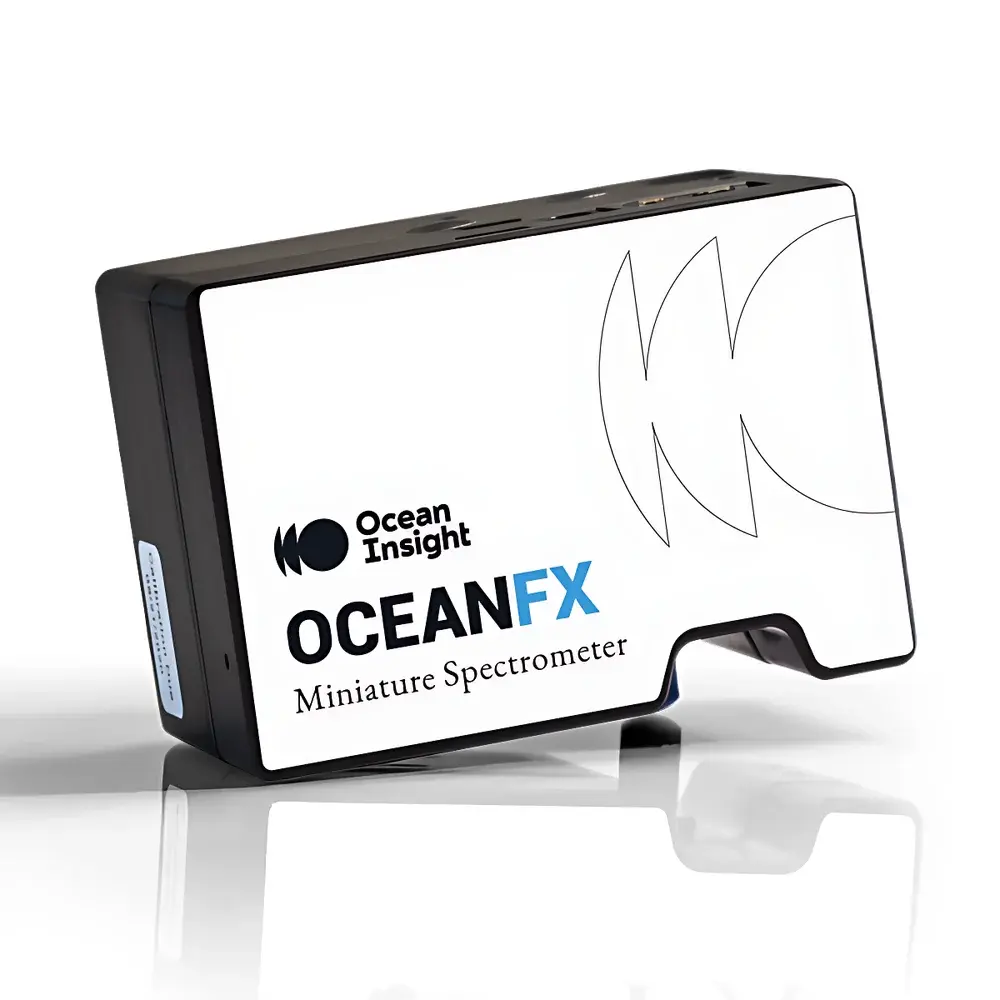
Ocean Optics Ocean-FX Fiber Optic Spectrometer
| Brand | Ocean Optics |
|---|---|
| Model | Ocean-FX |
| Spectral Range | 200–1100 nm |
| Optical Resolution (FWHM) | 0.8 nm (with 600 l/mm grating & 5 µm slit) |
| Detector | Hamamatsu S11639 CMOS |
| Sensitivity | Optimized for 200–1025 nm with 25 µm slit |
| Signal-to-Noise Ratio (SNR, single scan) | ~270:1 |
| Dynamic Range (single scan) | ~6400:1 |
| Stray Light | <0.08% at 600 nm |
| Minimum Integration Time | 10 µs |
| Onboard Buffer | 50,000 spectra with timestamping |
| Scan Rate | Up to 4500 scans/s (system-dependent) |
| Slit Options | 5, 10, 50, 100, or 200 µm |
| Input Connector | SMA 905 or FC |
| Thermal Drift | 0.11 pixels/°C |
| Communication Interfaces | Gigabit Ethernet, Wi-Fi 802.11n, USB 3.0 |
Overview
The Ocean Optics Ocean-FX Fiber Optic Spectrometer is a high-performance, modular spectrometer engineered for demanding UV-VIS-NIR applications requiring speed, sensitivity, and robust data integrity. Based on a back-thinned, scientific-grade Hamamatsu S11639 CMOS detector, the Ocean-FX delivers enhanced quantum efficiency—particularly in the ultraviolet region (200–350 nm)—compared to legacy CCD-based platforms. Its optical architecture employs fixed-grating Czerny-Turner design with selectable slit widths and optimized collimation optics, enabling consistent spectral resolution of 0.8 nm FWHM (with 600 lines/mm grating and 5 µm slit). The instrument operates across a broad spectral range of 200–1100 nm, configurable into application-specific bands including UV-VIS (200–850 nm), VIS-NIR (350–1000 nm), or wideband (200–1025 nm), all using a standard 25 µm input slit. Designed for integration into automated systems and field-deployable instrumentation, the Ocean-FX supports real-time spectral acquisition at up to 4500 full-spectrum scans per second—enabling time-resolved measurements of transient phenomena such as enzymatic kinetics, pulsed laser emission, plasma decay, and rapid industrial sorting processes.
Key Features
- High-speed CMOS detection: Enables up to 4500 full-spectrum acquisitions per second with hardware-timestamped metadata, supporting kinetic studies with sub-millisecond temporal resolution.
- Onboard spectral buffering: Integrated memory stores up to 50,000 spectra with precise timestamps, eliminating data loss during high-throughput or unattended operation.
- Multi-interface connectivity: Native Gigabit Ethernet, IEEE 802.11n Wi-Fi, and USB 3.0 interfaces facilitate flexible deployment—ranging from benchtop QC labs to embedded OEM systems and remote process monitoring nodes.
- Thermally stabilized optical path: Low thermal drift (0.11 pixels/°C) ensures wavelength calibration stability under variable ambient conditions, critical for long-duration measurements without active recalibration.
- Configurable input optics: Interchangeable slits (5–200 µm) and fiber coupling options (SMA 905 or FC) allow optimization of throughput vs. resolution trade-offs across diverse sample types and illumination geometries.
- Low stray light performance: Optical design achieves <0.08% stray light at 600 nm, minimizing spectral crosstalk in applications involving strong emission lines adjacent to weak analyte signals (e.g., Raman edge rejection or fluorescence background suppression).
Sample Compatibility & Compliance
The Ocean-FX is compatible with standard 200 µm–1000 µm core silica optical fibers and integrates seamlessly with Ocean Insight’s portfolio of light sources, cuvette holders, integrating spheres, and flow cells. It supports both free-space and fiber-coupled sampling configurations, making it suitable for transmission, reflectance, fluorescence, absorbance, and emission measurements. While the instrument itself does not carry intrinsic regulatory certification, its digital output and deterministic timing model support compliance workflows aligned with ISO/IEC 17025, ASTM E275, USP <857>, and FDA 21 CFR Part 11 when deployed within validated system architectures—including audit-trail-enabled software environments and calibrated reference standards traceable to NIST.
Software & Data Management
The Ocean-FX is fully supported by OceanView spectroscopy software (Windows/macOS/Linux), which provides real-time visualization, spectral math operations, multivariate analysis (PCA, PLS), and automated peak identification. Its SDK (OceanDirect API) offers native C/C++, Python, MATLAB, LabVIEW, and .NET bindings, enabling custom control logic and integration into SCADA, MES, or LIMS platforms. All acquired spectra include embedded metadata—integration time, temperature, firmware version, and hardware timestamps—ensuring traceability for GLP/GMP-aligned documentation. Raw spectral data is exported in vendor-neutral formats (CSV, HDF5, JCAMP-DX), facilitating third-party analysis and long-term archival in accordance with FAIR data principles.
Applications
- Biomedical research: Quantitative DNA/RNA quantification, protein conformational analysis via intrinsic fluorescence, and real-time monitoring of enzyme-catalyzed reactions.
- Industrial process analytics: In-line food sorting (e.g., ripeness assessment, contaminant detection), pharmaceutical blend uniformity verification, and chemical reaction endpoint determination.
- Environmental & gas sensing: UV absorption spectroscopy for ozone, NO2, SO2, and VOC detection in open-path or multipass cell configurations.
- Laser & plasma diagnostics: Pulse-resolved spectral characterization of Q-switched lasers, femtosecond pulse compression monitoring, and time-gated plasma emission analysis.
- Materials science: Thin-film thickness measurement via interference fringe analysis, photoluminescence quantum yield estimation, and LED phosphor characterization.
FAQ
What spectral calibration options are available for the Ocean-FX?
The Ocean-FX ships with factory calibration using NIST-traceable tungsten-halogen and mercury-argon sources. Users may perform user calibration using optional calibration kits (e.g., HG-1 Mercury-Argon lamp or LS-1-CAL tungsten halogen source) via OceanView software.
Can the Ocean-FX operate in triggered acquisition mode?
Yes—it supports external TTL triggering (rising/falling edge) for synchronization with pulsed light sources, mechanical shutters, or process control signals, with jitter <1 µs.
Is the onboard buffer volatile or non-volatile memory?
The 50,000-spectrum buffer resides in volatile RAM; data must be streamed or offloaded before power loss. For persistent storage, continuous streaming to host memory or network-attached storage is recommended.
Does the Ocean-FX support dark current correction in real time?
Yes—hardware-accelerated dark subtraction is applied per scan using a user-defined dark reference spectrum, configurable via software or firmware command.
How is wavelength accuracy maintained over temperature fluctuations?
The Ocean-FX incorporates an internal thermistor and pixel-shift compensation algorithm that adjusts wavelength mapping based on measured sensor temperature, maintaining calibration stability within ±0.3 nm over 15–35 °C ambient range.
Related Products





