
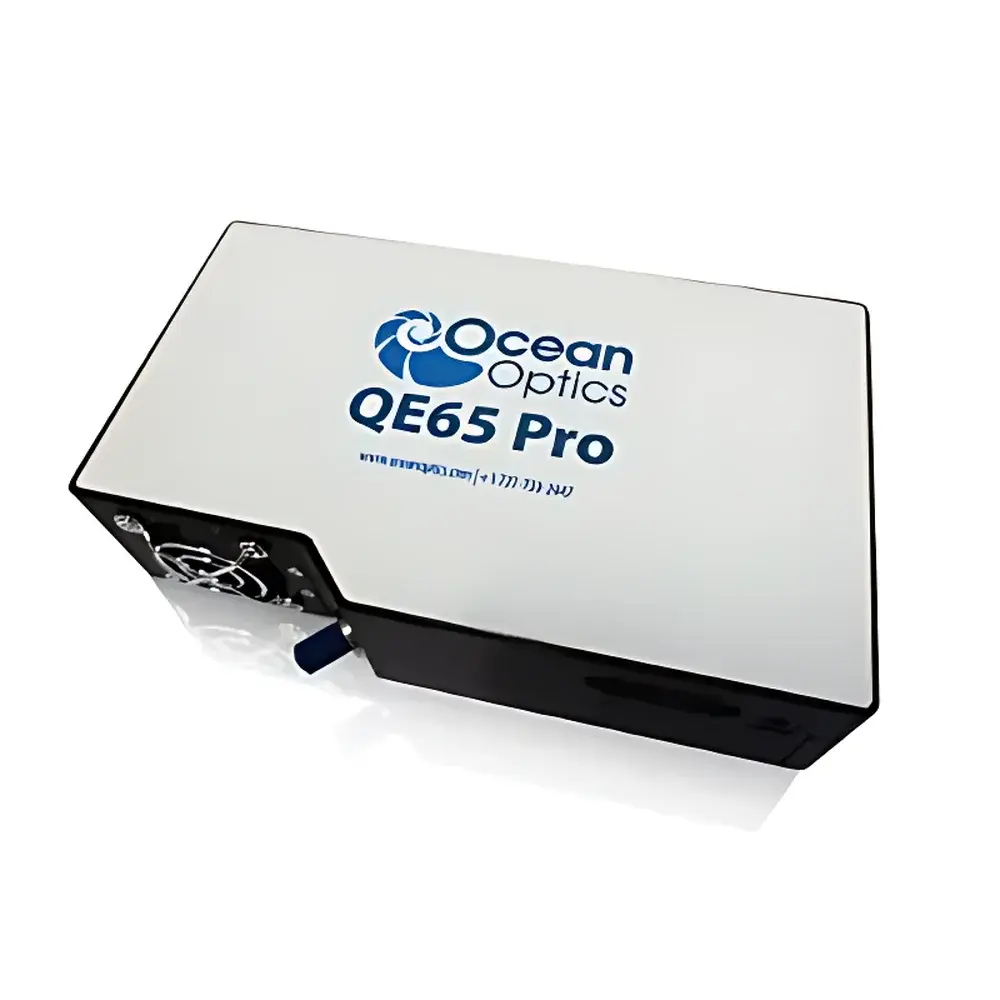
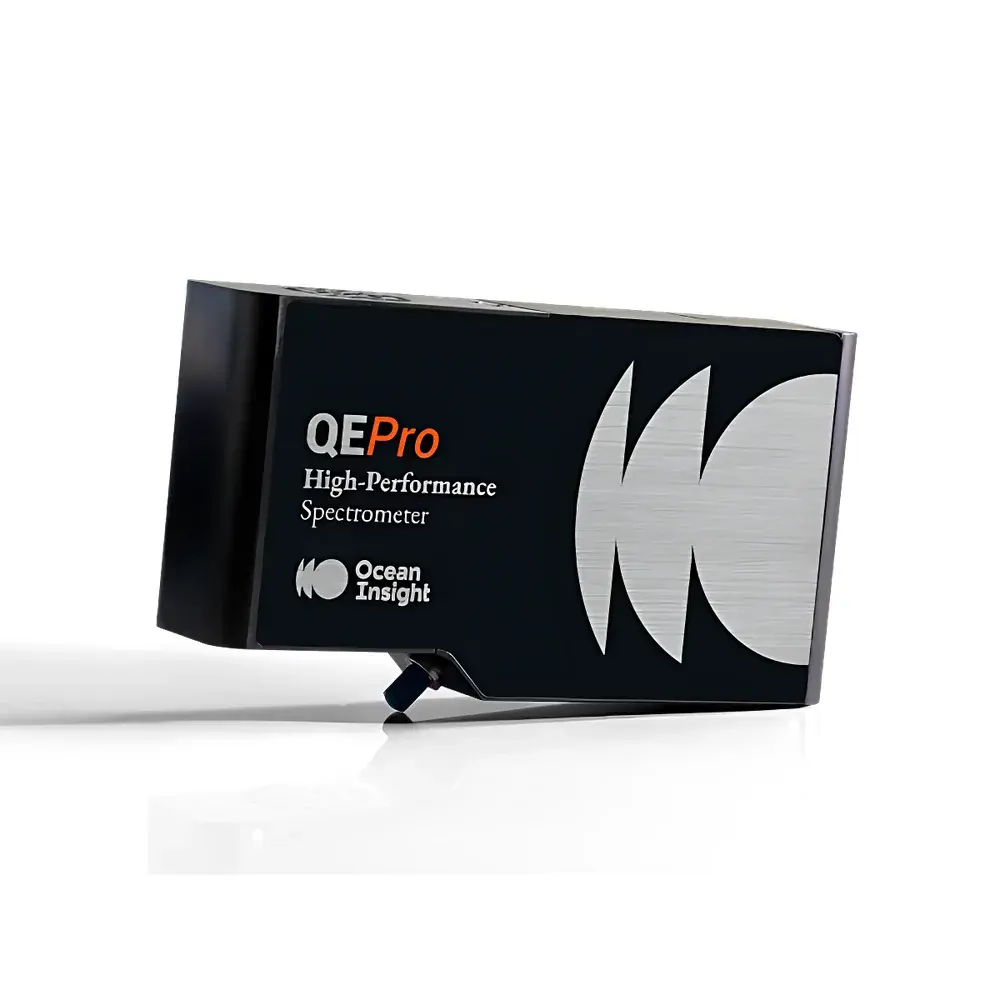
Ocean Optics QE65 Pro Research-Grade Fiber Optic Spectrometer
| Brand | Ocean Optics |
|---|---|
| Origin | USA |
| Model | QE65 Pro |
| Spectral Range | 200–1100 nm |
| Detector | Back-Illuminated CCD (Hamamatsu FFT-CCD) |
| Optical Resolution (FWHM) | 0.14–7.7 nm |
| Sensitivity | 22 e⁻/count (all λ) |
| Signal-to-Noise Ratio | 1000:1 (full signal) |
| Dynamic Range | 7.5 × 10⁹ |
| Stray Light | <0.08% @ 600 nm |
| Cooling | Two-stage TEC to –15 °C (ΔT = –40 °C below ambient) |
| Integration Time | 8 ms – 15 min |
| Slit | Interchangeable SMA905-compatible slit |
| Grating Options | Including 900 grooves/mm (#H36), blaze 500 nm |
Overview
The Ocean Optics QE65 Pro is a high-performance, research-grade fiber optic spectrometer engineered for demanding low-light applications requiring exceptional sensitivity, thermal stability, and spectral fidelity. Built around a back-illuminated, full-frame transfer (FFT) CCD detector from Hamamatsu, the QE65 Pro leverages deep-depletion silicon architecture to achieve peak quantum efficiency exceeding 90% in the UV-Vis-NIR range (200–1100 nm). Its optical design integrates a two-stage thermoelectric cooler (TEC) capable of stabilizing the detector at –15 °C—up to 40 °C below ambient temperature—significantly suppressing dark current and enabling long integration times (8 ms to 15 minutes) without spectral distortion or pixel saturation. This thermal management, combined with optimized optical throughput and minimized etalon effects, makes the QE65 Pro particularly suited for fluorescence spectroscopy, Raman scattering, DNA sequencing analysis, and other photon-starved measurements where signal integrity and reproducibility are critical.
Key Features
- Back-Illuminated FFT-CCD Detector: High quantum efficiency (>90% peak), low etalon fringing, and vertical binning capability—allowing column-wise pixel summation to enhance signal-to-noise ratio and effective sensitivity without sacrificing acquisition speed.
- Two-Stage TEC Cooling: Maintains detector temperature at –15 °C with ±0.1 °C stability, reducing dark noise by >95% compared to uncooled operation and enabling reliable sub-picoamp-level signal detection.
- Interchangeable Slit & Grating Architecture: SMA905-compatible modular slit assembly allows field-replaceable slits (10–200 µm standard); broad grating library—including 900 grooves/mm (#H36), blaze 500 nm—optimized for 532 nm and 785 nm laser excitation in Raman configurations.
- Stray Light Suppression: Optimized optical path and coated internal baffling yield stray light performance of <0.08% at 600 nm and 0.4% at 435 nm—critical for high-dynamic-range measurements across wide spectral spans.
- Precision Timing & Synchronization: Hardware trigger input/output supports external device synchronization (e.g., pulsed lasers, shutters, stage controllers) with jitter <100 ns, essential for time-resolved spectroscopy and pump-probe experiments.
- Thermally Stable Optical Platform: Monolithic aluminum housing with low-CTE optical mounts ensures wavelength calibration drift <0.02 nm/°C over operational temperature ranges, supporting GLP-compliant long-term monitoring.
Sample Compatibility & Compliance
The QE65 Pro interfaces seamlessly with standard 400 µm or 600 µm core optical fibers (SMA905 connector), supporting diverse sampling geometries including cuvette holders, integrating spheres, fiber-coupled probes, and custom Raman probe assemblies. Its modular design facilitates integration into ISO/IEC 17025-accredited laboratories and complies with key regulatory frameworks for analytical instrumentation: spectral data integrity aligns with FDA 21 CFR Part 11 requirements when used with OceanView software configured for audit-trail-enabled operation; optical performance metrics conform to ASTM E275 and ISO 17025 Annex C guidelines for spectrophotometric validation. The instrument’s stable wavelength calibration and documented uncertainty budgets support traceable measurement reporting in QC/QA and research publications.
Software & Data Management
OceanView spectroscopy software (v2.5+) provides full instrument control, real-time spectral visualization, and advanced post-processing—including dark/baseline correction, peak identification, multivariate analysis (PCA), and spectral averaging. Raw data export is supported in CSV, ASCII, and HDF5 formats, ensuring compatibility with MATLAB, Python (via PyOcean), and LabVIEW environments. For regulated environments, optional OceanView GxP Edition enables role-based user access, electronic signatures, and full audit trails compliant with 21 CFR Part 11 and EU Annex 11. All firmware and calibration files are digitally signed and version-controlled, supporting repeatable instrument reconfiguration across multi-user lab settings.
Applications
- Raman Spectroscopy: Paired with 785 nm or 532 nm lasers and fiber-coupled probes, the QE65 Pro delivers high-fidelity Raman spectra of solids, powders, liquids (in cuvettes), and biological tissues—with minimal fluorescence interference due to its low-stray-light optics and deep-UV-NIR coverage.
- Fluorescence Quantum Yield & Lifetime Studies: High SNR and extended integration enable precise measurement of weak emission signals from quantum dots, organic dyes, and protein fluorophores—even under low-excitation conditions.
- UV-Vis-NIR Absorption & Transmission Analysis: Supports kinetic studies, concentration quantification (Beer-Lambert), and thin-film characterization across pharmaceutical, materials science, and environmental labs.
- DNA Sequencing & Genomic Analysis: Used in capillary electrophoresis detection systems and microfluidic absorbance readers where high sensitivity and broad spectral response are required for multiplexed dye detection.
- Plasma & Combustion Diagnostics: Capable of time-resolved emission spectroscopy for species identification (e.g., OH*, CH*, CN*) in reactive flows, leveraging its fast triggering and thermal stability.
FAQ
What cooling temperature does the QE65 Pro achieve, and how does it impact dark current?
The two-stage TEC cools the CCD to –15 °C, reducing dark current by approximately two orders of magnitude versus room-temperature operation—enabling integration times up to 15 minutes while maintaining <0.01% dark signal contribution.
Can I change the slit and grating myself without recalibration?
Yes—the interchangeable slit and grating modules are mechanically registered and optically aligned to maintain factory calibration; however, full wavelength and intensity recalibration is recommended after any optical component swap per ISO/IEC 17025 best practices.
Is the QE65 Pro compatible with third-party software like MATLAB or Python?
Yes—Ocean Optics provides documented DLLs, .NET APIs, and Python bindings (PyOcean) for direct hardware control and spectral data streaming, supporting automated workflows and custom analysis pipelines.
Does the QE65 Pro meet FDA 21 CFR Part 11 requirements for electronic records?
When operated with OceanView GxP Edition and configured with audit-trail logging, electronic signatures, and user-role permissions, the system satisfies 21 CFR Part 11 criteria for electronic record retention and integrity.
What is the typical wavelength repeatability over 8 hours of continuous operation?
Under stabilized thermal conditions, wavelength repeatability is ≤±0.01 nm (RMS) over 8 hours, verified via Hg/Ne lamp line tracking and traceable to NIST-certified references.
Related Products






