
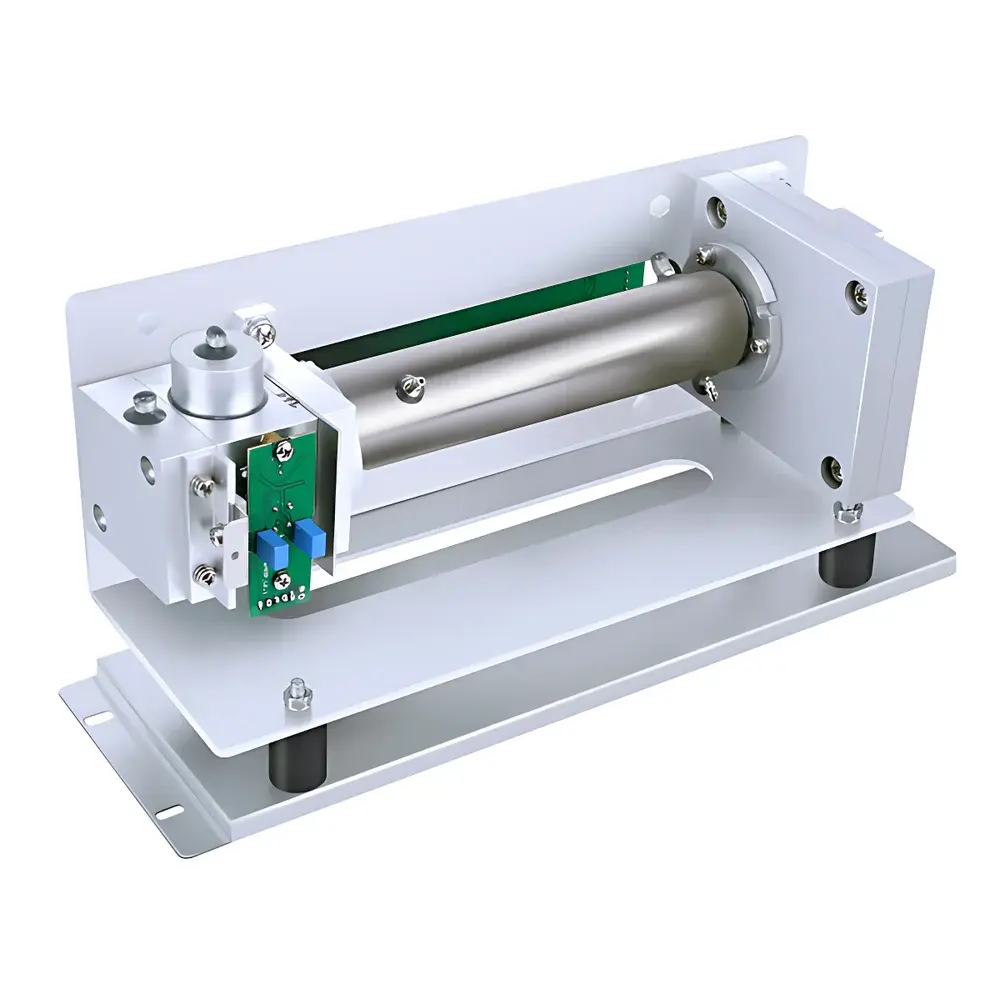
CUBIC INSTRUMENTS Gasboard-2100 Microflow Dual-Chamber NDIR Gas Sensor Module
| Brand | CUBIC INSTRUMENTS |
|---|---|
| Origin | Hubei, China |
| Model | Gasboard-2100 |
| Detection Principle | Non-Dispersive Infrared (NDIR) with Microflow Dual-Chamber Architecture |
| Measurands | SO₂, NO, CO, CH₄ |
| Range (configurable) | 0–500 / 0–5000 ppm |
| Linearity Error | ±2% FS |
| Repeatability | ±2% FS |
| Zero/SPAN Drift | <2.5% FS/7 days |
| Temperature & Pressure Compensation | Integrated automatic compensation |
| Output Interface | Analog (4–20 mA / 0–5 V) and digital (RS485, Modbus RTU) |
| Operating Temperature | –10 °C to +50 °C |
| Enclosure Rating | IP65 |
| Compliance | RoHS, CE (EMC & LVD), ISO 9001-manufactured |
Overview
The CUBIC INSTRUMENTS Gasboard-2100 is a high-stability, low-range gas sensing module engineered for precise quantification of trace-level gaseous analytes—including sulfur dioxide (SO₂), nitrogen monoxide (NO), carbon monoxide (CO), and methane (CH₄)—using patented microflow non-dispersive infrared (NDIR) detection technology. Unlike conventional single-beam NDIR sensors, the Gasboard-2100 implements a dual-chamber optical architecture: one chamber serves as the measurement cell exposed to the target gas stream, while the other functions as a sealed reference cell containing inert gas (e.g., N₂). An infrared source emits broadband IR radiation simultaneously through both chambers; wavelength-selective interference filters isolate absorption bands specific to each target gas (e.g., 7.3 µm for SO₂, 5.3 µm for NO, 4.6 µm for CO, 3.3 µm for CH₄). Differential microflow thermal detection—based on pressure-induced gas movement across a thermopile—converts minute absorption differentials into robust electrical signals. This architecture inherently suppresses common-mode drift caused by ambient temperature fluctuations, LED aging, and optical contamination, enabling sub-500 ppm detection with long-term baseline stability.
Key Features
- Patented microflow dual-chamber NDIR design (PCT/CN2018100767), eliminating reliance on mechanical choppers or complex optical alignment
- Integrated temperature and barometric pressure compensation algorithms—calibrated against NIST-traceable reference standards
- Modular form factor (120 × 85 × 45 mm) optimized for OEM integration into continuous emission monitoring systems (CEMS), portable analyzers, and industrial safety controllers
- Dual output interface: isolated 4–20 mA analog current loop compliant with IEC 61000-4-5 surge immunity, plus RS485 serial communication supporting Modbus RTU protocol
- Robust mechanical housing rated IP65, suitable for deployment in humid, dusty, or vibration-prone environments typical of boiler rooms, biogas plants, and chemical process areas
- Factory-calibrated with certified gas standards; zero and span verification intervals extend to 7 days under ISO 14644 Class 8 cleanroom-equivalent storage conditions
Sample Compatibility & Compliance
The Gasboard-2100 is validated for use with dry, non-corrosive gas matrices. For wet or particulate-laden samples (e.g., flue gas post-scrubber), integration with heated sampling lines, PTFE membrane filters (pore size ≤ 0.5 µm), and condensate traps is recommended per EN 15267-3 guidelines. Sensor response remains linear across relative humidity ranges of 15–90% RH when operated within its specified temperature envelope. All electronic components conform to RoHS Directive 2011/65/EU and CE marking requirements under EMC Directive 2014/30/EU and Low Voltage Directive 2014/35/EU. Manufacturing adheres to ISO 9001:2015 quality management system protocols. While not intrinsically safe certified, the module may be deployed in Zone 2 hazardous locations when installed within ATEX/IECEx-compliant enclosures.
Software & Data Management
The sensor operates autonomously without embedded firmware updates during field operation. Configuration and diagnostics are performed via ASCII command set over RS485, supporting baud rates from 9.6 kbps to 115.2 kbps. Raw signal outputs (microvolt-level thermopile voltages) and compensated concentration values are timestamped and accessible for audit logging. When integrated into larger analytical platforms, the Gasboard-2100 supports GLP/GMP-aligned data integrity workflows: all calibration events, zero/span adjustments, and environmental parameter logs are stored with immutable timestamps and operator IDs—enabling full traceability per FDA 21 CFR Part 11 requirements when paired with compliant host software.
Applications
- Low-concentration stack emission monitoring (e.g., compliance with EU Industrial Emissions Directive 2010/75/EU Annex V for SO₂ & NOₓ)
- On-board diagnostics (OBD-II) and portable roadside emissions testing for light-duty vehicles
- In-line monitoring of combustion efficiency in natural gas-fired boilers and industrial furnaces
- Real-time CH₄ and CO tracking in anaerobic digesters and landfill biogas upgrading units
- Process gas analysis in pharmaceutical drying tunnels, semiconductor purge lines, and catalyst regeneration loops
- OEM integration into multi-gas air quality stations (AQMS) meeting WHO and US EPA PM₂.₅/CO co-location criteria
FAQ
What gases can the Gasboard-2100 measure simultaneously?
The Gasboard-2100 is a single-analyte module. Each unit is factory-configured for one target gas (SO₂, NO, CO, or CH₄). Multi-gas capability requires parallel installation of dedicated modules or integration with a multiplexed optical bench.
Is cross-sensitivity to water vapor or CO₂ corrected in firmware?
Yes—embedded compensation algorithms correct for spectral interference from H₂O (absorption at 2.7 µm and 6.3 µm) and CO₂ (4.26 µm) using real-time dew point estimation derived from onboard thermistor and capacitive humidity readings.
Can the sensor be recalibrated in the field without returning to the manufacturer?
Field zero calibration is supported using certified zero air (≤0.1 ppm hydrocarbon); span calibration requires certified span gas at two points (e.g., 50% and 90% of full scale) and must be performed using CUBIC’s proprietary calibration utility and traceable gas cylinders.
What is the expected service life under continuous operation?
Based on accelerated life testing per IEC 60721-3-3 Class 3K5, the infrared source and thermopile exhibit ≥5 years MTBF at 25 °C ambient, assuming stable power supply and absence of mechanical shock exceeding 50 g.
Does the module meet any ASTM or ISO standards for gas analyzer performance?
While the Gasboard-2100 itself is not certified to ASTM D6522 (for NOₓ analyzers) or ISO 12039 (for SO₂), its metrological performance aligns with the repeatability, linearity, and drift specifications outlined in those standards—making it suitable as a core transducer in analyzers seeking formal accreditation.
Related Products







