
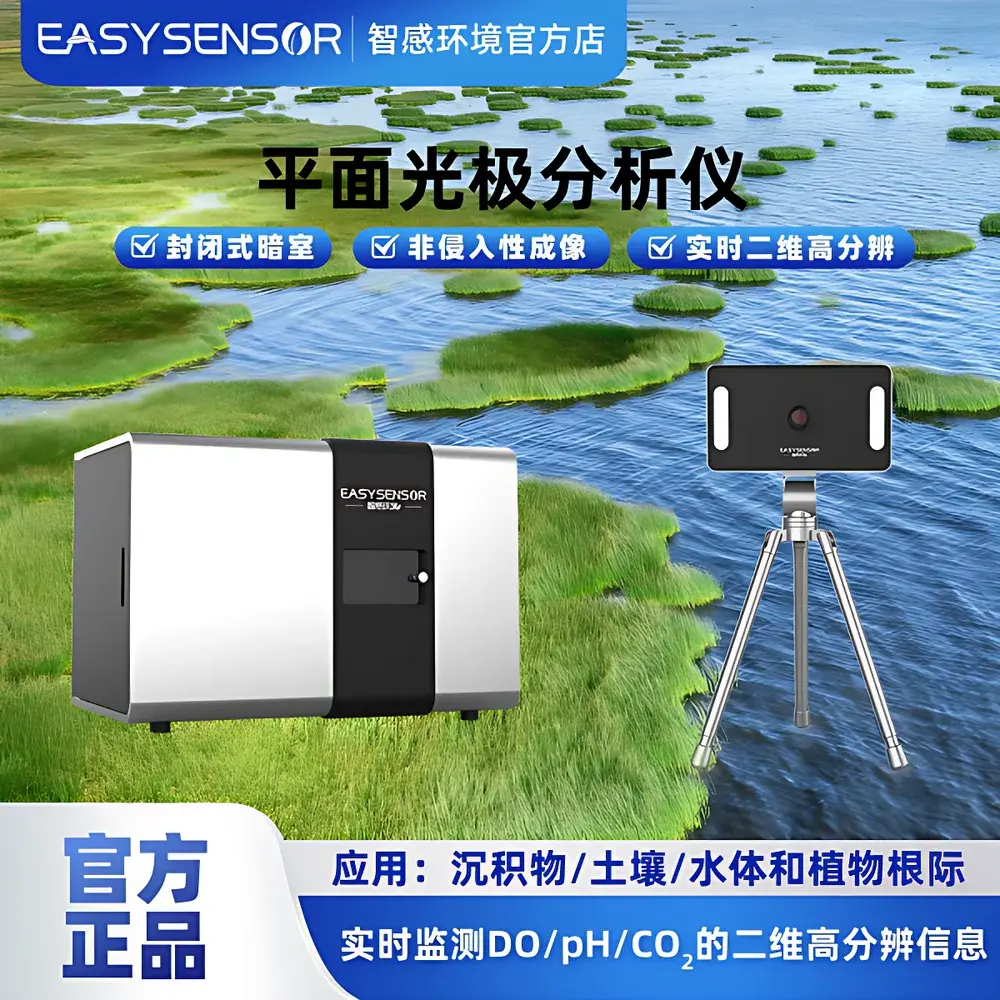
Easysensor Planar Optode Analyzer (Model 04)
| Brand | Easysensor |
|---|---|
| Origin | Jiangsu, China |
| Manufacturer Type | Authorized Distributor |
| Country of Origin | China |
| Model | Planar Optode Analyzer (04) |
| Price Range | USD 12,500 – 29,200 |
| Application Fields | Geoscience, Sedimentology, Soil Science, Rhizosphere Research |
| Imaging Resolution | 5472 × 3678 pixels |
| Camera Sensor | 20 MP color CCD |
| Spectral Sensitivity Range | 400–500 nm |
Overview
The Easysensor Planar Optode Analyzer (Model 04) is a dedicated optical imaging platform engineered for quantitative, two-dimensional mapping of dissolved oxygen (O₂), pH, and carbon dioxide (CO₂) in heterogeneous environmental matrices. It operates on the principle of planar optode sensing—where luminescent indicator dyes are immobilized within a gas-permeable polymer matrix to form thin-film optical sensors. Upon excitation by narrowband light (400–500 nm), these dyes exhibit intensity- or lifetime-based fluorescence responses modulated by local analyte concentration. A high-fidelity 20-megapixel color CCD camera captures spatially resolved emission signals under controlled dark-field conditions, enabling non-invasive, label-free, and calibration-referenced quantification across cm-scale sample surfaces. The system is designed for laboratory-based analysis of intact sediment cores, soil columns, rhizoboxes, and aquatic biofilms—supporting time-series monitoring with sub-millimeter spatial resolution and repeatable photometric reproducibility.
Key Features
- Sealed optical chamber with integrated LED excitation source and mechanical shutter—eliminates ambient light contamination and ensures measurement consistency.
- Non-destructive, contactless planar imaging—preserves sample integrity during repeated measurements of O₂, pH, and CO₂ gradients in sediments, soils, and root-soil interfaces.
- 20 MP color CCD sensor with native 5472 × 3678 pixel resolution—delivers high-fidelity spatial sampling without interpolation artifacts.
- Dedicated spectral window (400–500 nm) optimized for common ruthenium- and pyrene-based optode chemistries—ensures maximal signal-to-noise ratio for ratiometric or intensity-based quantification.
- Integrated lens-mount interface with standardized filter slots—supports interchangeable excitation/emission filters for multi-analyte sequential imaging (e.g., dual-wavelength pH sensing or O₂ lifetime referencing).
- Modular hardware architecture—enables straightforward maintenance, sensor film replacement, and future upgrade paths for advanced illumination control or synchronized environmental staging.
Sample Compatibility & Compliance
The analyzer accommodates standard cylindrical core tubes (up to Ø100 mm × 300 mm height), rectangular rhizoboxes (up to 200 × 150 mm viewing area), and Petri-dish–mounted optode films. Sample holders are compatible with temperature-controlled stages (external integration) and optional humidity regulation modules. All optical components comply with IEC 61000-6-3 (EMC emissions) and IEC 60529 IP20 enclosure standards. Data acquisition workflows support GLP-compliant metadata tagging—including timestamp, operator ID, sensor lot number, calibration date, and environmental chamber conditions—facilitating audit readiness per ISO/IEC 17025 and USP <1058> analytical instrument qualification guidelines.
Software & Data Management
The proprietary Easysensor OptoView Suite provides an integrated environment for sensor calibration, image acquisition, photometric correction, and quantitative mapping. Key modules include: (i) Auto-alignment and grid-based region-of-interest (ROI) definition; (ii) Ratiometric image processing using user-defined reference channels; (iii) Pixel-wise calibration curve application with uncertainty propagation; (iv) Export of calibrated concentration maps in GeoTIFF, HDF5, and CSV formats—with embedded coordinate metadata and SI-unit annotation. Software supports 21 CFR Part 11–compliant electronic signatures, audit trails, and role-based access control when deployed on Windows Server environments. Batch processing scripts (Python API available) enable reproducible pipeline execution across multi-experiment datasets.
Applications
This system is routinely deployed in biogeochemical research laboratories for: characterizing redox zonation in freshwater and marine sediments; quantifying oxygen dynamics around plant roots under varying nutrient or drought stress; mapping pH microgradients at mineral–water interfaces during weathering experiments; and assessing CO₂ flux heterogeneity in soil mesocosms. It supports method development aligned with ASTM D8227 (Standard Guide for Optical Sensor Use in Environmental Monitoring) and contributes directly to datasets used in reactive transport modeling (e.g., PHREEQC, CrunchFlow). Field-collected cores can be imaged post-sampling without sectioning—maintaining stratigraphic integrity and minimizing artefactual oxidation.
FAQ
What types of optode films are compatible with this system?
The analyzer supports commercially available planar optode membranes from PreSens, Ocean Insight, and custom-fabricated films adhering to standard thickness (20–50 µm) and substrate specifications (PET or glass slides).
Can the system perform lifetime-based O₂ measurements?
No—Model 04 is intensity-based and requires static or ratiometric calibration. Lifetime-resolved imaging requires pulsed excitation and time-gated detection, which is not implemented in this configuration.
Is remote operation supported?
Yes—via secure RDP or VNC over LAN; however, real-time video streaming is disabled during acquisition to prevent USB bandwidth contention with the CCD interface.
How is photobleaching mitigated during extended time-series experiments?
The software enforces minimum LED duty cycles, includes automatic exposure optimization per frame, and logs cumulative photon dose per pixel to flag potential degradation zones during post-processing.
Does the system meet CE or FCC certification requirements?
The analyzer carries CE marking under the EU Electromagnetic Compatibility Directive 2014/30/EU and RoHS 2011/65/EU. FCC verification is pending for North American distribution as of Q2 2024.





