
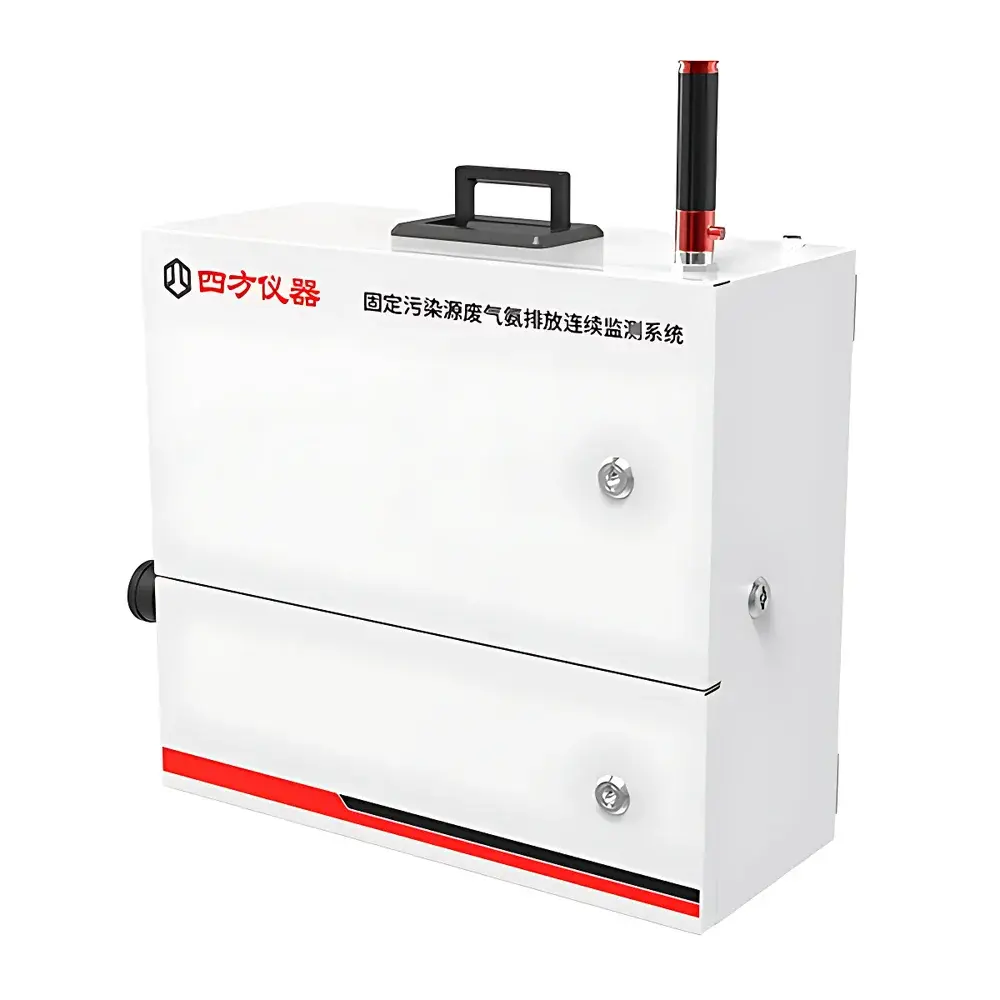
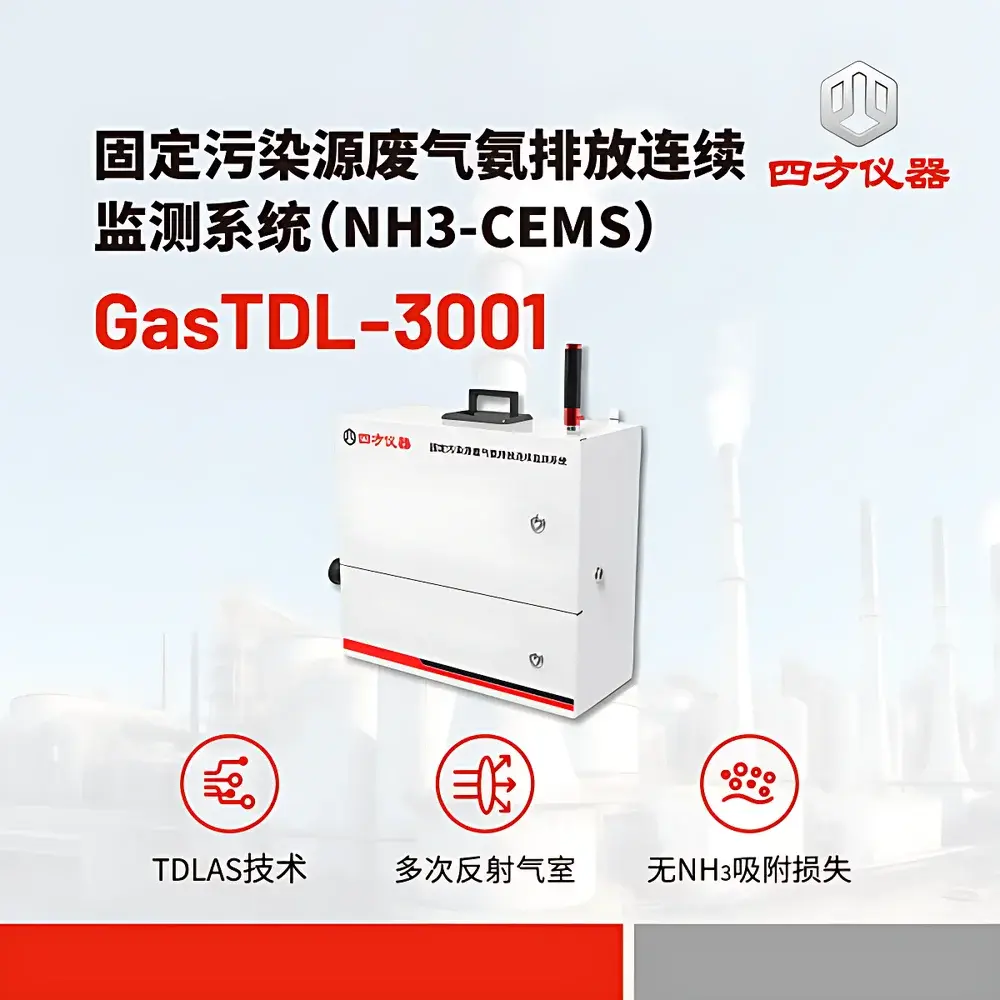
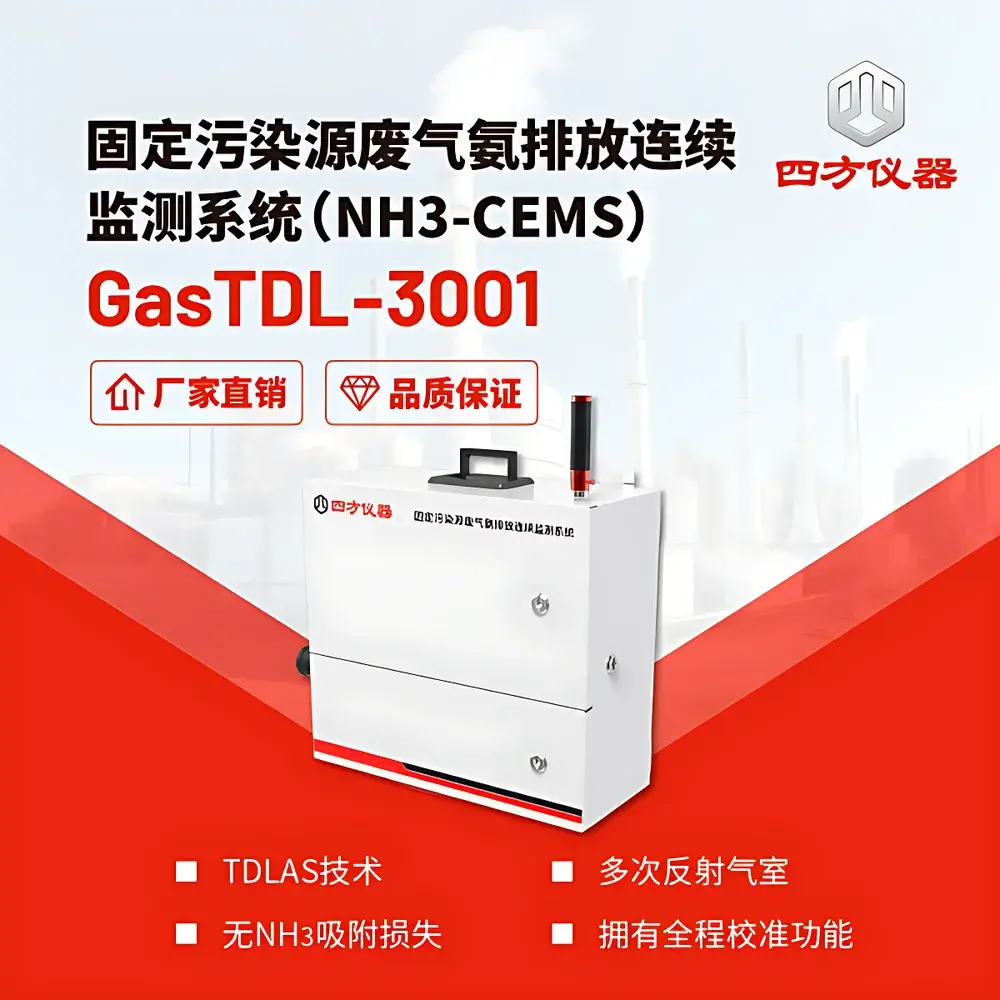
CUBIC INSTRUMENTS GasTDL-3001 Ammonia Slip Online Monitoring System for Steelmaking and Metallurgical SCR DeNOx Applications
| Brand | CUBIC INSTRUMENTS |
|---|---|
| Origin | Hubei, China |
| Model | GasTDL-3001 |
| Detection Principle | Tunable Diode Laser Absorption Spectroscopy (TDLAS) |
| Sampling Method | In-situ |
| Measurement Range | 0–10–100 ppm (selectable) |
| Accuracy | ±1% F.S. |
| Response Time (T90) | ≤30 s |
| Repeatability | ±1% |
| Operating Ambient Temperature | −30 to +60 °C |
| Resolution | 0.01 ppm |
| LOD | ±1% F.S. |
| IP Rating | IP65 |
| Power Supply | 220 VAC, 50 Hz, 800 W |
| Purge Gas | Compressed air, 0.4–0.8 MPa |
| Communication | 1× RS-232, 1× RS-485 |
| Analog Outputs | 4× 4–20 mA |
| Digital Outputs | 8× relay |
Overview
The CUBIC INSTRUMENTS GasTDL-3001 Ammonia Slip Online Monitoring System is an industrial-grade, in-situ gas analyzer engineered for continuous, real-time quantification of ammonia (NH₃) concentration downstream of selective catalytic reduction (SCR) systems in iron and steel metallurgical plants. It employs tunable diode laser absorption spectroscopy (TDLAS), a physics-based, line-of-sight optical technique that targets the fundamental rotational-vibrational absorption lines of NH₃ in the near-infrared spectral region (typically 1.5–2.0 µm). Unlike extractive NDIR or electrochemical sensors, TDLAS provides inherent selectivity—eliminating cross-sensitivity from CO₂, H₂O, SO₂, NOₓ, and particulate-laden flue gas matrices common in sintering, blast furnace, and coke oven exhaust streams. The system operates via direct optical path measurement across the duct, with no sample extraction, filtration, or conditioning required. Its optical head is mounted externally on the stack wall, minimizing maintenance while ensuring high signal-to-noise ratio and long-term stability under harsh thermal and mechanical conditions.
Key Features
- True in-situ TDLAS architecture—no sampling probe, no heated line, no condensation risk; eliminates NH₃ adsorption losses on stainless steel or PTFE surfaces
- Multi-pass optical cell integrated into the probe head enables effective path lengths >10 m, delivering sub-ppm detection limits (LOD: 0.01 ppm) and high sensitivity across three user-selectable ranges: 0–10 ppm, 0–50 ppm, and 0–100 ppm
- Full-path calibration capability using certified NH₃ reference gas at operating temperature and pressure—ensuring traceability to NIST-traceable standards and compliance with ISO 14064-3 verification requirements
- High-temperature optical interface (rated to 200 °C) and actively heated optical windows prevent dew formation and maintain spectral integrity in humid, high-dust environments
- Robust mechanical design with IP65-rated enclosure and vibration-damped mounting brackets suitable for installation on large-diameter ducts (≥1.2 m) in rolling mill and coking plant settings
- Integrated diagnostics including laser wavelength lock monitoring, beam alignment verification, and optical power decay tracking—supporting predictive maintenance and GLP-compliant instrument qualification
Sample Compatibility & Compliance
The GasTDL-3001 is validated for use in flue gas streams with dust loading up to 50 g/Nm³, moisture content ≤25 vol%, and temperatures ranging from 80 to 220 °C (flue gas side). It meets the functional requirements of EPA Method 320 and EN 15267-3 for automated emission monitoring systems (CEMS). Its measurement uncertainty profile aligns with EU BREF (Best Available Techniques Reference) documents for iron and steel production (ISB BREF, 2023), particularly Section 5.3.2 on NH₃ slip control in SCR units. The system supports audit-ready data logging compliant with 21 CFR Part 11 (electronic records & signatures) when paired with optional secure firmware and time-stamped event logs. All materials in optical contact—sapphire windows, gold-coated mirrors, and Inconel housings—are certified non-reactive toward NH₃ per ASTM G124.
Software & Data Management
The embedded Linux-based controller runs CUBIC’s proprietary TDLAS Engine v4.2 firmware, featuring real-time spectral fitting using Voigt line-shape modeling and polynomial baseline correction. Data acquisition occurs at 10 Hz, with second-level averaging applied for regulatory reporting intervals. The system provides dual communication protocols: Modbus RTU over RS-485 for integration into DCS/SCADA (e.g., Siemens PCS7, Honeywell Experion) and ASCII protocol over RS-232 for local configuration. Four isolated 4–20 mA analog outputs are configurable for NH₃ concentration, laser temperature, optical path loss, and system health status. Eight programmable relays support alarm staging (e.g., high-slip warning → SCR catalyst fault → shutdown interlock). Optional cloud gateway module enables encrypted MQTT transmission to central environmental data platforms (e.g., EnviroSuite, SGS EHS Cloud) with TLS 1.2 encryption and AES-256 payload protection.
Applications
- Continuous NH₃ slip monitoring at SCR reactor outlet in sinter plant flue gas treatment lines
- Real-time optimization of ammonia injection rate in coke oven gas denitrification systems
- Compliance verification against China’s GB 16297–1996 and EU IED Annex I (BAT conclusions for iron & steel)
- Performance validation of low-temperature SCR catalysts during commissioning and aging studies
- Source apportionment and fugitive emission mapping in multi-stack metallurgical complexes
- Integration with digital twin models of flue gas cleaning systems for predictive NH₃ dosing control
FAQ
How does the GasTDL-3001 handle high-dust environments without optical fouling?
The system uses forward-scatter compensation algorithms combined with periodic automatic window purge cycles triggered by optical transmission decay thresholds—no manual cleaning required within 6-month intervals under typical sinter plant conditions.
Can it be validated against reference methods per EN 14181?
Yes—the unit supports QAL1 (initial type approval), AST (annual surveillance test), and QAL3 (continuous performance verification) protocols with built-in zero/span check routines and documented uncertainty budgets.
Is the measurement affected by water vapor or CO₂ interference?
No—TDLAS operates on a single, narrow-linewidth laser tuned precisely to an isolated NH₃ absorption line (e.g., 6582.4 cm⁻¹), rendering it immune to broadband absorbers and overlapping molecular bands.
What is the minimum duct diameter for reliable installation?
The standard optical path configuration requires ≥1.0 m internal duct diameter; custom collimator optics are available for smaller ducts down to 0.6 m with path-length optimization.
Does the system support remote firmware updates and diagnostic telemetry?
Yes—via secure SSH tunnel or optional 4G LTE modem; all update packages are cryptographically signed and verified prior to installation.







