
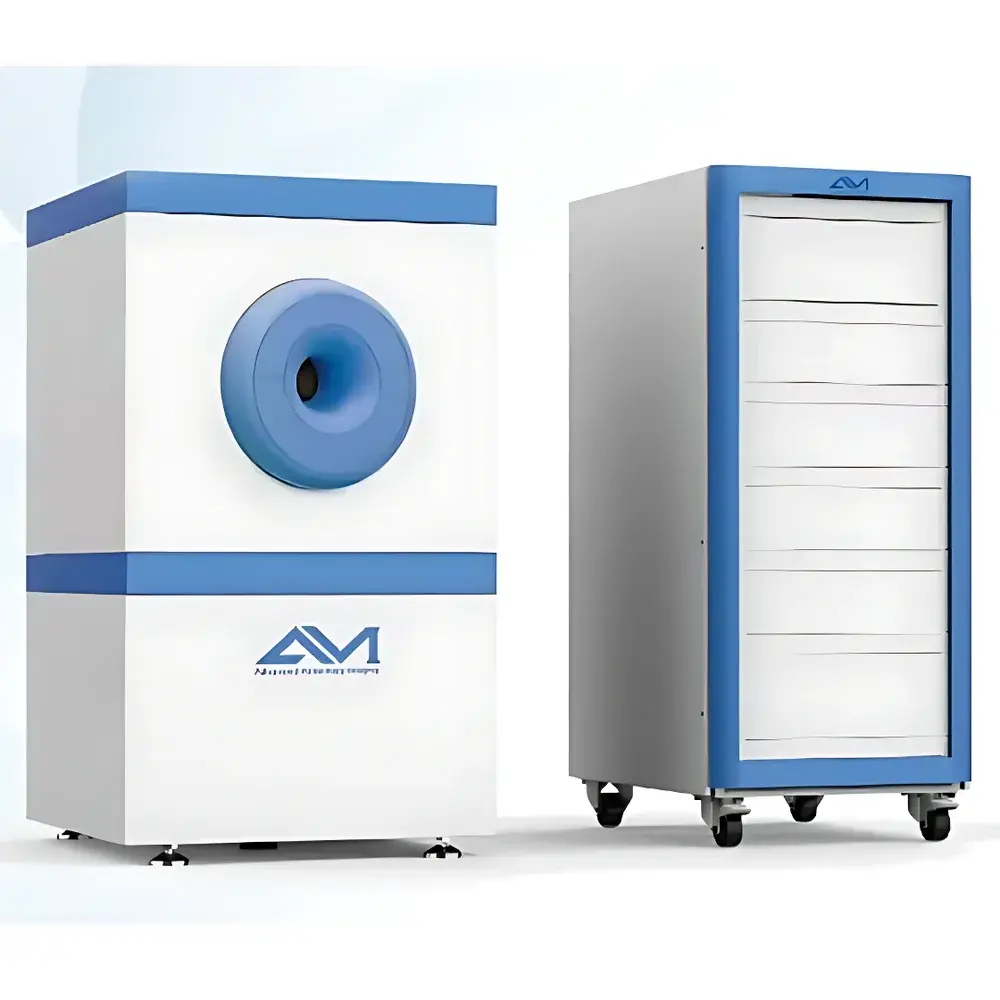
Magtech MT-MRI-20 Small Animal Preclinical MRI System
| Brand | Magtech |
|---|---|
| Origin | Beijing, China |
| Manufacturer Type | OEM Manufacturer |
| Instrument Type | Nuclear Magnetic Resonance Imaging System |
| Time Resolution | 20 ns |
| Field of View (FOV) | 60 mm × 60 mm |
| Model | MT-MRI-20 |
Overview
The Magtech MT-MRI-20 is a dedicated preclinical nuclear magnetic resonance imaging system engineered for high-fidelity, non-invasive structural and functional assessment of small animal models (e.g., mice, rats, rabbits) and soft biological specimens. Operating on the fundamental principles of pulsed NMR spectroscopy and spin-echo-based spatial encoding, the system delivers quantitative magnetic resonance data through precise control of RF excitation pulses, gradient field modulation, and coherent signal acquisition in the time domain. Its fully digital architecture—spanning RF pulse generation, gradient waveform synthesis, and quadrature detection—enables deterministic timing synchronization with sub-nanosecond jitter, supporting advanced sequence execution including multi-echo spin-echo (SE), inversion recovery (IR), gradient echo (GRE), and diffusion-weighted imaging (DWI). Designed for benchtop integration within biosafety level 2 (BSL-2) laboratories, the MT-MRI-20 features a permanent magnet configuration with homogeneous field strength optimized for 1H signal detection at low-field conditions (typical B₀ ≈ 0.5–1.0 T, depending on configuration), ensuring robust signal-to-noise ratio (SNR) for longitudinal in vivo studies without cryogenic infrastructure.
Key Features
- Fully digitized RF and gradient subsystems enabling reproducible pulse sequence implementation with 20 ns temporal resolution for precise T₂*, diffusion, and dynamic contrast-enhanced (DCE-MRI) acquisitions
- Adjustable field-of-view up to 60 mm × 60 mm with isotropic spatial resolution down to 100 µm (subject to sequence parameters and signal averaging)
- Integrated dual-channel RF receiver with phase-coherent quadrature detection and real-time digital signal processing (DSP)
- Dedicated software suite supporting automated shimming, B₁ mapping, and sequence parameter optimization for small-animal physiology
- Modular hardware design compliant with IEC 61000-6-3 (EMC) and IEC 61000-6-4 standards; magnet housing meets ISO 13485-aligned mechanical safety requirements
- Compatible with standard rodent anesthesia systems (isoflurane/O₂), physiological monitoring interfaces (respiratory gating, ECG leads), and temperature-regulated animal beds
Sample Compatibility & Compliance
The MT-MRI-20 accommodates live rodents (up to 500 g), excised organs (e.g., liver, brain, tumor xenografts), hydrogels, food matrices, and colloidal suspensions in standardized NMR tubes or custom-built imaging cradles. All imaging protocols adhere to the principles of the 3Rs (Replacement, Reduction, Refinement) and support Institutional Animal Care and Use Committee (IACUC)-approved study designs. Data acquisition workflows are compatible with GLP-compliant documentation practices, including electronic audit trails for sequence parameters, calibration logs, and operator authentication. While not FDA-cleared for human diagnostics, the system conforms to ASTM F2503-21 (Standard Practice for Labeling Medical Devices Using RFID Technology) for traceability and supports metadata embedding per DICOM-SR (Supplement 122) for structured reporting in preclinical repositories.
Software & Data Management
The proprietary Magtech MRI Studio software provides a unified interface for sequence programming (via Python-based scripting API), real-time image reconstruction (including parallel imaging acceleration), and quantitative parametric mapping (T₁, T₂, T₂*, ADC, MTR). Raw k-space data is stored in vendor-neutral HDF5 format with embedded NIfTI-compatible headers, enabling direct import into FSL, SPM, or AFNI for cross-platform analysis. The software enforces role-based access control (RBAC), encrypted local storage, and optional 21 CFR Part 11-compliant electronic signatures when configured with third-party validation packages. Batch processing pipelines support automated segmentation of tumor volumes, fat-water separation (IDEAL algorithm), and voxel-wise relaxation time inversion using non-negative least-squares (NNLS) regularization.
Applications
- In vivo longitudinal monitoring of orthotopic and subcutaneous tumor growth, angiogenesis, and treatment response in oncology models
- Quantitative hepatic steatosis grading via T₂*-corrected proton density fat fraction (PDFF) mapping
- Dynamic contrast-enhanced MRI for assessing vascular permeability and perfusion kinetics in targeted nanocarrier studies
- Diffusion tensor imaging (DTI) of white matter integrity in neurodegenerative disease models
- Time-resolved moisture migration profiling in cereal-based foods during drying, hydration, and thermal processing
- Relaxometry-based discrimination of water populations (bound, intermediate, free) in protein gels and plant tissues
- Oil/water phase distribution analysis in emulsions and fermented dairy products using chemical shift-selective (CHESS) suppression
- Surface area estimation of nanoparticle suspensions via transverse relaxation dispersion (R₂D) modeling
FAQ
What magnetic field strength does the MT-MRI-20 operate at?
The system utilizes a permanent magnet configuration with a nominal central field strength ranging from 0.5 T to 1.0 T, optimized for high SNR in ¹H imaging of biological tissues without liquid helium dependency.
Is the system capable of spectroscopic imaging (MRSI)?
Yes—single-voxel and chemical shift imaging (CSI) modes are supported, enabling spatially resolved acquisition of metabolite spectra (e.g., lactate, choline, NAA) with spectral bandwidths up to 5 kHz and digital filtering resolution of 0.5 Hz.
Can the MT-MRI-20 be integrated into existing laboratory LIMS or ELN platforms?
Via RESTful API and HL7/FHIR adapters, raw data and processed metrics can be exported to enterprise research informatics systems, including LabVantage, Benchling, and Dotmatics, with configurable metadata schemas.
Does the system meet electromagnetic compatibility requirements for installation in shared vivarium spaces?
Yes—the enclosure meets Class B emission limits per CISPR 32 and includes active shielding to suppress stray field leakage beyond 1 m, satisfying NIH and AAALAC facility guidelines for adjacent equipment operation.





