
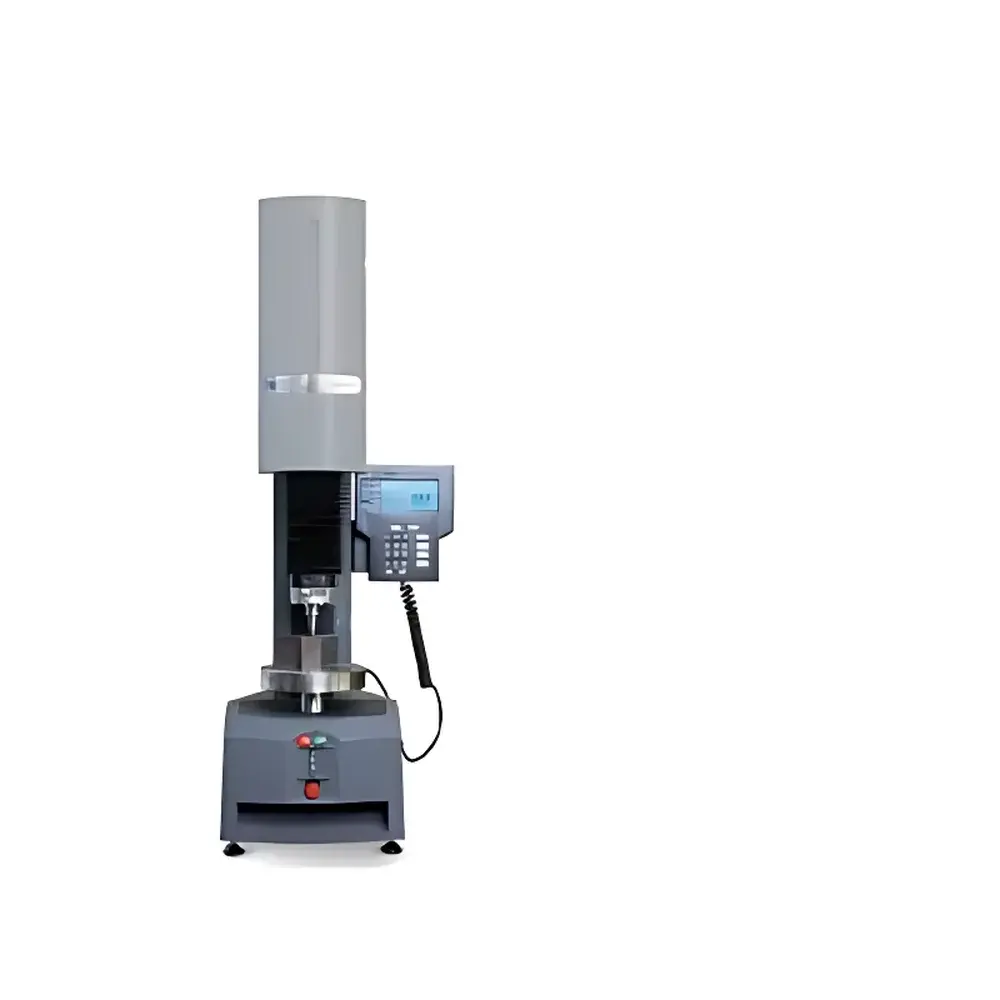
Wilson Rockwell® 2000 Advanced Hardness Tester
| Brand | Wilson Hardness |
|---|---|
| Origin | USA |
| Manufacturer Type | Original Equipment Manufacturer (OEM) |
| Product Category | Imported Instrument |
| Model | RB2000 |
| Instrument Type | Rockwell Hardness Tester |
| Test Force Control | Fully Automatic Closed-Loop Electromechanical Load System |
| Initial Test Force | 98.07 N (10 kgf) / 29.42 N (3 kgf) |
| Main Test Forces | 147.1–1471 N (15–150 kgf) |
| Indentation Depth Resolution | 0.1 HR or 0.01 HR (selectable) |
| Maximum Specimen Height | 153 mm (6 in), 255 mm (10 in), 355 mm (14 in) |
| Maximum Specimen Weight | 100 kg |
| Compliance Standards | ASTM E18, ASTM B254, ISO 6508-1, JIS Z2245, ASTM E140 |
| Illumination | Fiber-Optic Integrated Specimen Lighting |
| Test Cycle | Fully Automated (Load–Hold–Unload) with Adjustable Dwell Time (1–99 s) |
| Hardness Scales Supported | Regular Rockwell (A, B, C, D, E, F, G, H, K, L, M, P, R, S, V), Superficial Rockwell (15N, 30N, 45N |
Overview
The Wilson Rockwell® 2000 Advanced Hardness Tester is a fully automated, electromechanically controlled hardness measurement system engineered for precision, repeatability, and compliance in industrial metrology environments. It operates on the fundamental Rockwell principle—measuring the permanent depth deformation of a standardized indenter under defined major and minor loads—and integrates closed-loop force feedback control to ensure traceable, high-fidelity load application across all Rockwell and Superficial Rockwell scales. Unlike legacy mechanical or semi-automatic systems, the RB2000 employs a coaxial, high-resolution depth-sensing architecture that eliminates parallax error and mechanical hysteresis, delivering true depth resolution down to 0.01 HR units. Its design conforms to the metrological requirements of ASTM E18 (Standard Test Methods for Rockwell Hardness of Metallic Materials) and ISO 6508-1 (Metallic materials — Rockwell hardness test — Part 1: Test method), supporting both laboratory-grade calibration verification and production-floor quality assurance workflows.
Key Features
- Fully automatic closed-loop electromechanical loading system with real-time force monitoring and dynamic compensation for environmental drift or specimen deflection
- Coaxial depth measurement technology ensuring sub-micron positional accuracy at the indenter tip, independent of operator alignment or stage tilt
- Three configurable test height zones (153 mm / 255 mm / 355 mm) accommodating flat, cylindrical, and irregularly shaped specimens up to 100 kg
- Integrated fiber-optic illumination with adjustable intensity, optimized for visual verification of indentation location and surface condition prior to testing
- Intuitive LCD interface with programmable test methods, customizable dwell times (1–99 s), and one-touch cycle initiation for rapid throughput
- Multi-scale capability covering all standard Rockwell (A–V), Superficial Rockwell (N, T, W, X, Y series), and dual-scale configurations in a single platform
- Traceable force application calibrated per ASTM E4 and verified against NIST-traceable reference standards
Sample Compatibility & Compliance
The RB2000 supports a broad range of metallic and ceramic materials including carbon steels, alloy steels, stainless steels, aluminum alloys, copper-based alloys, titanium, hardmetals (e.g., tungsten carbide), and structural ceramics. Its modular anvil system accommodates flat plates, rods, tubes, gears, bearing races, and forged components with diameters from 1 mm to 350 mm. All hardness measurements are compliant with ASTM E18 (including verification of machine performance using certified reference blocks), ISO 6508-1 (with mandatory periodic verification per Annex B), JIS Z2245, and ASTM B254 (for electrodeposited coatings). The instrument’s audit trail functionality—when paired with optional GLP/GMP-compliant software—supports FDA 21 CFR Part 11 requirements for electronic records and signatures.
Software & Data Management
When connected to Wilson’s proprietary HardMetrix™ software suite (optional), the RB2000 enables full data traceability, statistical process control (SPC), and automated report generation. Raw depth displacement values, load-time curves, and hardness results are timestamped and stored with user ID, method parameters, and environmental metadata. Data export formats include CSV, PDF, and XML for integration into LIMS or MES platforms. The system supports configurable pass/fail limits, histogram visualization, Cp/Cpk calculation, and trend analysis across shifts or batches. All software modules undergo validation per IQ/OQ protocols and maintain revision-controlled change logs for regulatory audits.
Applications
The Wilson Rockwell® 2000 is deployed in mission-critical applications across aerospace component certification (e.g., turbine disk heat treatment verification per AMS 2242), automotive powertrain QA (crankshaft surface hardness mapping), metallurgical R&D (phase transformation studies in quenched-and-tempered steels), and supplier qualification programs governed by IATF 16949. It is routinely used for incoming material inspection of castings and forgings, post-heat-treatment verification of case-hardened gears, hardness profiling of welded joints, and routine QC in foundries and metalworking facilities. Its robust construction and thermal stability make it suitable for both climate-controlled laboratories and shop-floor environments with ambient temperature fluctuations between 10–35 °C.
FAQ
What Rockwell hardness scales does the RB2000 support?
It covers all standard Rockwell scales (A, B, C, D, E, F, G, H, K, L, M, P, R, S, V), Superficial Rockwell scales (15N/30N/45N, 15T/30T/45T, 15W/30W/45W, 15X/30X/45X, 15Y/30Y/45Y), and dual-scale configurations.
Is the instrument compliant with ISO/IEC 17025 requirements?
Yes—the RB2000 meets the metrological performance criteria outlined in ISO/IEC 17025:2017 Clause 6.4.3 for hardness testing equipment when operated within specified environmental conditions and maintained per Wilson’s calibration schedule.
Can the RB2000 be integrated into a factory automation system?
Yes—via RS-232, USB, or Ethernet interfaces, the instrument supports SCADA and PLC communication protocols (Modbus RTU/TCP) for automated job dispatching and result ingestion.
What is the recommended recalibration interval?
Wilson recommends annual verification against certified reference blocks per ASTM E18 Section 8, with intermediate daily verification using control samples prior to critical test runs.
Does the system support hardness conversion per ASTM E140?
Yes—HardMetrix™ software includes an embedded ASTM E140-22 conversion table with selectable material categories (steel, nonferrous, carbides) and uncertainty propagation modeling.



