
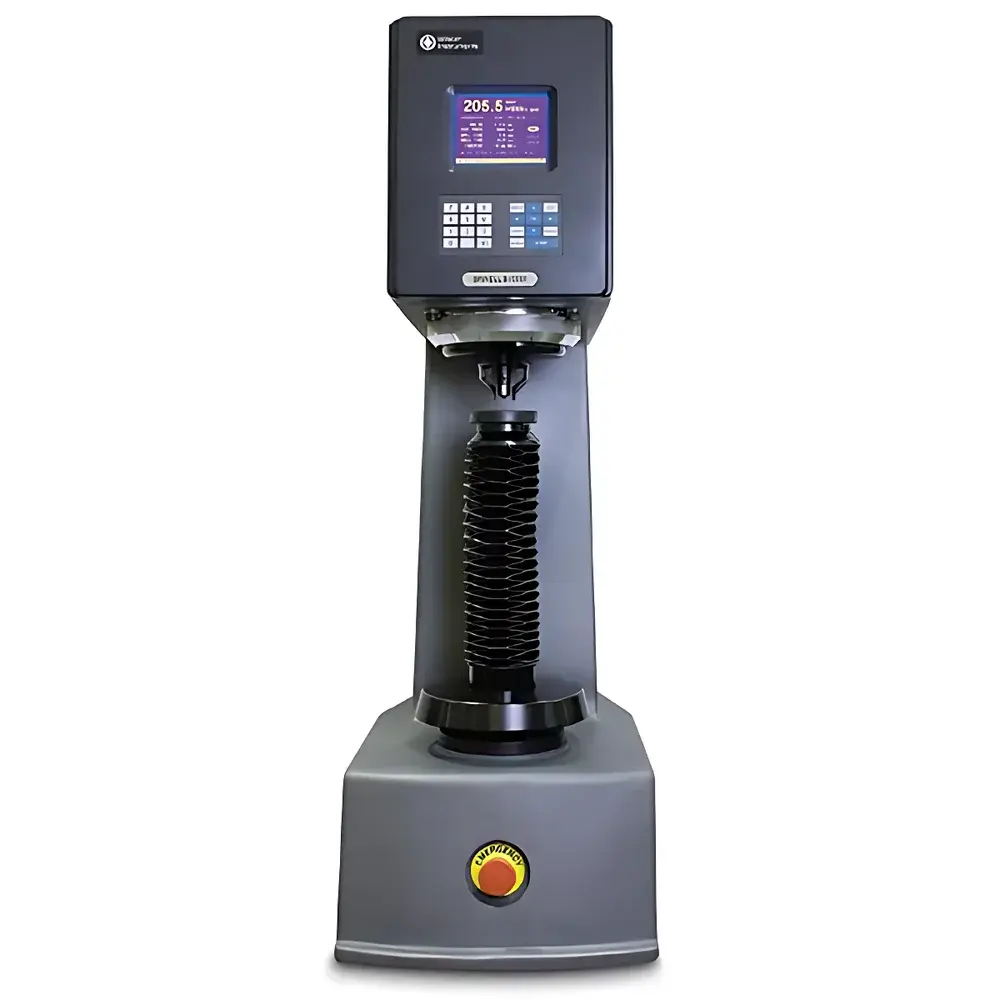
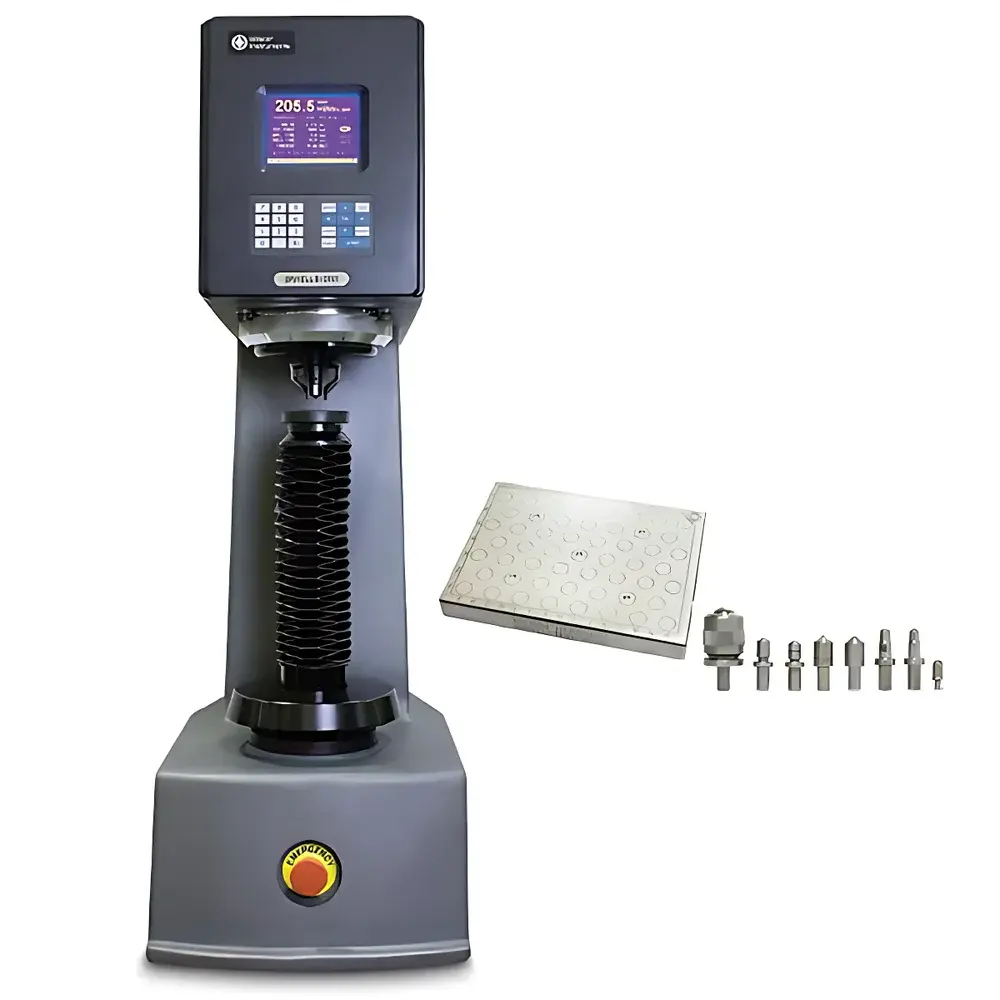
Wilson BH3000 Automatic Closed-Loop Brinell Hardness Tester
| Brand | Wilson Hardness |
|---|---|
| Origin | Shanghai, China |
| Manufacturer Type | OEM Manufacturer |
| Product Origin | Domestic (China) |
| Model | BH3000 |
| Price Range | USD 42,000 – 84,000 (FOB) |
| Instrument Type | Brinell Hardness Tester |
| Hardness Range | HBW 10–100 |
| Total Test Force | 62.5–3000 kgf |
| Test Space | 280 mm (H) × 130 mm (D) |
| Indenter Options | 2.5 mm, 5 mm, 10 mm tungsten carbide balls |
| Dwell Time | 2–99 s |
| Optical System | External digital measurement microscope (20×/40×/60× magnification |
| resolution | 12.5–50.0 µm |
| max measurable indentation diameter | 2–7 mm) |
| Display Resolution | 0.1 HBW (HBW < 100), 1.0 HBW (HBW ≥ 100) |
| Compliance | ISO 6506-1:2014, ASTM E10-23, JIS Z 2243:2019 |
| Data Interface | RS-232 serial port |
| Optional Output | Built-in thermal printer |
| Power Supply | 100–240 VAC, 50/60 Hz |
| Net Weight | 250 kg |
| Dimensions (W×D×H) | 265 × 608 × 1000 mm |
Overview
The Wilson BH3000 is a fully automated, closed-loop sensor-controlled Brinell hardness tester engineered for precision, repeatability, and long-term stability in industrial quality control and metallurgical laboratories. It operates on the fundamental Brinell principle—applying a precisely controlled spherical indenter (tungsten carbide ball) under standardized test force to produce a permanent impression on the specimen surface, with hardness calculated as the quotient of applied load divided by the spherical surface area of the indentation. Designed for high-volume production environments and R&D facilities alike, the BH3000 delivers traceable, metrologically sound results across a broad range of metallic materials—including cast iron, aluminum alloys, copper, brass, forgings, and heat-treated steels—where coarse microstructures or heterogeneous grain distributions make other hardness methods (e.g., Rockwell or Vickers) less representative.
Key Features
- Fully automatic closed-loop load control system ensures high fidelity force application and maintenance, minimizing drift and hysteresis across the full 62.5–3000 kgf range (including standard forces: 62.5, 187.5, 250, 500, 750, 1000, 1500, and 3000 kgf).
- Modular optical configuration with external digital measurement microscope—selectable magnifications of 20× (50.0 µm resolution, max 7 mm indentation), 40× (12.5 µm, max 4 mm), or 60× (12.5 µm, max 2 mm)—enabling accurate diagonal measurement per ISO 6506-2 requirements.
- Large backlit LCD interface displays real-time test parameters: applied force, dwell time, indenter type, measured indentation diameter, calculated HBW value, statistical summaries (mean, SD, CV%), and cross-standard conversions (e.g., HBW ↔ HRB, HRC, tensile strength).
- Rugged cast-iron frame and vibration-damped base support stable operation in non-climate-controlled shop-floor settings; maximum specimen height: 280 mm; throat depth: 130 mm from column centerline.
- Comprehensive indenter compatibility: interchangeable tungsten carbide balls (2.5 mm, 5 mm, 10 mm) compliant with ISO 6506-1 Annex A; supports all standard Brinell scales including HBW 10/3000, HBW 10/1500, HBW 5/750, HBW 2.5/187.5, etc.
- Configurable dwell time (2–99 s) and programmable test sequences for batch processing; built-in thermal printer or RS-232 interface for direct data export to LIMS or QA databases.
Sample Compatibility & Compliance
The BH3000 accommodates specimens up to 280 mm in height and 130 mm in depth at the column centerline, supporting large castings, billets, and structural components. Minimum cylindrical specimen diameter is 3 mm (0.12 in); surface roughness must not exceed Ra ≤ 21.6 µm (per ASTM E10 Section 7.2) to ensure indentation geometry integrity. All test protocols adhere strictly to ISO 6506-1:2014 (Metallic materials — Brinell hardness test — Part 1: Test method), ASTM E10-23 (Standard Test Method for Brinell Hardness of Metallic Materials), and JIS Z 2243:2019. Calibration verification follows ISO/IEC 17025 guidelines, and routine operator verification is supported via certified reference blocks traceable to NIST or PTB standards.
Software & Data Management
While the BH3000 operates via embedded firmware without PC dependency, its RS-232 interface enables seamless integration into enterprise QA systems. Exported data includes timestamp, operator ID (manually entered), test sequence number, raw indentation measurements (d₁, d₂), applied force, dwell time, HBW result, statistical deviation, and conversion values. The system supports audit-ready output for GLP/GMP environments—retaining full test history with no user-editable fields. Thermal printouts include machine ID, calibration due date, and compliance statement referencing applicable standards. No proprietary software installation is required; ASCII-formatted output is compatible with Excel, LabVIEW, and MES platforms.
Applications
- Foundry process validation: monitoring hardness uniformity across cast iron engine blocks, ductile iron pipe fittings, and aluminum die-cast housings.
- Forging and rolling mill QC: verifying post-heat-treatment hardness of carbon steel shafts, alloy steel flanges, and stainless steel billets.
- Raw material acceptance testing per ASTM A668 / ISO 4990 specifications for structural and pressure-vessel steels.
- Failure analysis labs: correlating Brinell hardness with tensile strength (via empirical HB↔UTS equations per ISO 6506-4) and microstructural evaluation.
- Third-party certification bodies performing accredited hardness testing under ISO/IEC 17025 scope.
FAQ
Does the BH3000 comply with FDA 21 CFR Part 11 requirements?
While the BH3000 itself does not implement electronic signatures or audit-trail encryption, its RS-232 data export supports integration with validated LIMS platforms that fulfill Part 11 requirements for electronic records and signatures.
Can the BH3000 perform hardness conversions automatically?
Yes—the instrument calculates and displays real-time conversions between Brinell (HBW), Rockwell B/C, superficial Rockwell, and estimated tensile strength based on ISO 6506-4 and ASTM E140 annexes.
Is calibration verification required before each test series?
No—but daily verification using certified reference hardness blocks (e.g., NIST SRM 2820) is recommended per ASTM E10 Section 10 and ISO 6506-1 Clause 8.2 to confirm system performance.
What maintenance intervals are specified for the closed-loop load cell?
Wilson recommends annual recalibration of the load cell and optical measurement system by an ISO/IEC 17025-accredited service provider; preventive maintenance (lubrication, mechanical alignment check) every 6 months under continuous operation.
Is the external microscope included or optional?
The digital measurement microscope is optional but required for compliant Brinell testing; Wilson offers calibrated 20×, 40×, and 60× models with stage micrometers and NIST-traceable certificates.



