
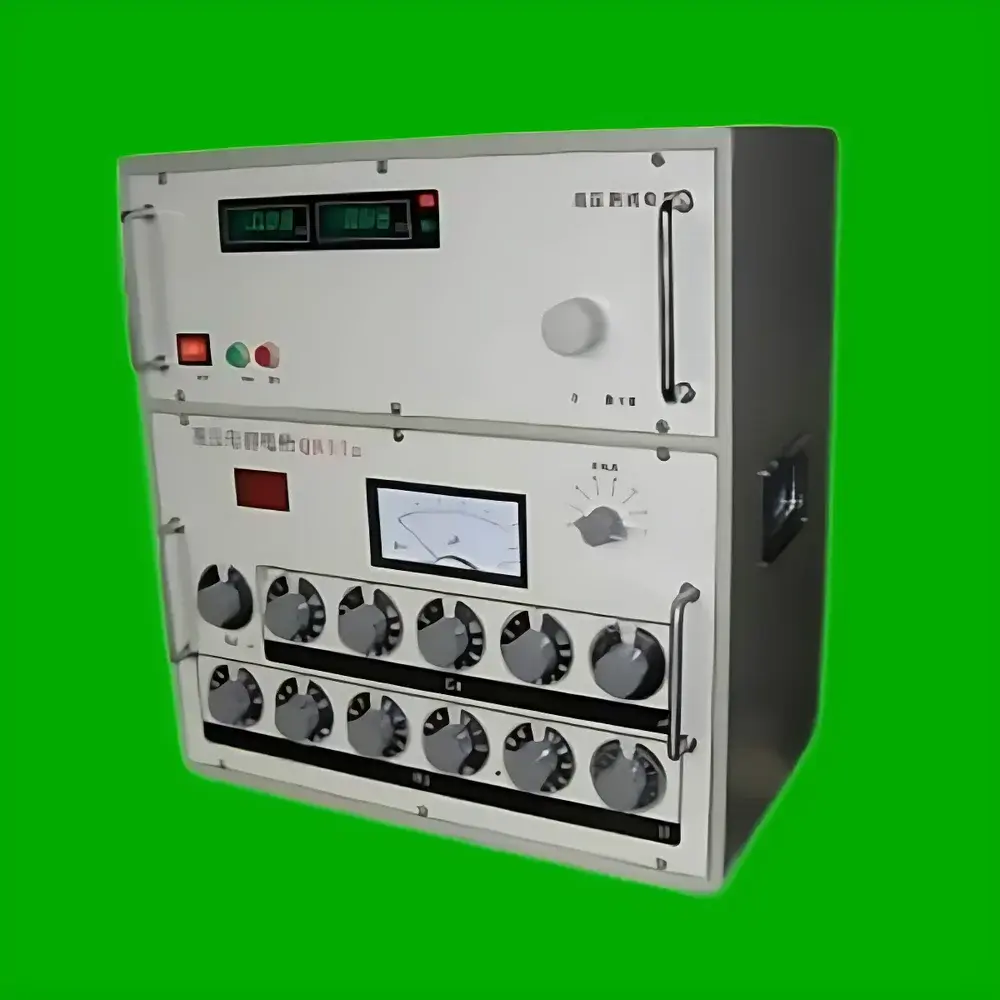
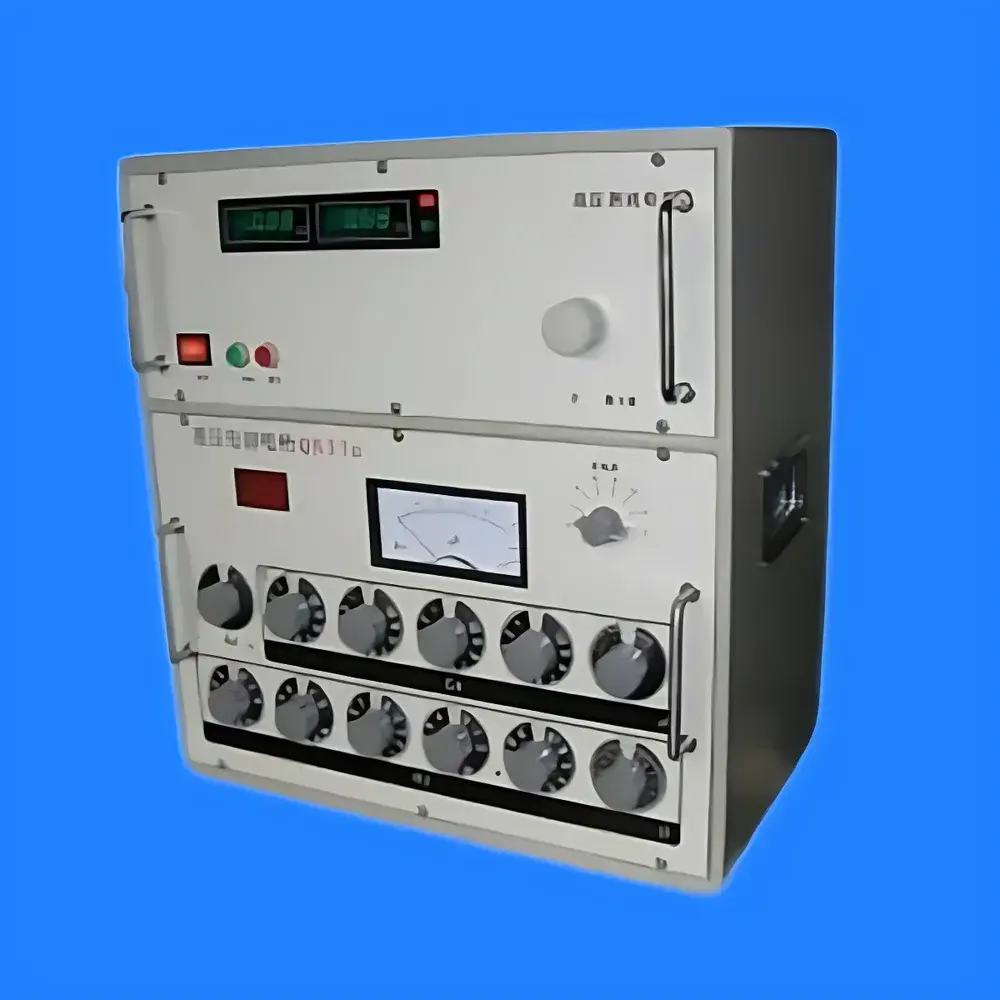
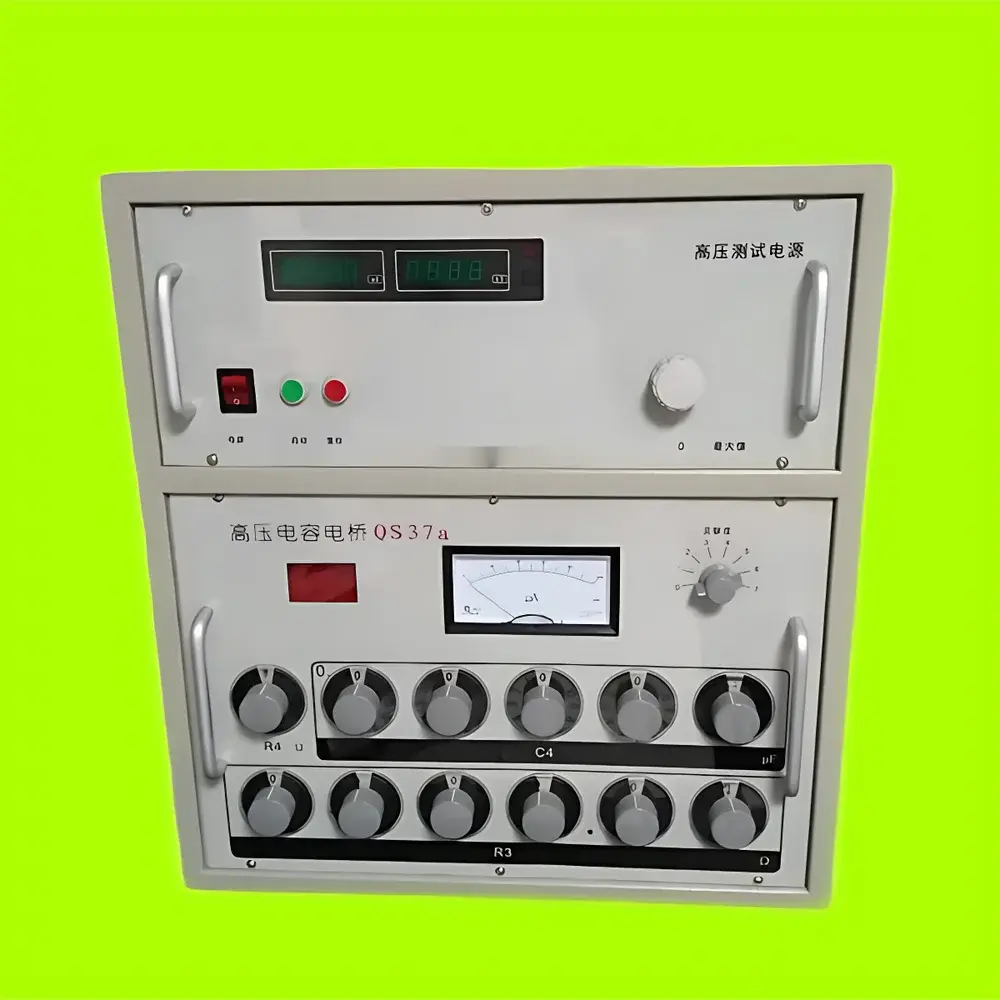
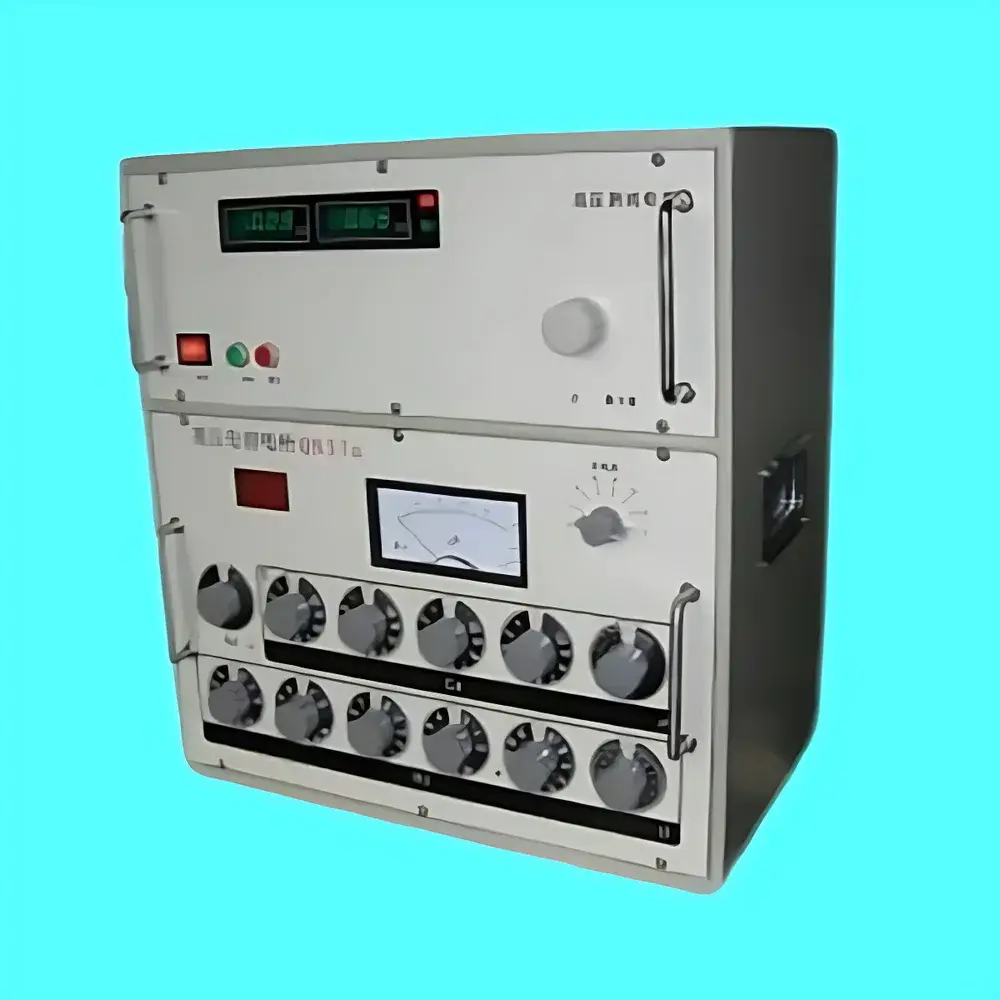
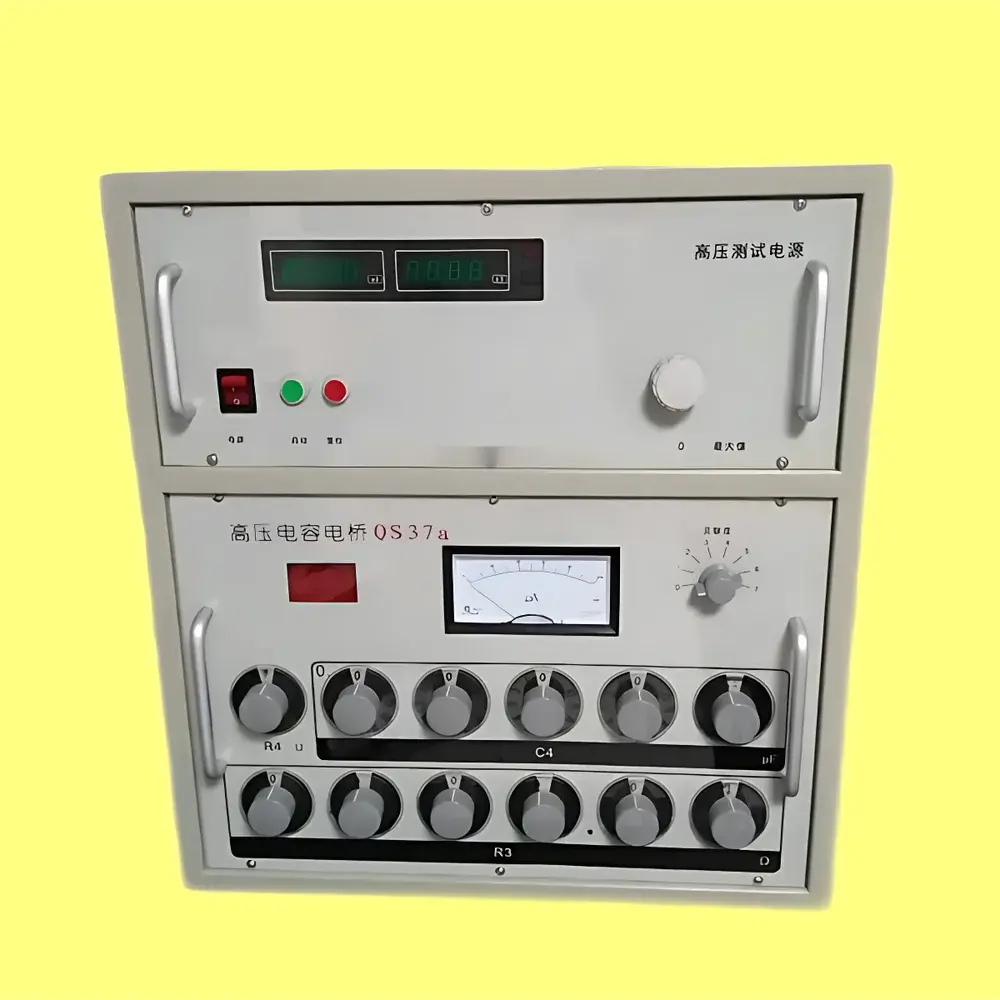
Red Sun HRQS-37A High-Voltage Capacitance Bridge & Dielectric Constant / Dissipation Factor Analyzer
| Brand | Red Sun Instrument |
|---|---|
| Model | HRQS-37A |
| Measurement Principle | Schering Bridge (High-Voltage AC Null Detection) |
| Frequency | 50 Hz / 60 Hz (Power Frequency), Optional 100 Hz–10 kHz Range |
| Test Voltage | Up to 2.5 kV AC (RMS), Adjustable |
| Capacitance Range | 1 pF – 25 µF |
| Dissipation Factor (tan δ) Range | 0 – 1 |
| tan δ Accuracy | ±1.5% of reading ±0.0001 |
| Relative Permittivity (εᵣ) Resolution | 0.01 |
| εᵣ Accuracy | Derived from Cₓ/Cₙ with calibrated standard capacitor (Cₙ = 100 pF) |
| Temperature Control | Dual-zone PID-controlled heating (inner/outer chambers), simultaneous internal/external temperature monitoring |
| Compliance | ASTM D150-11, GB/T 1409-2006, GB/T 1693-2007, GB/T 5594.4-2015 |
| Data Output | Analog voltage signals + RS232 interface |
| Operating Environment | 20 ± 5 °C, 30–80% RH |
Overview
The Red Sun HRQS-37A High-Voltage Capacitance Bridge & Dielectric Constant / Dissipation Factor Analyzer is a precision laboratory instrument engineered for the standardized determination of complex permittivity and dielectric loss in solid and liquid insulating materials. It operates on the classical Schering bridge principle—a four-arm AC null-balancing method—where the unknown specimen capacitance (Cₓ) and its associated series or parallel loss component (represented by tan δ) are compared against a high-stability reference capacitor (Cₙ) under controlled sinusoidal excitation at power frequency (50/60 Hz) or extended audio-frequency ranges (100 Hz–10 kHz, optional configuration). The system employs high-voltage AC excitation up to 2.5 kV RMS, enabling evaluation of dielectric behavior under service-relevant electrical stress conditions. Designed for metrological traceability, the HRQS-37A integrates dual independent PID-controlled thermal zones with real-time internal/external temperature feedback, minimizing thermal drift and ensuring measurement stability across extended test cycles—critical for evaluating temperature-dependent polarization mechanisms in polymers, ceramics, transformer oils, and composite laminates.
Key Features
- High-voltage Schering bridge architecture with automatic null detection and manual fine-tuning capability for maximum measurement repeatability.
- Dual-zone thermal management system: Separate microprocessor-controlled heating circuits regulate inner chamber (specimen zone) and outer jacket temperatures independently, each monitored via calibrated Pt100 sensors.
- PID-fuzzy logic temperature regulation compensates for line voltage fluctuations and ambient thermal transients, maintaining ±0.3 °C stability over 24-hour operation.
- Four-decade capacitance measurement range (1 pF–25 µF) with selectable reference standards (Cₙ = 100 pF or 318.3 Ω/3183.2 Ω impedance scaling) to optimize signal-to-noise ratio for low-loss (<0.001) or high-loss (>0.1) materials.
- Direct tan δ readout with 4-digit resolution (0.0001), validated per ASTM D150-11 Annex A2 for uncertainty budgeting in quality control laboratories.
- Integrated Q-factor measurement mode (Q = 1/tan δ) with auto-ranging across five fixed scales (30, 100, 300, 1000) or fully automatic selection based on bridge balance condition.
- Calibration traceable to national standards; includes factory certificate of conformance with as-tested accuracy data for Cₓ and tan δ at multiple points.
Sample Compatibility & Compliance
The HRQS-37A accommodates flat-plate, coaxial, and guarded-electrode configurations per IEC 60250 and ASTM D150. Compatible specimen geometries include discs (10–100 mm diameter, 0.5–10 mm thickness), cast films, impregnated paper, and fluid cells (for transformer oil or silicone dielectrics). Electrode systems support both unguarded (two-terminal) and guarded (three-terminal) arrangements to eliminate surface leakage errors in high-resistivity materials. All measurement protocols adhere strictly to regulatory frameworks governing electrical insulation qualification: ASTM D150-11 (ac loss and permittivity), GB/T 1409-2006 (frequency-swept dielectric spectroscopy), GB/T 1693-2007 (vulcanized rubber), and GB/T 5594.4-2015 (electronic structural ceramics). The instrument’s mechanical design and grounding architecture meet IEC 61010-1 safety requirements for Class II protected high-voltage equipment.
Software & Data Management
While the HRQS-37A operates as a stand-alone analog bridge, it provides RS232 serial output compliant with EIA/TIA-232-E for integration into LIMS or custom QA/QC software environments. Raw bridge balance parameters (R₃, C₄, phase angle) and derived values (εᵣ, tan δ, Q) are transmitted in ASCII format with timestamp and operator ID fields. Optional PC-based acquisition software supports automated sequence execution (e.g., temperature-ramped dielectric profiling), statistical process control (SPC) charting per ISO 22514, and audit-trail logging aligned with FDA 21 CFR Part 11 requirements when deployed in GMP-regulated settings. Calibration history, environmental logs, and measurement metadata are stored in encrypted binary files with SHA-256 checksum validation.
Applications
- Quality assurance of high-voltage insulation systems: transformer winding papers, bushing composites, cable jackets, and SF₆ gas barriers.
- Development and screening of polymer dielectrics for capacitors, printed circuit board substrates (e.g., FR-4, polyimide), and piezoelectric ceramics.
- Accelerated aging studies correlating tan δ increase with oxidation, hydrolysis, or partial discharge damage in epoxy resins and silicone elastomers.
- Batch release testing of dielectric fluids per IEEE C57.106 for power transformers.
- Academic research on dipole relaxation dynamics in ferroelectric thin films and nanocomposite dielectrics using variable-temperature, multi-frequency protocols.
FAQ
What voltage levels can the HRQS-37A apply during measurement?
The instrument delivers adjustable AC test voltages from 100 V to 2.5 kV RMS at 50/60 Hz, with built-in overvoltage protection and interlocked HV enclosure doors meeting IEC 61010-1.
Is the system compatible with ASTM D150-compliant electrode fixtures?
Yes—the base unit accepts standard ASTM D150 three-terminal guarded electrodes (e.g., 50-mm-diameter brass plates with guard ring) and supports optional coaxial fluid cells for liquid dielectric testing.
How is temperature uniformity verified across the sample chamber?
Dual Pt100 sensors (one embedded in the specimen holder, one in the outer thermal jacket) feed real-time data to independent PID controllers; uniformity is validated to ±0.5 °C over a 50 mm × 50 mm area using NIST-traceable thermographic mapping.
Can the HRQS-37A measure materials with very low loss (tan δ < 0.0005)?
Yes—when configured with Cₙ = 100 pF and R₄ = 3183.2 Ω, the system achieves a minimum detectable tan δ of 0.0001 with ±0.0001 absolute error, satisfying requirements for ultra-low-loss quartz and sapphire calibration standards.
Does the instrument support GLP-compliant data archiving?
When paired with the optional software suite, all measurements include electronic signatures, immutable timestamps, calibration status flags, and revision-controlled report templates—fully compliant with GLP Annex 11 and ISO/IEC 17025 documentation requirements.



