
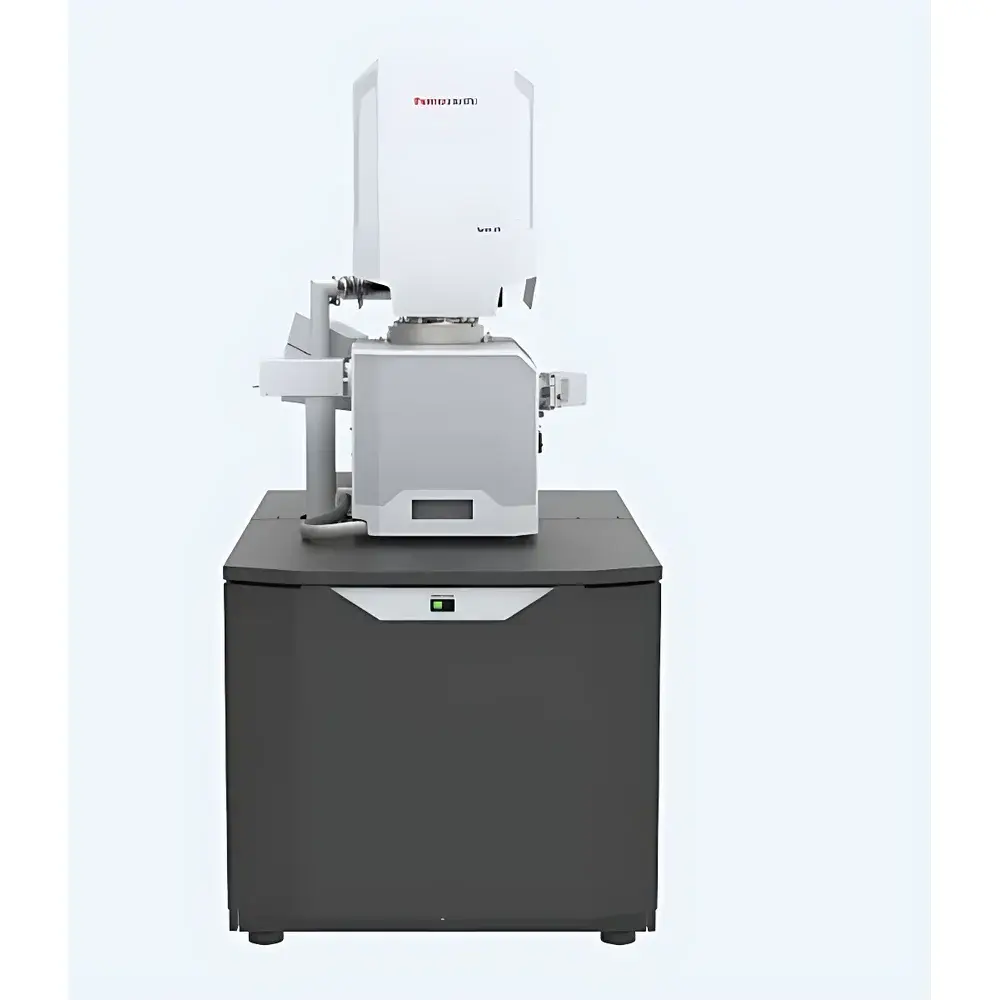
Thermo Fisher Scientific Apreo Field Emission Scanning Electron Microscope
| Brand | Thermo Fisher Scientific |
|---|---|
| Origin | Guangdong, China |
| Manufacturer Type | Original Equipment Manufacturer (OEM) |
| Regional Classification | Domestic Production |
| Model | Apreo |
| Instrument Type | Floor-Model High-Performance SEM |
| Electron Gun Type | Cold Field Emission (CFEG) |
| Microscope Class | Ultra-High-Resolution Field-Emission SEM |
| Secondary Electron Resolution | 1.0 nm at 1 kV (in-lens detection, no beam deceleration or monochromator) |
| Accelerating Voltage Range | 200 V – 30 kV |
| Backscattered Electron Resolution | ≤1.5 nm at 30 kV (T1 in-lens BSE detector) |
| Chamber Configuration | Triple EDS/WDS port capability |
| Vacuum System | Dual-mode (High Vacuum & Variable Pressure up to 500 Pa) |
| Software Platform | xT User Interface with SmartSCAN™, Drift Compensation Frame Integration (DCFI), and Charge Filtering Algorithms |
Overview
The Thermo Fisher Scientific Apreo Field Emission Scanning Electron Microscope (FE-SEM) is an engineered platform for ultra-high-resolution imaging and multi-modal characterization of nanoscale materials. Built upon a proprietary electrostatic-magnetic hybrid final lens architecture—first introduced by FEI and now refined under Thermo Fisher’s instrumentation leadership—the Apreo delivers exceptional signal collection efficiency, material contrast fidelity, and operational flexibility across demanding application domains. Unlike conventional SEMs relying solely on magnetic immersion or electrostatic lenses, the Apreo integrates both technologies into a single compound objective lens. This design enables sub-nanometer probe formation at low accelerating voltages (down to 200 V), minimizes spherical and chromatic aberrations, and enhances electron trajectory control within the lens bore. As a result, the system achieves 1.0 nm secondary electron resolution at 1 kV without beam deceleration or monochromation—meeting the performance expectations of advanced materials science, catalysis research, semiconductor metrology, and life sciences applications requiring high surface sensitivity and minimal sample damage.
Key Features
- Hybrid Electrostatic–Magnetic Final Lens: Combines electrostatic focusing with magnetic immersion to optimize probe convergence, signal yield, and depth of field—particularly critical for low-kV imaging of beam-sensitive or insulating specimens.
- In-Lens T1 Backscattered Electron Detector: Positioned directly above the sample, this solid-state detector captures >85% of backscattered electrons with high angular selectivity, enabling rapid acquisition of compositional contrast even at picoampere beam currents.
- Energy-Selective Signal Filtering: Integrated electrostatic filtering within the final lens allows voltage-contrast suppression, topographic enhancement, and charge-neutralized imaging of non-conductive samples without coating.
- Multi-Detector Compatibility: Supports simultaneous operation of directional backscattered (DBS), STEM-in-SEM (STEM 3+), and gas secondary electron (GAD) detectors—all software-synchronized via the xT interface for correlative signal acquisition.
- Triple-Port Analytical Chamber: Accommodates up to three independent EDS and/or WDS ports, enabling concurrent energy-dispersive X-ray spectroscopy (EDS), wavelength-dispersive spectroscopy (WDS), electron backscatter diffraction (EBSD), transmission Kikuchi diffraction (TKD), cathodoluminescence (CL), and Raman integration—with cryo-ready configurations available.
- Adaptive Vacuum Architecture: Features a field-proven in-column differential pumping system supporting both high-vacuum (<1×10⁻⁷ mbar) and variable-pressure modes (up to 500 Pa), with dedicated low-vacuum detectors for charge mitigation on polymers, biological tissues, and geological specimens.
Sample Compatibility & Compliance
The Apreo is validated for use with a broad spectrum of specimen types—including magnetic alloys, nanoparticle catalysts, battery electrode composites, semiconductor wafers, freeze-fractured biological sections, and uncoated ceramic powders. Its charge management suite—comprising SmartSCAN™ line-scan optimization, drift-compensated frame integration (DCFI), and real-time electrostatic charge filtering—is compliant with GLP and GMP workflows requiring traceable image acquisition parameters. The instrument supports ASTM E1558 (SEM image quality assessment), ISO 16700 (electron probe microanalysis), and USP (microscopic evaluation of pharmaceutical particulates). All detector calibrations, stage movements, and vacuum logs are timestamped and audit-trail enabled per FDA 21 CFR Part 11 requirements when operated with Thermo Fisher’s optional Compliance Package.
Software & Data Management
Controlled through the intuitive xT user interface, the Apreo provides role-based access levels, customizable workflow templates, and scriptable automation for repetitive tasks such as particle analysis, grain boundary mapping, or multi-region EDS surveying. Image metadata—including kV, probe current, dwell time, working distance, lens mode, and detector configuration—is embedded in TIFF/DM3 formats and exportable in FAIR-compliant JSON-LD schemas. Raw data streams from all detectors can be routed to external storage arrays or integrated with Thermo Fisher’s Connect platform for centralized instrument monitoring, remote diagnostics, and AI-assisted feature recognition (e.g., nanoparticle size distribution modeling using trained CNN models). Software updates follow IEC 62304 Class B medical device standards for safety-critical firmware revisions.
Applications
- Nanoscale catalyst morphology and dispersion analysis in fuel cell electrodes
- Sub-10 nm defect inspection and overlay metrology in advanced logic node fabrication
- 3D reconstruction of porous battery cathodes via serial sectioning (FIB-SEM)
- Phase identification and crystallographic orientation mapping in multiphase metallic alloys
- Uncoated polymer blend morphology characterization under low-kV, charge-free conditions
- Correlative CL–EBSD–EDS studies of quantum dot heterostructures
- High-throughput nanoparticle sizing and agglomeration state quantification in pharmaceutical suspensions
FAQ
What is the minimum accelerating voltage supported by the Apreo?
The Apreo operates down to 200 V, enabling high-resolution imaging of beam-sensitive organic and biological specimens with minimized charging and knock-on damage.
Does the Apreo support automated EDS mapping with spatial registration to SE/BSE images?
Yes—xT software synchronizes EDS pixel acquisition with stage positioning and detector signals, delivering fully registered spectral maps with sub-50 nm spatial correlation accuracy.
Can the Apreo perform EBSD analysis on magnetic samples without compromising resolution?
Yes—the hybrid lens design maintains optimal probe stability during EBSD pattern acquisition, and the system includes magnetic shielding options for ferromagnetic specimens.
Is remote operation supported for multi-user lab environments?
Yes—via Thermo Fisher Connect, users can initiate acquisitions, monitor vacuum status, review queued jobs, and retrieve processed data from any authorized network endpoint.
What vacuum level is required for high-resolution STEM-in-SEM imaging?
STEM 3+ operation requires high-vacuum conditions (<5×10⁻⁶ mbar) in both gun and column chambers, maintained automatically through interlocked pressure regulation and ion pump sequencing.



