
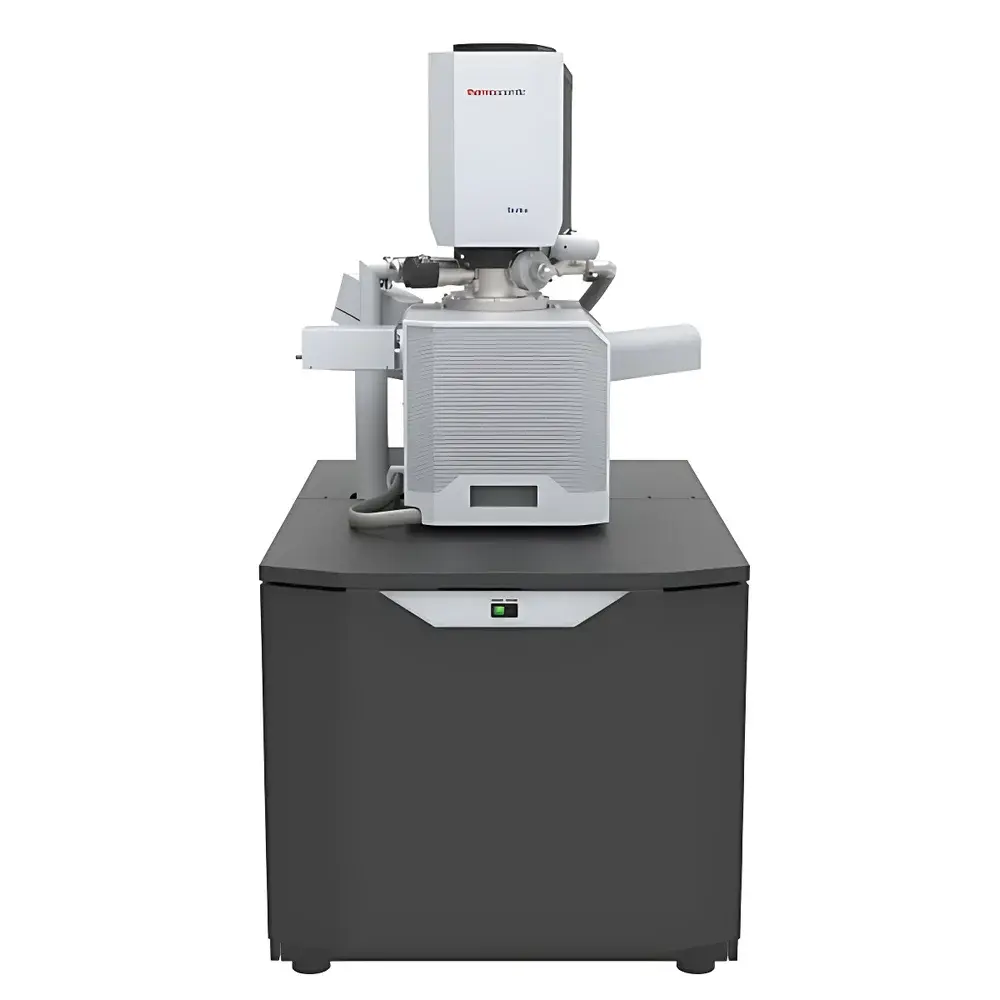
Thermo Fisher Scientific Quattro Scanning Electron Microscope
| Brand | Thermo Fisher Scientific |
|---|---|
| Origin | Netherlands |
| Manufacturer | Thermo Fisher Scientific |
| Import Status | Imported |
| Model | Quattro |
| Configuration | Floor-standing (Conventional High-Performance SEM) |
| Electron Source | Cold Field Emission Gun (CFEG) |
| Vacuum Modes | High Vacuum / Low Vacuum / Environmental SEM (ESEM™) |
| Detector Compatibility | In-lens SE, Solid-state BSE, STEM-in-SEM, Cathodoluminescence (CL), EDS (up to 3 detectors), EBSD, WDS |
| Stage | Motorized 5-axis eucentric stage with ±105° tilt |
| Temperature Range (In-situ) | –165°C to 1400°C (with optional cryo/thermal stages) |
| Software Platform | Thermo Scientific™ Avizo™-integrated SmartSEM™ with Python-based AutoScript API |
| Compliance | Designed for GLP/GMP environments |
Overview
The Thermo Fisher Scientific Quattro Scanning Electron Microscope is a high-performance, field-emission scanning electron microscope engineered for advanced materials characterization across diverse scientific and industrial domains. Built upon cold field emission gun (CFEG) technology, the Quattro delivers exceptional beam brightness, energy stability, and sub-nanometer spatial resolution—enabling high-fidelity imaging and quantitative microanalysis under variable pressure and environmental conditions. Its defining capability lies in the integration of Environmental SEM (ESEM™) technology, which allows direct observation of uncoated, insulating, hydrated, or volatile specimens without conventional metal sputter coating or extensive drying protocols. This eliminates artifacts introduced by sample preparation while preserving native morphology and chemical state. The instrument operates across three distinct vacuum regimes—high vacuum (HV), low vacuum (LV), and ESEM—each optimized for specific specimen classes and analytical modalities. Its modular chamber design accommodates simultaneous multi-detector acquisition, supporting correlative structural, compositional, and crystallographic analysis within a single experimental session.
Key Features
- Cold field emission electron source ensuring long-term beam stability, high current density, and <1 nm resolution at 1 kV (in-lens SE mode)
- Tri-mode vacuum architecture: high vacuum (≤1×10⁻⁷ mbar), low vacuum (1–130 Pa), and ESEM™ (up to 2600 Pa water vapor), enabling analysis of beam-sensitive, non-conductive, or hydrated samples
- Multi-detector synchronization: real-time concurrent acquisition of secondary electron (SE), backscattered electron (BSE), STEM-in-SEM, and cathodoluminescence (CL) signals using retractable or fixed-position detectors
- Advanced analytical chamber with up to three EDS detector ports (two positioned 180° apart), co-planar EDS/EBSD configuration, and optional wavelength-dispersive spectrometer (WDS) integration
- Eucentric 5-axis motorized stage with ±105° tilt range, precise navigation, and full geometric correction for accurate tomography and orientation mapping
- In-situ thermal and cryogenic capabilities: compatible with liquid nitrogen-cooled stages (–165°C), Peltier stages, and high-vacuum hot stages (up to 1400°C or 1100°C depending on configuration)
- SmartSEM™ software with context-aware user guidance, one-click workflow automation, and full “Undo” functionality to reduce operator dependency and accelerate method development
Sample Compatibility & Compliance
The Quattro accommodates an exceptionally broad spectrum of specimens—including biological tissues, polymers, ceramics, geological sections, battery electrodes, catalysts, and semiconductor devices—without mandatory conductive coating. Its differential pumping system maintains optimal column vacuum while permitting elevated partial pressures in the sample chamber, enabling stable EDS and EBSD acquisition even under low-vacuum or ESEM conditions. All hardware and software components are designed in alignment with international quality frameworks: data integrity safeguards comply with FDA 21 CFR Part 11 requirements for electronic records and signatures; audit trails, role-based access control, and electronic signature support facilitate GLP and GMP compliance. Instrument validation documentation and IQ/OQ protocols are available to meet regulatory submission standards for pharmaceutical, medical device, and aerospace applications.
Software & Data Management
SmartSEM™ provides a unified interface for acquisition, processing, and reporting, integrating seamlessly with Avizo™ for 3D reconstruction, segmentation, and quantitative morphometry. The platform supports automated stage navigation, feature-based targeting, and batch acquisition across multiple locations. AutoScript—a Python-based application programming interface—enables custom script development for repetitive tasks, machine learning-assisted particle analysis, or integration with external laboratory information management systems (LIMS). All image and spectral datasets are stored in vendor-neutral formats (e.g., TIFF, HDF5, EMSA/MSA), ensuring long-term archival compatibility and third-party tool interoperability. Metadata embedding includes acquisition parameters, detector configurations, calibration references, and user-defined annotations—critical for traceability in regulated environments.
Applications
- Materials science: grain boundary analysis, phase distribution mapping, porosity quantification, and in-situ deformation studies
- Life sciences: cryo-embedded tissue ultrastructure, hydrated biofilms, and unstained cellular interfaces
- Geosciences: pore-network characterization in shales, mineral assemblage identification, and fluid-rock interaction experiments
- Electronics & energy: failure analysis of microelectronics, cross-sectional imaging of multilayer devices, and solid-electrolyte interphase (SEI) evolution in Li-ion batteries
- Nanotechnology: nanoparticle dispersion assessment, nanowire growth kinetics, and plasmonic nanostructure CL spectroscopy
- Forensics & cultural heritage: pigment stratigraphy, corrosion product identification, and fiber morphology without destructive sampling
FAQ
Can the Quattro perform EDS analysis on uncoated insulating samples?
Yes—the differential pumping system enables reliable EDS acquisition in low vacuum and ESEM modes, minimizing surface charging while preserving elemental quantification accuracy.
Is EBSD possible under ESEM conditions?
EBSD requires high vacuum for optimal pattern quality; however, the Quattro supports rapid vacuum mode switching and co-planar EDS/EBSD detector mounting to enable sequential or hybrid analysis workflows.
What level of training is required to operate the Quattro independently?
SmartSEM’s guided workflows, contextual tooltips, and “Undo” functionality significantly reduce the learning curve; most users achieve proficiency in under 40 hours of supervised operation.
Does the system support automated particle analysis and reporting?
Yes—via integrated Avizo modules and AutoScript, users can define custom measurement protocols, generate statistical reports, and export results to Excel or PDF with embedded metadata.
Are service contracts and remote diagnostics available globally?
Thermo Fisher Scientific offers comprehensive global service plans including preventive maintenance, expert remote support, and on-site engineering assistance aligned with ISO/IEC 17025-accredited calibration practices.




