
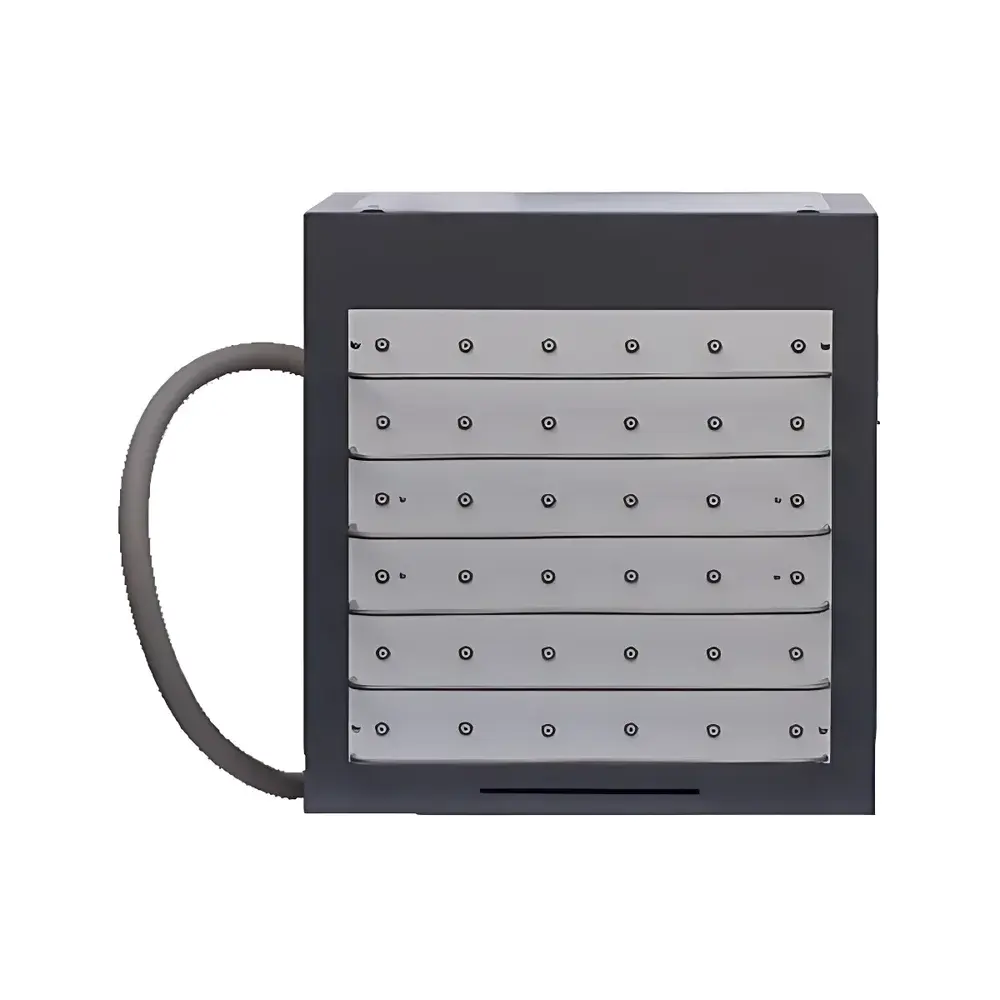
Zhonghui Pu GI Series Gas Bag Autosampler
| Brand | Zhonghui Pu |
|---|---|
| Origin | Beijing, China |
| Manufacturer Type | Manufacturer |
| Product Category | Domestic |
| Model | GI Series |
| Instrument Type | Gas Chromatography Gas Bag Autosampler |
| Maximum Sample Capacity | 136 positions |
| Optional Heating Range for 6/10-Port Valve | 40–240 °C (±1 °C) |
| Optional Heating Range for Transfer Line | 40–240 °C (±1 °C) |
| Sample Position Options | 34 / 68 / 102 / 136 |
| RSD | ≤1% (at 100 ppm methane) |
| Power Consumption | Main Unit — 100 W (avg) |
| Dimensions (L×W×H) | Main Unit — 520 × 520 × 550 mm |
| Backflush Flow Rate | 10–1000 mL/min |
| Net Weight | ~30 kg |
| Optional Features | Integrated Dynamic Dilution Module, Dual-Channel 10-Port Valve Configuration, PTFE Seals, RESTEK Siltek®/Sulfinert®-Treated Stainless Steel Quantitative Loop |
Overview
The Zhonghui Pu GI Series Gas Bag Autosampler is an engineered solution for automated, trace-level volatile organic compound (VOC) and hydrocarbon analysis in ambient air, stack emissions, and fugitive source monitoring. Designed specifically for direct injection of pre-collected gas samples from Tedlar® or aluminum-laminated gas bags, it operates on a precise pneumatic-driven sampling principle—utilizing high-stability pressure-controlled gas transfer, heated multi-port valve switching, and inert flow-path architecture to preserve sample integrity. Its core function aligns with regulatory workflows requiring unattended, high-reproducibility introduction of discrete bagged samples into gas chromatographic systems—particularly for compliance with Chinese EPA methods such as HJ 38–2017 (total hydrocarbons, methane, and non-methane hydrocarbons) and HJ 1261–2022 (aromatic hydrocarbons via direct bag injection). The system eliminates manual syringe handling, minimizes operator exposure, and ensures consistent dwell time, loop fill dynamics, and thermal management across all sample positions.
Key Features
- Modular capacity configuration: 34-, 68-, 102-, or 136-position trays—enabling scalability from routine QA/QC labs to high-throughput environmental monitoring centers.
- Heated critical path components: Optional 40–240 °C temperature control (±1 °C) for both the 6-port or 10-port injection valve and transfer line—preventing condensation of semi-volatiles (e.g., C6–C12 aromatics) and ensuring quantitative transfer of thermally labile analytes.
- Inert fluidic pathway: All seals constructed from high-purity PTFE; quantitative loop fabricated from RESTEK Siltek®/Sulfinert®-passivated stainless steel with stainless compression fittings—minimizing adsorption, catalytic decomposition, and memory effects for sulfur compounds, aldehydes, and reactive VOCs.
- Integrated backflush cleaning: Programmable post-injection purge (10–1000 mL/min) of the valve rotor, transfer line, and loop during GC oven ramp time—reducing carryover to <0.1% for benzene/toluene/xylene (BTX) at 1 ppm levels.
- Intelligent motion control: Real-time positional feedback and torque monitoring enable automatic emergency stop upon mechanical anomaly—protecting precision stepper actuators and maintaining long-term repeatability (RSD ≤1% at 100 ppm methane, verified per ISO 8573-1 calibration protocol).
- Maintenance-friendly architecture: Dedicated service mode allows safe valve rotation, leak verification via pressure decay test, and seal replacement without full disassembly—supporting GLP-aligned instrument qualification (IQ/OQ/PQ).
Sample Compatibility & Compliance
The GI Series accommodates standard 0.5–10 L gas bags (including SKC, Supelco, and GASTEC formats) and supports dual-channel operation via optional 10-port valve—enabling simultaneous analysis of total hydrocarbons and speciated VOCs in a single run. It meets material compatibility requirements for EPA Method TO-14A/TO-15 analog workflows and is validated for use with HJ 38–2017 and HJ 1261–2022. All wetted surfaces comply with USP Class VI biocompatibility standards, and the heating enclosure design conforms to IEC 61010-1 safety specifications for laboratory equipment. When operated with audit-trail-enabled chromatography data systems (CDS), the autosampler supports 21 CFR Part 11-compliant electronic records through timestamped command logging and parameter change history.
Software & Data Management
Control is executed via dedicated Windows-based software compatible with both 32-bit and 64-bit OS environments. The interface provides full programmability of sequence parameters—including bag position mapping, valve timing, heating setpoints, backflush duration, and dilution factor (when dynamic dilution module is installed). All method files are stored in encrypted XML format with checksum validation. The software supports trigger synchronization with GC start signals (TTL or contact closure), monitors instrument readiness status (via RS-232 or Ethernet), and exports structured CSV logs containing injection time, valve temperature, loop pressure, and error codes—facilitating integration into LIMS and automated report generation pipelines.
Applications
- Regulatory stack testing for NMHC, methane, and BTEX under national emission standards.
- Fugitive emission surveys in petrochemical, pharmaceutical, and semiconductor facilities.
- Indoor air quality (IAQ) assessment using passive bag sampling followed by direct GC injection.
- Calibration gas preparation via integrated dynamic dilution—generating 5–7 point linear curves from a single certified standard (e.g., EPA Protocol G mixtures).
- Method development for low-concentration halogenated VOCs (e.g., chloromethanes, vinyl chloride) where cold trapping introduces bias.
FAQ
Does the GI Series support ASTM D6420-18 or EPA Method TO-15?
Yes—when paired with a GC-FID or GC-MS system meeting sensitivity and retention time stability requirements, the GI Series satisfies sample introduction criteria for both methods, provided heated transfer lines and valves are maintained ≥150 °C.
Can the autosampler be integrated into a fully automated unattended run spanning 72+ hours?
Yes—its robust power management, thermal stability over extended cycles, and fault-resilient sequencing logic enable multi-day operation; users routinely deploy 136-position sequences with overnight GC oven cooling intervals.
Is third-party software (e.g., Chromeleon, OpenLab CDS) compatibility documented?
Yes—driver-level integration packages and detailed API documentation are provided for major CDS platforms, including hardware handshake protocols and status polling intervals.
What maintenance intervals are recommended for PTFE seals and quantitative loops?
Under typical environmental lab usage (≤500 injections/week), PTFE rotor seals require replacement every 6 months; Siltek®-treated loops demonstrate >2000-cycle durability with routine helium leak checks per ISO 10648-2.
Does the dynamic dilution module meet ISO 6142 traceability requirements?
The module uses mass-flow controlled primary/secondary dilution with NIST-traceable flow sensors (±0.8% reading accuracy); certificate of conformance includes uncertainty budget per ISO/IEC 17025 Annex A.






