
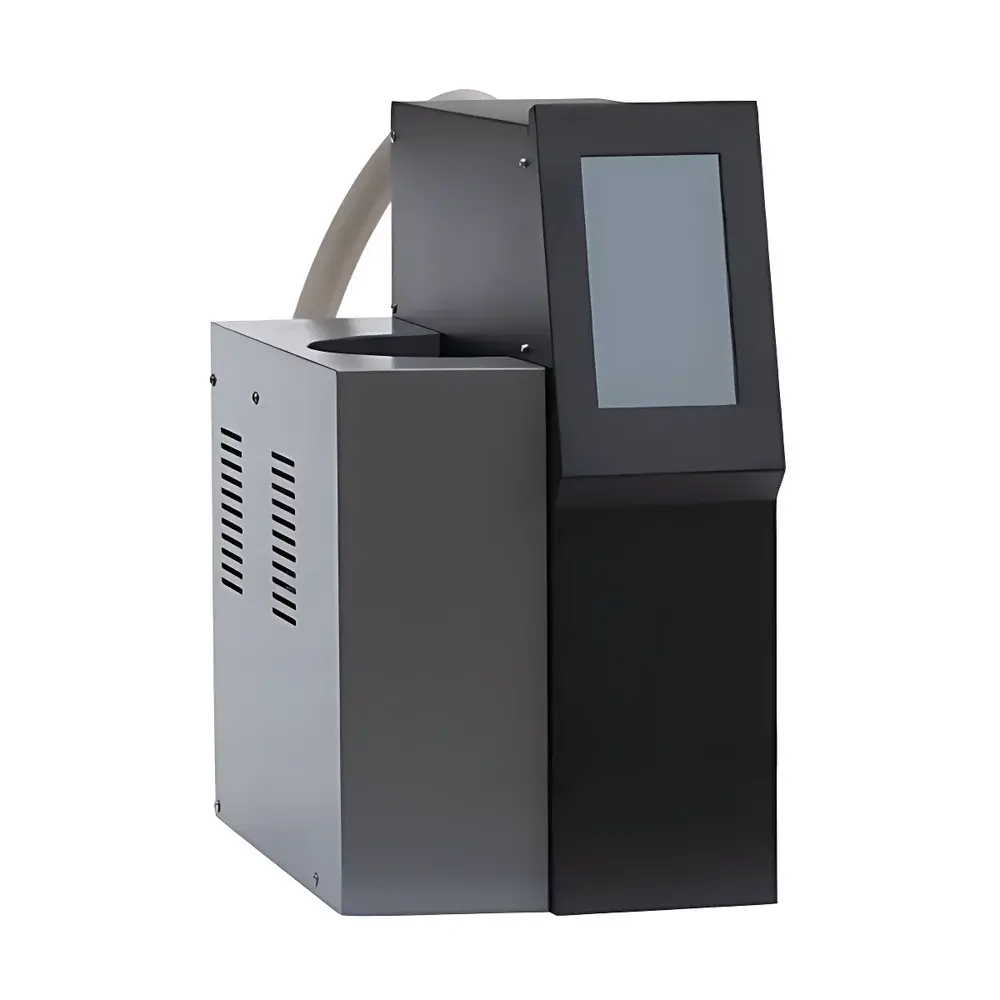
Zhonghui Pu HS-15 Fully Automated Static Headspace Sampler
| Brand | Zhonghui Pu |
|---|---|
| Origin | Beijing, China |
| Manufacturer Type | Direct Manufacturer |
| Instrument Type | Static Headspace Sampler |
| Automation Level | Fully Automated |
| Sample Vial Heating Range | 40–200 °C (customizable up to 250 °C) |
| Valve & Transfer Line Heating Range | 40–200 °C (customizable up to 330 °C) |
| Quantitative Loop Volume | 1 mL (customizable up to 3 mL) |
| Temperature Control Accuracy | ±1 °C |
| Sample Capacity | 15 positions |
| Vial Sizes Supported | 10 mL and 20 mL |
| RSD | ≤1.5% (for 100 ppm ethanol in water) |
| Dimensions (L×W×H) | 430 × 270 × 500 mm |
| Net Weight | ~20 kg |
Overview
The Zhonghui Pu HS-15 Fully Automated Static Headspace Sampler is an engineered solution for reproducible, unattended volatile compound analysis in gas chromatography (GC) workflows. It operates on the principle of static headspace sampling—where a sealed sample vial is heated to equilibrium, allowing volatile analytes to partition into the vapor phase above the matrix. A precisely metered volume of this equilibrated headspace gas is then transferred under positive pressure directly into the GC injection port. Designed for laboratories requiring high-throughput, method-compliant routine analysis of residual solvents, environmental contaminants (e.g., benzene in water at sub-ppb levels), flavor volatiles, or pharmaceutical impurities, the HS-15 delivers robust performance with minimal operator intervention.
Key Features
- Fully automated 15-position sample carousel with intelligent vial detection—automatically skips empty or misaligned positions to prevent mechanical collision and ensure process continuity.
- Independent, PID-controlled heating zones for sample vials (40–200 °C, optional 250 °C), six-port valve (40–200 °C, optional 330 °C), and transfer lines (40–200 °C, optional 330 °C), eliminating cold spots and preserving thermally labile analytes.
- RESTEK Siltek®/Sulfinert®-treated 316L stainless steel flow path—including quantitative loop (standard 1 mL, optional up to 3 mL) and valve manifold—ensuring inertness for polar, acidic, sulfur-containing, and reactive compounds with negligible carryover.
- Three programmable rotational agitation intensities accelerate vapor-phase equilibration, improving method robustness across heterogeneous solid or viscous liquid matrices.
- Motor-driven actuation system—no external carrier gas or compressed air required—reducing infrastructure dependencies and enhancing operational safety in regulated environments.
- Integrated 7-inch capacitive touchscreen interface with full中文-to-English bilingual firmware support (configurable), enabling intuitive method setup, real-time status monitoring, and one-touch sequence launch.
- Comprehensive fault diagnostics: automatic stall detection, positional error recovery, thermal deviation alerts, and emergency motion halt with logged event timestamps.
Sample Compatibility & Compliance
The HS-15 accommodates standard 10 mL and 20 mL crimp-top headspace vials, including compatibility with certified USP Residual Solvents and ICH Q3C-compliant vial formats. Its inert flow path and low-RSD performance (≤1.5% RSD for 100 ppm ethanol in water) support validation under ISO/IEC 17025, FDA 21 CFR Part 11 (when paired with compliant chromatography data systems), and GLP/GMP audit requirements. The instrument’s positive-pressure sampling architecture ensures baseline stability during GC injection—critical for trace-level quantitation such as benzene detection at 1 ppb in aqueous matrices per EPA Method 502.2 and ASTM D3699.
Software & Data Management
The HS-15 features a native RS-232 and USB interface for bidirectional communication with third-party GC data systems (e.g., Agilent OpenLab, Thermo Chromeleon, Shimadzu GC Solutions). It supports hardware handshake protocols—including GC ready-signal input and synchronized start command—to enable fully coordinated method execution. Optional PC-based control software provides method library management, audit-trail-enabled parameter logging, electronic signature support, and export of run metadata (temperature profiles, timing events, error codes) in CSV or XML format for LIMS integration. All configuration changes are timestamped and user-attributed to satisfy ALCOA+ data integrity principles.
Applications
- Pharmaceutical quality control: Residual solvent testing per ICH Q3C guidelines (Classes 1–3) in APIs and excipients.
- Environmental analysis: Volatile organic compounds (VOCs) in soil leachates, groundwater, and wastewater per EPA Methods 502.2, 624, and 8260.
- Food & beverage safety: Ethanol, acetaldehyde, and off-flavor compounds in beverages, dairy, and packaged foods.
- Polymer and packaging migration studies: Extractables and leachables from plastic containers and closures.
- Clinical toxicology: Blood alcohol concentration (BAC) and volatile metabolite screening using headspace-GC-FID or GC-MS.
FAQ
Is the HS-15 compatible with all major GC brands?
Yes—the HS-15 interfaces seamlessly with Agilent, Thermo Fisher, Shimadzu, PerkinElmer, and国产 GC systems via standard TTL-level ready signals and configurable trigger protocols.
Can the instrument be validated for GMP use?
It supports IQ/OQ documentation packages and provides full traceability of temperature setpoints, timing parameters, and error logs—enabling compliance with Annex 11 and FDA 21 CFR Part 11 when deployed with validated CDS software.
What maintenance is required for long-term reliability?
Routine checks include vial septum integrity verification, quantitative loop purge validation, and annual calibration of temperature sensors against NIST-traceable references; no consumable valves or seals require scheduled replacement.
Does it support dynamic headspace or purge-and-trap configurations?
No—the HS-15 is designed exclusively for static headspace sampling; dynamic modes require dedicated purge-and-trap instrumentation.
How is cross-contamination prevented between runs?
Through chemically inert Siltek®-treated flow paths, programmable post-injection bake-out cycles (up to 330 °C), and automated loop/valve purging with carrier gas between samples.




