
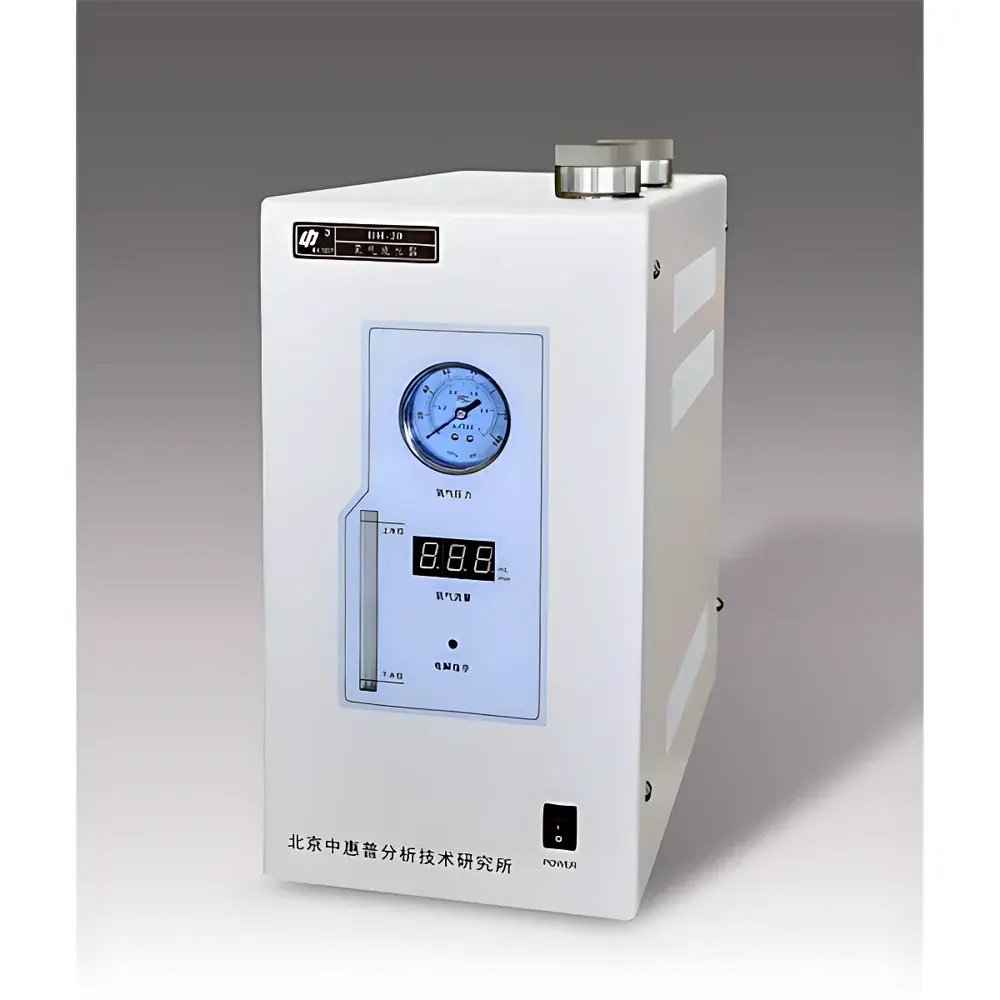
Zhonghui Pu DH-20 Ultra-High-Purity Hydrogen Generator for ICP Applications
| Brand | Zhonghui Pu |
|---|---|
| Origin | Beijing, China |
| Manufacturer Type | Direct Manufacturer |
| Model | DH-20 |
| Hydrogen Generation Principle | Alkaline Electrolysis |
| Output Flow Rate | 0–20 mL/min |
| Output Pressure | 60–80 kPa |
| Hydrogen Purity | ≥99.99999% |
| Power Consumption | 175 W |
| Pressure Stability | <0.0001 MPa |
| Input Power | 220 V ±10%, 50 Hz |
| Dimensions (W×D×H) | 420 × 200 × 350 mm |
| Net Weight | ~15 kg |
Overview
The Zhonghui Pu DH-20 Ultra-High-Purity Hydrogen Generator is an engineered solution designed specifically to support inductively coupled plasma (ICP) analytical systems—including ICP-OES and ICP-MS—where ultra-trace elemental analysis demands hydrogen gas of exceptional chemical and isotopic purity. Unlike standard electrolytic hydrogen generators, the DH-20 integrates a dual-stage purification architecture: first, high-efficiency alkaline electrolysis of deionized water produces nascent H₂; second, the generated gas passes through a thermally stabilized palladium alloy membrane—a selective diffusion barrier that permits only molecular hydrogen and its isotopes (e.g., deuterium) to permeate while rejecting all other gaseous contaminants (O₂, N₂, Ar, CO, CH₄, moisture, and hydrocarbons). This physicochemical separation mechanism ensures continuous delivery of hydrogen at ≥99.99999% purity (i.e., ≤100 ppt total non-hydrogen impurities), meeting the stringent background gas requirements of modern ICP instruments operating in low-noise, high-sensitivity detection modes.
Key Features
- Automated pressure- and flow-regulated operation: Maintains constant output pressure (60–80 kPa) and dynamically adjusts hydrogen flow (0–20 mL/min) in real time based on instrument demand—eliminating manual throttling or external pressure regulators.
- Palladium alloy membrane purification: A diffusion-selective, catalytically active metallic membrane operating at controlled temperature (typically 350–400 °C), delivering consistent 7N-grade hydrogen without consumable cartridges or regeneration cycles.
- Stable pressure control: Achieves pressure stability of <0.0001 MPa (100 Pa) under dynamic load conditions—critical for maintaining plasma torch stability and minimizing signal drift during long-duration analyses.
- Robust safety architecture: Integrated leak detection, over-pressure shutoff, thermal cutoff, and hydrogen sensor-based ambient monitoring ensure compliance with laboratory safety protocols for Class 2A flammable gas handling (NFPA 55, CGA G-5.4).
- Continuous 24/7 operability: Designed for unattended, long-term deployment in core analytical laboratories; validated for >10,000 hours of cumulative runtime with minimal maintenance intervals.
- Energy-efficient design: Rated power consumption of 175 W at full output—optimized for low thermal load and compatibility with standard laboratory circuits (220 V ±10%, 50 Hz).
Sample Compatibility & Compliance
The DH-20 is compatible with all major ICP platforms requiring ultra-pure hydrogen as a make-up gas, reaction gas (e.g., in hydrogen reaction mode for polyatomic interference removal), or auxiliary plasma gas. It meets essential performance benchmarks aligned with ISO 8573-1:2010 Class 1 compressed air/gas purity equivalency for hydrogen (though adapted for H₂-specific contaminants), and supports GLP/GMP-compliant workflows through deterministic, repeatable gas delivery—free from batch-to-batch variability inherent in cylinder-based supply. While not certified to UL/CE for standalone electrical safety, its internal architecture adheres to IEC 61010-1:2010 requirements for laboratory electrical equipment. The system requires feed water conductivity ≤1 µS/cm (Type I deionized water per ISO 3696 or ASTM D1193) to prevent electrode scaling and ensure membrane longevity.
Software & Data Management
The DH-20 operates as a stand-alone hardware unit with embedded microcontroller logic—no external PC interface or proprietary software is required for basic operation. All operational parameters (flow, pressure, temperature, fault status) are displayed via a front-panel LED interface with tactile feedback. For integration into centralized lab infrastructure, optional analog 0–10 V or 4–20 mA output signals are available (upon request) to relay real-time pressure and flow data to building management systems (BMS) or LIMS. Audit trails are maintained internally for critical events (e.g., over-pressure event, membrane temperature excursion, power interruption), supporting FDA 21 CFR Part 11 readiness when paired with validated electronic logbook solutions.
Applications
- ICP-MS hydrogen reaction cell gas for suppression of 40Ar16O+, 40Ar35Cl+, and other polyatomic interferences in environmental, clinical, and geochemical trace metal analysis.
- Make-up gas for ICP-OES axial-view configurations to enhance plasma robustness and reduce matrix-induced signal suppression.
- Carrier gas for hydride generation–ICP systems where H₂ co-injection improves hydride transport efficiency and reduces memory effects.
- Calibration gas dilution systems requiring ultra-low-background hydrogen as a zero-gas reference or blending component.
- Research applications in catalysis, surface science, and hydrogenation chemistry requiring on-demand, high-purity H₂ without cylinder logistics or contamination risk.
FAQ
What is the expected lifetime of the palladium alloy membrane?
Under normal operating conditions (feed water ≤1 µS/cm, ambient temperature 15–30 °C), the membrane is rated for ≥5 years or 30,000 hours of continuous use—subject to periodic verification of purity via residual gas analysis (RGA).
Does the DH-20 require regular electrolyte replacement?
No. The alkaline electrolyte is sealed and non-consumable; only deionized water replenishment is required every 7–14 days depending on usage frequency.
Can the DH-20 be integrated with an ICP instrument’s auto-start sequence?
Yes—via optional dry-contact relay output, enabling synchronized generator startup/shutdown with the host ICP system’s power cycle.
Is certification documentation (e.g., factory calibration report, purity test data) provided with shipment?
Each unit ships with a Certificate of Conformance, including factory-measured hydrogen purity (verified by GC-TCD), pressure stability test results, and electrical safety inspection records.



