
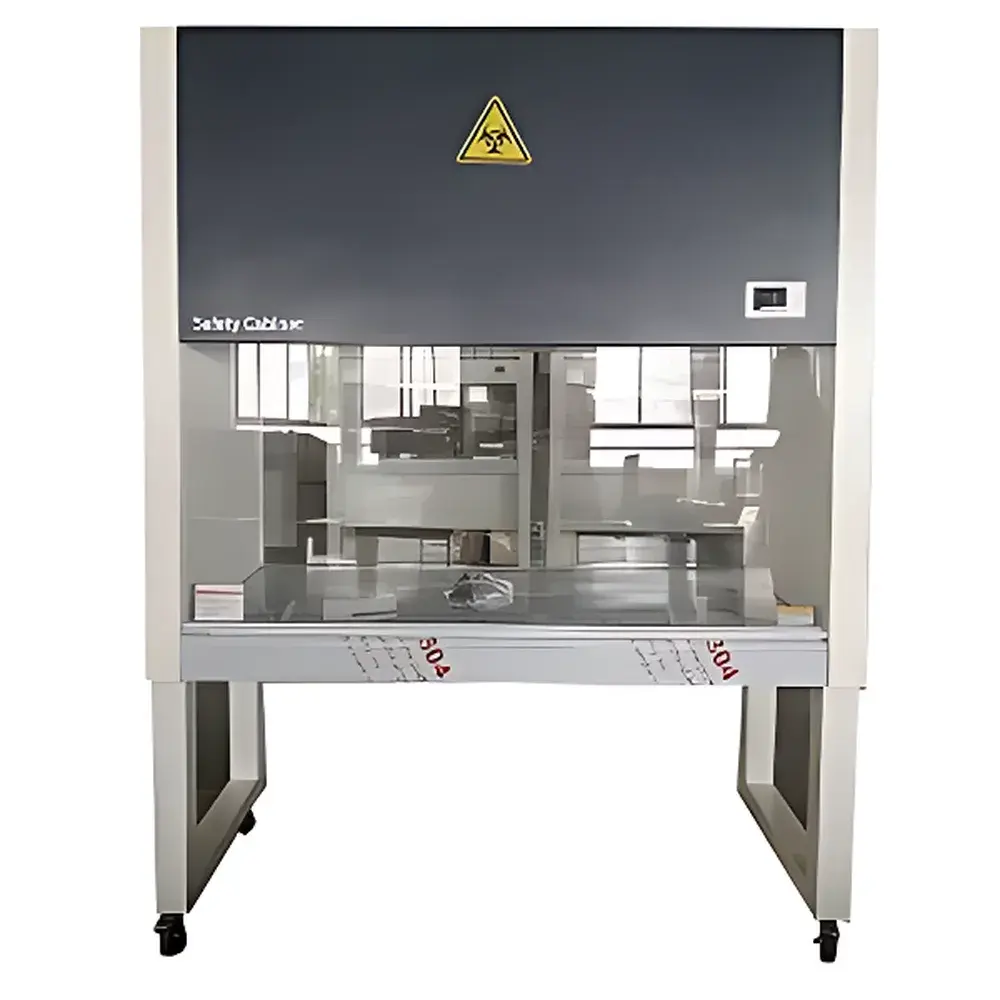
Chuanyu BHC-1300IIA2 Class II Type A2 Biological Safety Cabinet
| Brand | Chuanyu Instruments |
|---|---|
| Origin | Shanghai, China |
| Model | BHC-1300IIA2 |
| Cabinet Class | NSF/EN 12469 Class II, Type A2 |
| External Dimensions (L×W×H) | 1500 × 640 × 1950 mm |
| Internal Work Area (L×W×H) | 1300 × 580 × 680 mm |
| HEPA Filter Efficiency | ≥99.99% @ 0.3 µm (tested per ISO 14644-3 & IEST-RP-CC001.3) |
| Inflow Velocity | 0.35 ± 0.025 m/s |
| Downflow Velocity | 0.26–0.27 ± 0.025 m/s |
| Noise Level | ≤62 dB(A) |
| Illumination | ≥300 lx |
| Power Supply | AC 220 V / 50 Hz |
| Max. Power Consumption | 0.9 kW |
| Weight | <250 kg |
| Filter Configuration | Single integrated HEPA filter (1295 × 600 × 38 mm), liquid-sealed, pre-filtered intake |
Overview
The Chuanyu BHC-1300IIA2 is a certified Class II, Type A2 biological safety cabinet engineered for personnel, product, and environmental protection in biosafety level 1–2 (BSL-1/2) laboratories. It operates on the principle of laminar airflow dynamics combined with dual air recirculation and exhaust pathways—approximately 70% of the total airflow is recirculated through a vertically downward HEPA-filtered downflow, while ~30% is exhausted externally via a dedicated ducted or thimble-connected system. This configuration ensures continuous decontamination of the work surface and operator breathing zone, meeting the fundamental performance criteria defined in NSF/ANSI 49-2022 and EN 12469:2000. The cabinet maintains ISO Class 5 (Federal Standard 209E Class 100) cleanliness within the work area, validated by particle count testing at ≥0.5 µm and microbial challenge using settle plate assays (≤0.5 CFU/plate·hour, Φ90 mm). Its structural integrity supports long-term stability under continuous operation, with airflow uniformity maintained across the full work surface (±5% velocity variation).
Key Features
- Robust cold-rolled steel chassis with electrostatically applied epoxy-polyester coating—resistant to corrosion, abrasion, and routine disinfectants including 70% ethanol, 10% bleach, and hydrogen peroxide vapor.
- Stainless steel 304 work surface (1.2 mm thickness) with seamless welds and radiused corners for complete cleanability and compliance with GLP cleaning validation protocols.
- Dual independent HEPA filtration: one for recirculated downflow (≥99.99% efficiency at 0.3 µm), and one for exhaust stream (same specification), both housed in liquid-seal frames to prevent bypass leakage.
- Precision-engineered centrifugal blower system with voltage-adjustable speed control—enables real-time optimization of inflow and downflow velocities to accommodate variable sash positions and equipment loading.
- Integrated LED lighting (≥300 lx at work surface) and UV-C germicidal lamp (254 nm, 30 W), both independently switchable with safety interlocks preventing UV activation when sash is open.
- Microprocessor-based control panel with digital airflow monitoring, alarm diagnostics (e.g., low inflow, filter saturation, motor failure), and event logging capability compatible with audit trail requirements.
Sample Compatibility & Compliance
The BHC-1300IIA2 accommodates standard microbiological workflows involving bacterial culture, mammalian cell passaging, plasmid transfection, and low-risk viral handling (e.g., lentiviral vectors under BSL-2 containment). It is not suitable for volatile toxic chemicals or radionuclides due to its non-ducted recirculation design. All performance claims are verified against internationally recognized standards: NSF/ANSI 49-2022 (U.S.), EN 12469:2000 (EU), and GB/T 25915.3-2010 (China). The cabinet undergoes factory certification for containment integrity (smoke visualization per Annex D), airflow velocity mapping, and HEPA leak testing (DOP/PAO scan at 100% face velocity). Documentation includes full test reports traceable to NIST-calibrated instrumentation, supporting FDA 21 CFR Part 11–aligned laboratory qualification (IQ/OQ/PQ).
Software & Data Management
While the BHC-1300IIA2 operates via embedded hardware controls (no external PC dependency), its control module stores up to 12 months of operational data—including daily runtime, airflow deviations, alarm history, and filter pressure differentials—accessible via USB export in CSV format. Optional RS-485 or Modbus RTU interface enables integration into centralized lab infrastructure monitoring systems (e.g., LabVantage, Siemens Desigo, or custom SCADA). All stored events include timestamps with millisecond resolution and user-accessible audit trails compliant with ALCOA+ principles (Attributable, Legible, Contemporaneous, Original, Accurate, Complete, Consistent, Enduring, Available). No cloud connectivity or remote firmware updates are implemented—ensuring data sovereignty and cybersecurity alignment with ISO/IEC 27001 lab IT policies.
Applications
- Molecular biology: Plasmid preparation, PCR setup, CRISPR-Cas9 editing workflows requiring sterile manipulation without cross-contamination.
- Tissue culture: Routine subculturing of adherent and suspension cell lines (e.g., HEK293, CHO-K1, Jurkat), including media exchange and cryovial handling.
- Clinical microbiology: Isolation and identification of pathogenic bacteria (e.g., Staphylococcus aureus, Escherichia coli) from patient specimens under BSL-2 conditions.
- Pharmaceutical QC: Aseptic sampling of bulk intermediates, sterility test preparation, and environmental monitoring media plate pouring.
- Academic teaching labs: Hands-on instruction in aseptic technique, biosafety fundamentals, and equipment validation methodologies aligned with ISO/IEC 17025 competency frameworks.
FAQ
What is the recommended HEPA filter replacement interval?
Filter service life depends on usage intensity, ambient air quality, and decontamination frequency. Under typical academic or QC lab conditions (6–8 hrs/day, 5 days/week), the primary HEPA filter requires replacement every 18–24 months. Pre-filters should be inspected quarterly and replaced when pressure drop exceeds 100 Pa above baseline. Filter integrity must be revalidated post-replacement per ISO 14644-3.
Can this cabinet be installed without external ducting?
Yes—the BHC-1300IIA2 supports recirculating (non-ducted) mode using a built-in carbon exhaust filter kit. However, this configuration reduces effective containment for aerosol-generating procedures and is not permitted for work involving volatile chemicals or high-concentration pathogens. Ducted installation is required for full NSF 49 Type A2 compliance.
Is UV-C irradiation validated for surface decontamination?
UV-C dose delivery (measured in J/m²) is not standardized across cabinets. Users must perform in-situ validation using biological indicators (e.g., Bacillus atrophaeus spores) placed at shadowed locations (e.g., behind pipette racks, under shelves) to confirm log3 reduction. UV exposure time must be adjusted based on lamp aging and reflectivity loss.
How does this model support regulatory audits?
The cabinet provides full documentation packages—including factory test certificates, material declarations (RoHS/REACH), electrical safety reports (IEC 61010-1), and traceable calibration records—for inclusion in lab quality management systems (QMS). All alarms generate timestamped entries suitable for FDA 21 CFR Part 11 electronic record review.





