
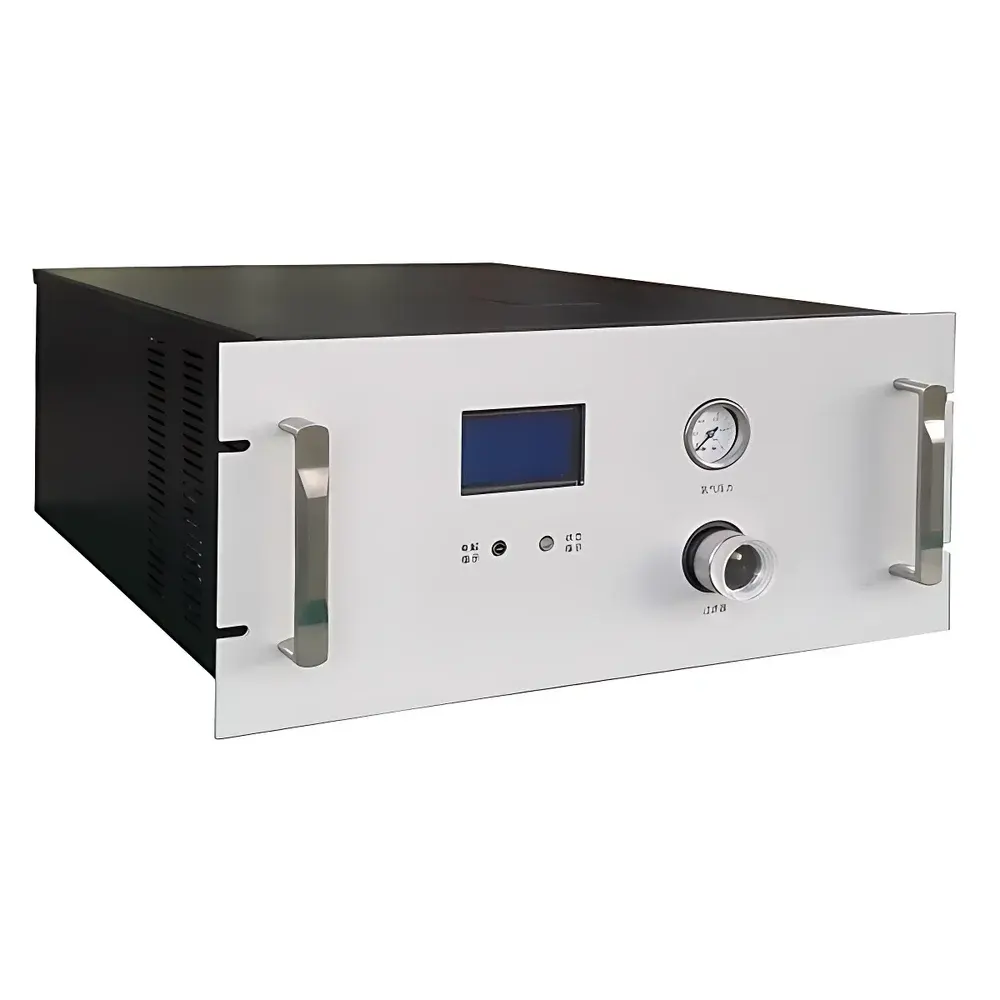
Zhonghuipu ZPH-500 Rack-Mounted Alkaline Electrolytic Hydrogen Generator
| Brand | Zhonghuipu |
|---|---|
| Origin | Beijing, China |
| Manufacturer Type | Direct Manufacturer |
| Model | ZPH-500 |
| Hydrogen Generation Principle | Alkaline Electrolysis |
| Output Flow Rate | 0–500 mL/min |
| Output Pressure | 0–0.4 MPa |
| Hydrogen Purity | 99.999% |
| Power Consumption | 250 W |
| Dimensions (L×W×H) | 450 × 430 × 222 mm |
| Net Weight | 15 kg |
| Pressure Stability | < 0.001 MPa |
| Input Power | 220 V ±10%, 50 Hz |
| Interface | RS232 |
Overview
The Zhonghuipu ZPH-500 is a rack-mounted alkaline electrolytic hydrogen generator engineered for continuous, high-purity hydrogen supply in analytical laboratories and industrial gas chromatography (GC) applications. It operates on the principle of aqueous potassium hydroxide (KOH) electrolysis—where direct current splits deionized water into hydrogen and oxygen gases at nickel-plated stainless steel electrodes. The evolved hydrogen is purified via a multi-stage process including catalytic recombination of residual oxygen, pressure-swing adsorption (PSA), and palladium-diffusion membrane polishing to achieve ≥99.999% purity—meeting ASTM D7613 and ISO 8573-1 Class 1 requirements for instrumental-grade hydrogen. Designed for integration into 19-inch laboratory racks, the ZPH-500 delivers stable flow (0–500 mL/min) and regulated pressure (0–0.4 MPa) with dynamic response to downstream demand fluctuations, minimizing pressure drift (<0.001 MPa) during operation.
Key Features
- Rack-mountable 4U chassis (450 × 430 × 222 mm) optimized for space-constrained GC labs and centralized gas supply systems.
- Fully sealed electrolysis cell with integrated stainless-steel water reservoir—eliminates alkali vapor leakage and reduces thermal stress on electrodes, extending service life beyond 10,000 operating hours.
- Intelligent microprocessor control system with real-time LCD interface (Chinese-language firmware); enables auto-refill, flow/pressure monitoring, and adaptive flow modulation based on connected instrument demand.
- Comprehensive safety architecture: over-pressure cut-off (0.42 MPa threshold), over-current protection, electrolyte level sensor interlock, and temperature-triggered shutdown (≥65°C).
- RS232 serial interface compliant with Modbus RTU protocol—supports remote status interrogation, alarm logging, and bidirectional communication with GC controllers or LIMS platforms.
- Low-energy operation at 250 W nominal power draw; compatible with standard 220 V ±10%, 50 Hz AC mains without external voltage regulation.
Sample Compatibility & Compliance
The ZPH-500 is designed exclusively for hydrogen generation—not for sample analysis—and requires feed water meeting ASTM D1193 Type II specifications (resistivity ≥1 MΩ·cm, TOC < 50 ppb). It complies with IEC 61000-6-3 (EMC emission limits) and GB/T 32204–2015 (Chinese national standard for electrolytic hydrogen generators). While not certified to UL/CSA or ATEX standards, its sealed construction and internal pressure relief valve (set at 0.45 MPa) align with general laboratory safety practices per OSHA 1910.103 and ISO/IEC 17025 clause 5.3.2 for auxiliary equipment qualification. For GLP/GMP environments, audit-ready operational logs—including runtime, pressure events, and refill cycles—are exportable via RS232 for traceability.
Software & Data Management
The embedded controller stores up to 30 days of operational history (flow setpoint vs. actual, pressure deviation, temperature trends, and fault codes) in non-volatile memory. Through the RS232 port, users may interface with custom Python- or LabVIEW-based scripts to extract timestamped CSV data or integrate with enterprise SCADA systems. No proprietary software is required; terminal emulation (e.g., PuTTY) suffices for manual command issuance (e.g., “GET_STATUS”, “RESET_ALARM”). Firmware updates are performed offline via USB-to-serial adapter—ensuring compliance with FDA 21 CFR Part 11 when paired with validated electronic signature workflows.
Applications
- Carrier and fuel gas source for flame ionization detectors (FID) and thermal conductivity detectors (TCD) in GC and GC-MS systems.
- Reducing atmosphere generation in thermal analysis (TGA/DSC) and catalyst characterization setups.
- Calibration gas blending systems requiring ultra-high-purity H₂ as a base component.
- On-site hydrogen supply for portable hydrogen sensors and electrochemical test stations.
- Backup or primary hydrogen source in research labs where cylinder logistics, storage constraints, or safety regulations limit compressed gas usage.
FAQ
What feed water quality is required for optimal performance?
Deionized water meeting ASTM D1193 Type II specifications (resistivity ≥1 MΩ·cm, silica < 0.02 mg/L, TOC < 50 ppb) is mandatory. Tap or distilled water will cause rapid electrode fouling and void the warranty.
Can the ZPH-500 be operated continuously for 24/7 applications?
Yes—the system is rated for uninterrupted operation under ambient temperatures of 10–35°C and relative humidity ≤80% non-condensing. Electrolyte replacement is recommended every 6 months under continuous use.
Is the hydrogen output suitable for GC-MS applications?
While 99.999% purity meets ASTM D7613 for GC-FID/TCD, mass spectrometry applications requiring sub-ppb oxygen or moisture may necessitate additional inline purifiers (e.g., copper-based oxygen scavengers and molecular sieve dryers).
Does the unit support remote monitoring via Ethernet or Wi-Fi?
No—only RS232 serial communication is provided. Integration with networked infrastructure requires an external RS232-to-Ethernet converter configured in TCP server mode.
How often does the KOH electrolyte require replenishment?
Under typical lab use (8 h/day, 500 mL/min average), the 1.5 L reservoir lasts approximately 6 months. The system alerts users via LCD and RS232 when electrolyte volume falls below 20% capacity.



