
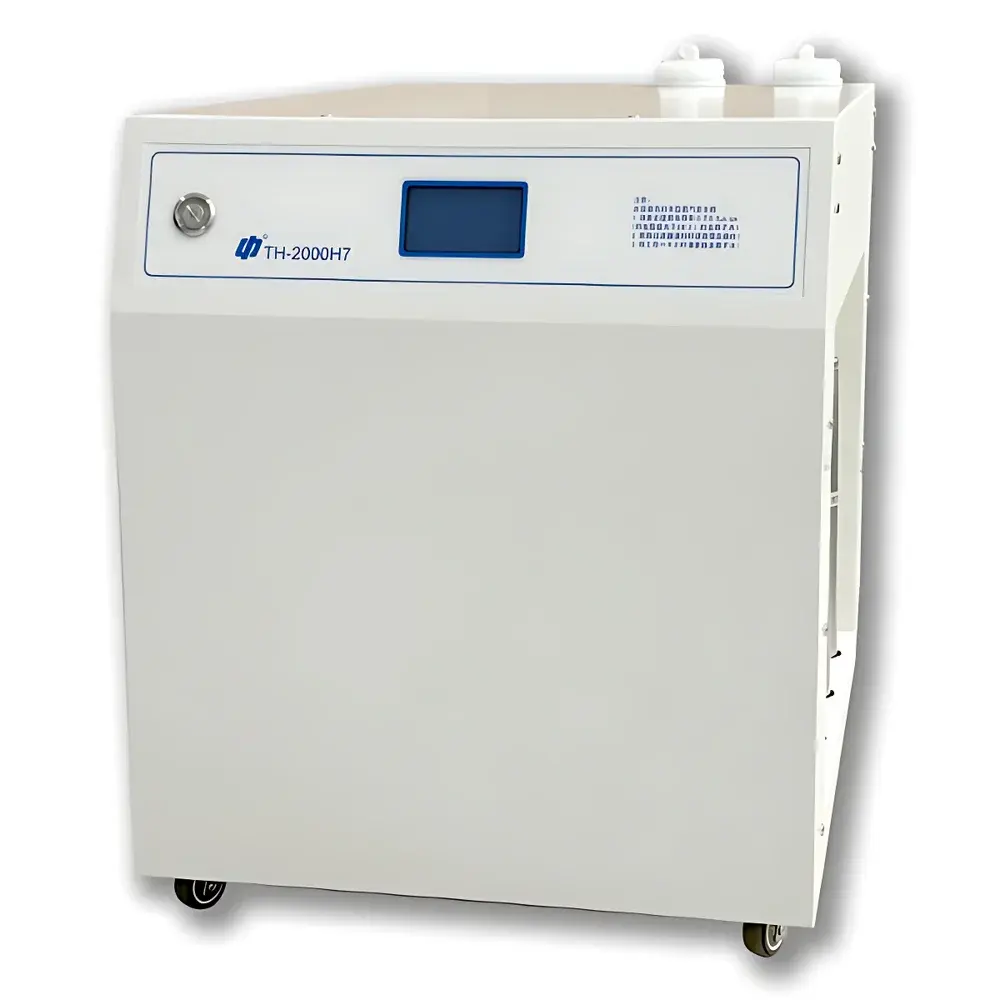
Zhonghuipu TH-2000H7 High-Pressure Hydrogen Generator
| Brand | Zhonghuipu |
|---|---|
| Origin | Beijing, China |
| Manufacturer Type | Direct Manufacturer |
| Model | TH-2000H7 |
| Hydrogen Generation Principle | Pure Water Electrolysis (SPE Proton Exchange Membrane) |
| Output Flow Rate | 0–2000 mL/min |
| Output Pressure | 0–7 MPa (70 kgf/cm²) |
| Hydrogen Purity | 99.999% |
| Power Consumption | 900 W |
| Dimensions (W×D×H) | 690 × 455 × 590 mm |
| Net Weight | 64 kg |
| Pressure Stability | < 0.01 MPa |
| Input Power | 220 V ±10%, 50 Hz |
| Certifications | CE |
Overview
The Zhonghuipu TH-2000H7 High-Pressure Hydrogen Generator is an engineered solution for laboratories requiring on-demand, ultra-high-purity hydrogen gas at elevated pressures—up to 7 MPa (70 bar)—without reliance on compressed gas cylinders. It employs solid polymer electrolyte (SPE) proton exchange membrane technology to perform pure water electrolysis, eliminating the need for caustic potassium hydroxide (KOH) or sodium hydroxide (NaOH) solutions. This design ensures inherently safer operation, reduced maintenance burden, and avoidance of alkaline corrosion risks associated with traditional liquid-electrolyte systems. The generator delivers hydrogen at a continuously adjustable flow rate from 0 to 2000 mL/min, with pressure regulation stability maintained within ±0.01 MPa under dynamic load conditions—critical for applications demanding consistent gas delivery, such as high-pressure catalytic hydrogenation, hydride generation atomic absorption spectroscopy (HG-AAS), or pressurized fuel cell testing.
Key Features
- SPE-based electrolysis using imported perfluorosulfonic acid (PFSA) proton exchange membranes for high proton conductivity and long-term electrochemical stability
- Zero-alkali operation: only deionized water (≥1 MΩ·cm resistivity) required as feedstock—no chemical handling, storage, or neutralization waste
- Full stainless-steel wetted components—including gas–liquid separator, particulate filter, and pressure-rated manifolds—rated for continuous service up to 7 MPa
- Low-sulfur silicone O-rings and fluoropolymer seals minimize sulfur contamination, preserving trace-level analytical integrity in GC carrier gas and ICP-MS applications
- Integrated PID-controlled pressure and flow regulation with real-time digital feedback; no external regulators or manual valves needed
- Intelligent water-level monitoring system with automatic shutdown upon low-water detection, protecting the electrolyzer stack from dry-out and thermal degradation
- CE-compliant electrical architecture with overtemperature, overpressure, and current-limiting safety interlocks aligned with IEC 61010-1 requirements
Sample Compatibility & Compliance
The TH-2000H7 is compatible with all standard laboratory-grade deionized water sources meeting ASTM D1193 Type II or ISO 3696 Grade 2 specifications. Its output gas meets ISO 8573-1:2010 Class 1 (solid particles), Class 2 (water), and Class 1 (oil) purity requirements when operated with certified feed water and routine filter replacement. The 99.999% hydrogen purity supports compliance with USP , EP 2.5.27, and ASTM D7622 for carrier gas use in gas chromatography. As a CE-marked device, it conforms to the EU Machinery Directive 2006/42/EC and Low Voltage Directive 2014/35/EU. While not inherently 21 CFR Part 11 compliant, its analog control architecture allows integration into validated environments via external data loggers with audit-trail capability.
Software & Data Management
The TH-2000H7 operates via a front-panel LCD interface with tactile push-button controls—designed for robustness in glove-box and fume hood installations. No embedded firmware or proprietary software is required for basic operation. Optional RS-485 Modbus RTU interface enables integration into centralized lab automation systems (e.g., LabVantage, Thermo Fisher SampleManager) for remote start/stop, pressure setpoint adjustment, and status monitoring (electrolyzer temperature, water level, fault codes). All operational parameters are logged internally for ≥30 days with timestamping, supporting GLP-aligned record retention when exported via USB-C port. Firmware updates are performed offline using signed binary files to ensure system integrity.
Applications
- High-pressure heterogeneous catalysis studies (e.g., Fischer–Tropsch synthesis, ammonia decomposition)
- Carrier and fuel gas for GC-FID, GC-TCD, and GC-MS systems requiring stable, low-moisture, sulfur-free H2
- Hydrogen supply for PEM fuel cell test stations operating up to 5 MPa anode pressure
- Reducing atmosphere generation in thermal analysis (TGA-DSC-H2) and XRD in situ cells
- On-site hydrogen sourcing for portable hydrogen sensors and leak detection calibration
- Research-scale metal hydride charging/discharging experiments under controlled pressure profiles
FAQ
What feed water quality is required for optimal performance and membrane longevity?
Deionized water with resistivity ≥1 MΩ·cm (ASTM D1193 Type II) and total organic carbon (TOC) < 50 ppb is recommended. Pretreatment with reverse osmosis + mixed-bed resin polishing is strongly advised for extended SPE membrane life.
Can the TH-2000H7 be used as a direct replacement for cylinder-based hydrogen in GC applications?
Yes—provided the instrument’s internal gas lines and detectors are compatible with 7 MPa inlet pressure and the existing regulator manifold is removed or bypassed. A pressure-reducing valve set to 0.1–0.2 MPa is typically installed downstream for GC compatibility.
Is routine maintenance required beyond water refilling and filter replacement?
Annual inspection of electrolyzer stack voltage balance and O-ring integrity is recommended. No electrolyte replenishment or electrode cleaning is necessary due to the sealed SPE architecture.
Does the unit support continuous unattended operation for >72 hours?
Yes—when connected to an automated water reservoir (≥5 L capacity) and operated within ambient temperatures of 15–30°C, the TH-2000H7 supports uninterrupted 24/7 operation with built-in safety cutoffs.
How is hydrogen purity verified during commissioning and periodic qualification?
Purity validation is performed using calibrated gas chromatography with thermal conductivity detection (GC-TCD) per ISO 8573-5:2010, measuring O2, N2, CO, CO2, CH4, and H2O impurities against certified reference standards.



