
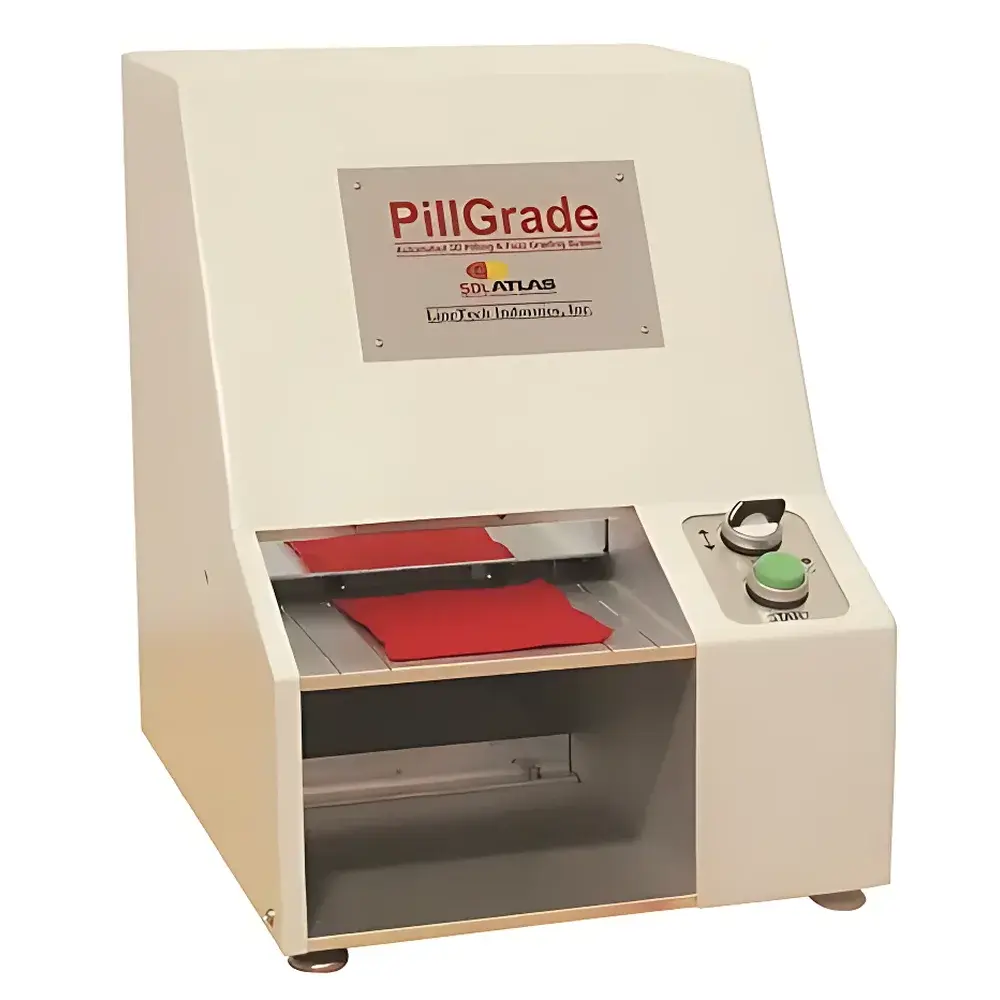
SDL Atlas PillGrade M227G Automatic Pilling & Snagging Assessment System
| Brand | SDL Atlas |
|---|---|
| Origin | USA |
| Manufacturer Type | Original Equipment Manufacturer (OEM) |
| Import Status | Imported |
| Model | M227G |
| Price Range | USD $14,000 – $43,000 (FOB USA) |
Overview
The SDL Atlas PillGrade M227G is a fully automated, three-dimensional fabric surface assessment system engineered for objective, repeatable, and standards-compliant evaluation of pilling and snagging behavior in textile materials. Unlike conventional visual grading methods—which are inherently subjective and operator-dependent—the PillGrade employs patented optical imaging and quantitative image analysis to extract morphological metrics directly from fabric surfaces. Its core measurement principle integrates high-resolution industrial CCD imaging under controlled dual-illumination (LED backlit + top-lit) conditions, enabling consistent contrast enhancement across diverse fabric structures, colors, and reflectivity profiles. The system operates on the fundamental premise that pilling is a surface topology phenomenon: it identifies, segments, and characterizes individual pills and snags based on size, density, spatial distribution, and height-relative-to-fabric-plane—parameters that correlate strongly with human-perceived grade but are captured without perceptual bias. Designed specifically for textile R&D labs, quality control departments, and third-party testing facilities, the M227G delivers ASTM D3512 and ISO 12945-1/2 compliant pilling grades (1.0–5.0 scale) while simultaneously quantifying snag severity—a capability absent in manual or semi-automated alternatives.
Key Features
- Patented 3D surface scanning architecture with dual LED illumination (backlight + top-light) for uniform contrast across dark, light, textured, or low-contrast fabrics
- Automated sample handling via integrated electric feed mechanism and protective test hood with anti-vibration rubber feet
- Objective pilling grading from 1.0 (severe pilling) to 5.0 (no pilling), fully traceable to ASTM D3512 and ISO 12945-1/2 reference standards
- Simultaneous snag detection and quantification—including snag count, length, and spatial clustering—enabling comprehensive surface defect profiling
- No fabric-type restrictions: validated for woven, knitted, nonwoven, wool, automotive upholstery, technical textiles, and blended composites
- Standardized sample area support: accommodates specimens from 10 cm × 10 cm (4″ × 4″) up to 15 cm × 15 cm (6″ × 6″)
- Real-time data visualization with histogram-based pill size distribution, pill density (per in² and per cm²), average pill diameter, and fuzz/fiber protrusion metrics
Sample Compatibility & Compliance
The PillGrade M227G eliminates material-related variability in surface assessment. Its illumination-invariant imaging algorithm normalizes reflectance differences across black polyester, white cotton, metallic-threaded jacquards, and carbon-fiber-reinforced composites—ensuring metrological equivalence regardless of substrate optical properties. All test protocols adhere strictly to ASTM D3512 (rotary box method) and ISO 12945-1 (Martindale abrasion) / ISO 12945-2 (pilling box method) for specimen preparation, abrading, and final evaluation. The system’s output documentation—including annotated images, statistical summaries, and grade assignments—supports GLP-compliant audit trails and satisfies internal quality system requirements for ISO 9001-certified textile manufacturers. While not FDA-regulated, its structured data export and user-access logging align with GMP-aligned documentation practices for medical textile validation workflows.
Software & Data Management
PillGrade software (v4.2+) runs natively on Windows platforms and provides full audit-trail functionality: every test session records operator ID, timestamp, instrument configuration, raw image metadata, and version-stamped analysis parameters. Export formats include CSV (for integration into LIMS or statistical process control platforms), PDF reports (with embedded high-res specimen thumbnails and grade justification logic), and printable hard copies containing actual scanned regions of the tested fabric. All data files are timestamped, digitally signed, and stored in hierarchical directories compliant with 21 CFR Part 11 principles—supporting electronic record retention, reviewer sign-off, and retrospective analysis. Software updates are delivered via secure HTTPS portal; no cloud storage is used—data sovereignty remains fully on-premise.
Applications
- Pre-production fabric qualification for apparel, home textiles, and technical wearables
- Supplier performance benchmarking across global sourcing networks using standardized digital grade baselines
- Accelerated durability testing of functional finishes (e.g., anti-pilling silicones, plasma treatments)
- Root-cause analysis of pilling mechanisms during fiber selection (e.g., polyester vs. Tencel® vs. recycled PET blends)
- Automotive interior validation per OEM specifications (e.g., Ford WSS-M2P178-A2, GMW14872)
- Regulatory submission support for OEKO-TEX® Standard 100 and bluesign® certification requiring objective surface integrity evidence
FAQ
Does PillGrade require calibration standards or reference fabrics?
No—its algorithm is geometry- and intensity-normalized; however, daily verification using a supplied NIST-traceable grayscale target is recommended for long-term consistency.
Can the system analyze fabrics after Martindale or ICI pilling tests?
Yes—it accepts post-abraded specimens from all standard pilling test methods, including ASTM D4966 (Martindale), ISO 12947, and ISO 12945.
Is color correction applied during image acquisition?
No—color information is discarded; only luminance and texture gradients inform segmentation, eliminating chromatic bias.
What is the minimum detectable pill size?
The system resolves features ≥125 µm in diameter at standard working distance, sufficient to capture early-stage pilling per ISO definitions.
Can multiple operators share one PillGrade installation securely?
Yes—role-based access control (administrator, technician, reviewer) enforces password-protected workflows and prevents unauthorized parameter changes.




