
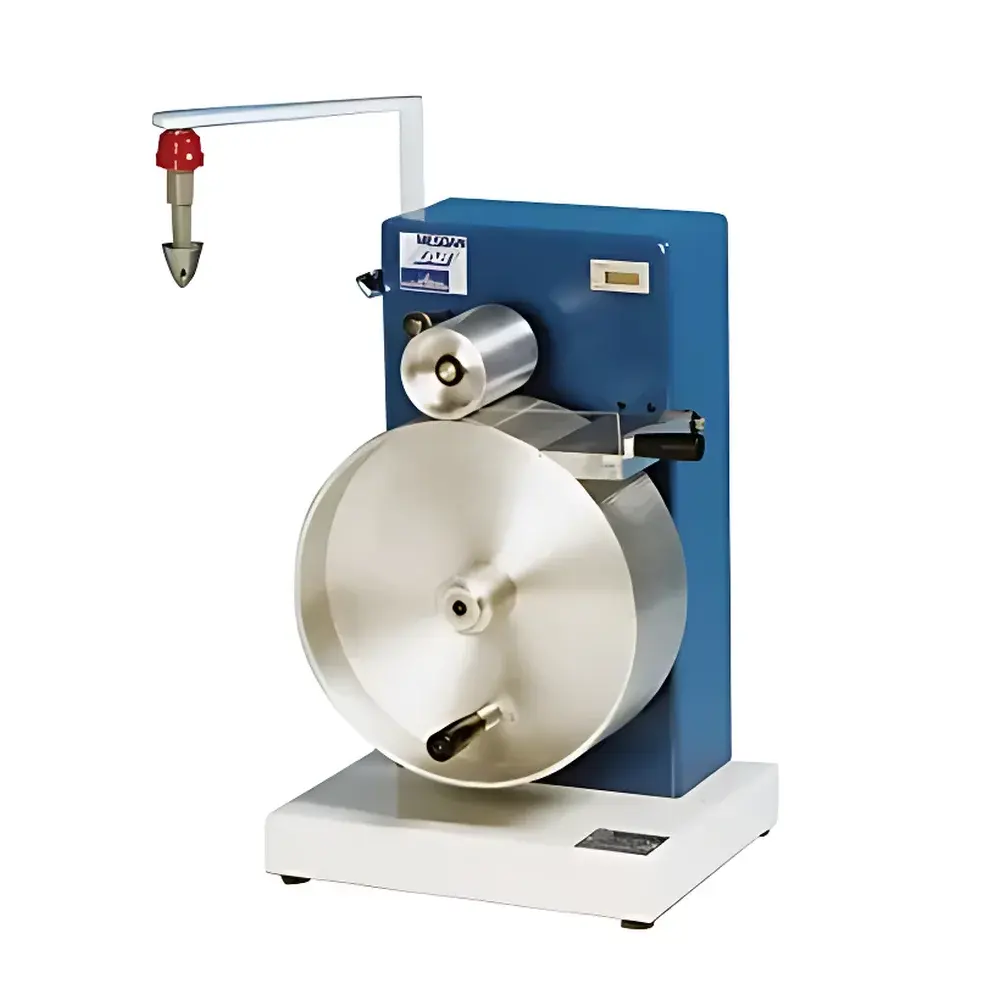
SDL Atlas F216A Fiber Sliver and Roving Lea Tester
| Brand | SDL Atlas |
|---|---|
| Origin | USA |
| Manufacturer Type | Original Equipment Manufacturer (OEM) |
| Origin Category | Imported |
| Model | F216A |
| Price Range | USD 14,000 – 70,000 |
| Testing Principle | Constant-Length Winding & Gravimetric Linear Density Determination |
| Standard Circumference Options | 1 m or 1 yd |
| Counting System | Digital Counter with Auto-Stop |
| Cutting Mechanism | Precision Guillotine Blade |
| Sample Holder | Adjustable Roving Bobbin Stand |
Overview
The SDL Atlas F216A Fiber Sliver and Roving Lea Tester is a precision-engineered instrument designed for the gravimetric determination of linear density—commonly expressed as English count (Ne), metric count (Nm), or tex—in textile slivers and rovings. It operates on the standardized lea testing principle defined in ASTM D1439, ISO 2060, and GB/T 28285:2012: a fixed-length sample (either 1 meter or 1 yard, user-selectable at installation) is wound under controlled tension onto a mandrel, then weighed to calculate mass per unit length. This method delivers high reproducibility for QC labs in spinning mills, fiber research institutes, and third-party textile testing laboratories where traceable, operator-independent linear density assessment is required for process control and specification compliance.
Key Features
- Fixed-circumference winding system with dual calibration options: 1-meter or 1-yard circumference drum—configured during factory setup and mechanically locked to prevent field modification.
- Digital counter with programmable auto-stop functionality, synchronized with the winding motor to terminate rotation precisely after the selected lea length is achieved.
- Integrated precision guillotine-style cutting mechanism ensures clean, perpendicular severance of the wound lea without fiber pull-out or deformation—critical for accurate mass measurement.
- Adjustable roving bobbin stand accommodates standard U-shaped or flanged bobbins (up to Ø250 mm × 300 mm height) with spring-loaded clamping and tension-regulated guide rollers.
- Robust cast-iron base and anodized aluminum frame provide mechanical stability during winding, minimizing vibration-induced mass error in subsequent weighing steps.
- No integrated scale: Designed for seamless integration with external analytical balances (0.001 g resolution recommended) compliant with ISO/IEC 17025 calibration requirements.
Sample Compatibility & Compliance
The F216A supports continuous sliver and roving samples ranging from 0.5 g/m to 25 g/m (approx. Ne 0.1–200 / tex 5–2000), including cotton, polyester, wool, viscose, PVA, and blended staple-fiber intermediates. Its mechanical design conforms to the dimensional and operational requirements of ASTM D1439 (Standard Test Method for Linear Density of Sliver and Roving), ISO 2060 (Textiles — Yarns — Determination of Linear Density), and ISO 1973 (Textiles — Yarns — Determination of Linear Density by the Skein Method, where applicable). The instrument is supplied with a full traceable calibration certificate referencing NIST-traceable length standards and includes documentation supporting GLP-compliant operation in regulated environments.
Software & Data Management
The F216A is a standalone electromechanical instrument with no embedded microprocessor or data storage. All test parameters—including selected circumference, winding speed (fixed at 60 rpm ±2%), stop count, and operator ID—are set manually via front-panel controls. Results are recorded externally: users log weight values from calibrated balances into LIMS or Excel-based templates aligned with ISO/IEC 17025 record-keeping protocols. Optional CSV export templates (provided in the User Manual) support audit-ready reporting, including calculation of coefficient of variation (CV%) across replicate leas per ASTM D1439 Annex A1. Instrument maintenance logs, calibration history, and uncertainty budgets are maintained separately per laboratory quality management system requirements.
Applications
- Quality assurance in ring-spinning and rotor-spinning preparatory sections—verifying draw frame and speed frame output consistency prior to yarn formation.
- Raw material acceptance testing of purchased sliver lots against supplier specifications (e.g., ±2% tolerance on nominal Ne).
- Process optimization studies evaluating drafting ratio effects on linear density uniformity across multiple machine settings.
- Reference method validation for inline near-infrared (NIR) or capacitive linear density sensors deployed on modern draw frames.
- Teaching laboratories demonstrating fundamental textile metrology principles, including the relationship between count systems (Ne, Nm, tex) and mass-length equivalence.
FAQ
What length options are supported for lea winding?
The F216A is configured at the factory for either 1-meter or 1-yard circumference—this is a mechanical setting and cannot be changed in the field. Users must specify their preferred standard during ordering.
Does the instrument include a balance?
No. The F216A does not incorporate a weighing module. It is intended for use with external analytical balances meeting ISO 9001 and ISO/IEC 17025 traceability requirements.
Is the winding tension adjustable?
Tension is maintained passively via calibrated spring-loaded guide rollers and is optimized for standard sliver/roving tensile strength (1.5–3.5 cN/tex); no user adjustment is provided to ensure method consistency per ASTM D1439.
Can the F216A test filament yarns?
No. This instrument is validated exclusively for discontinuous staple-fiber products—slivers and rovings—with cohesive structure sufficient to withstand lea winding without breakage or slippage.
What maintenance is required?
Biannual inspection of blade sharpness, drum surface integrity, and counter gear alignment is recommended; full service documentation and OEM spare parts (e.g., replacement blades, roller bushings) are available directly from SDL Atlas Technical Support.





