
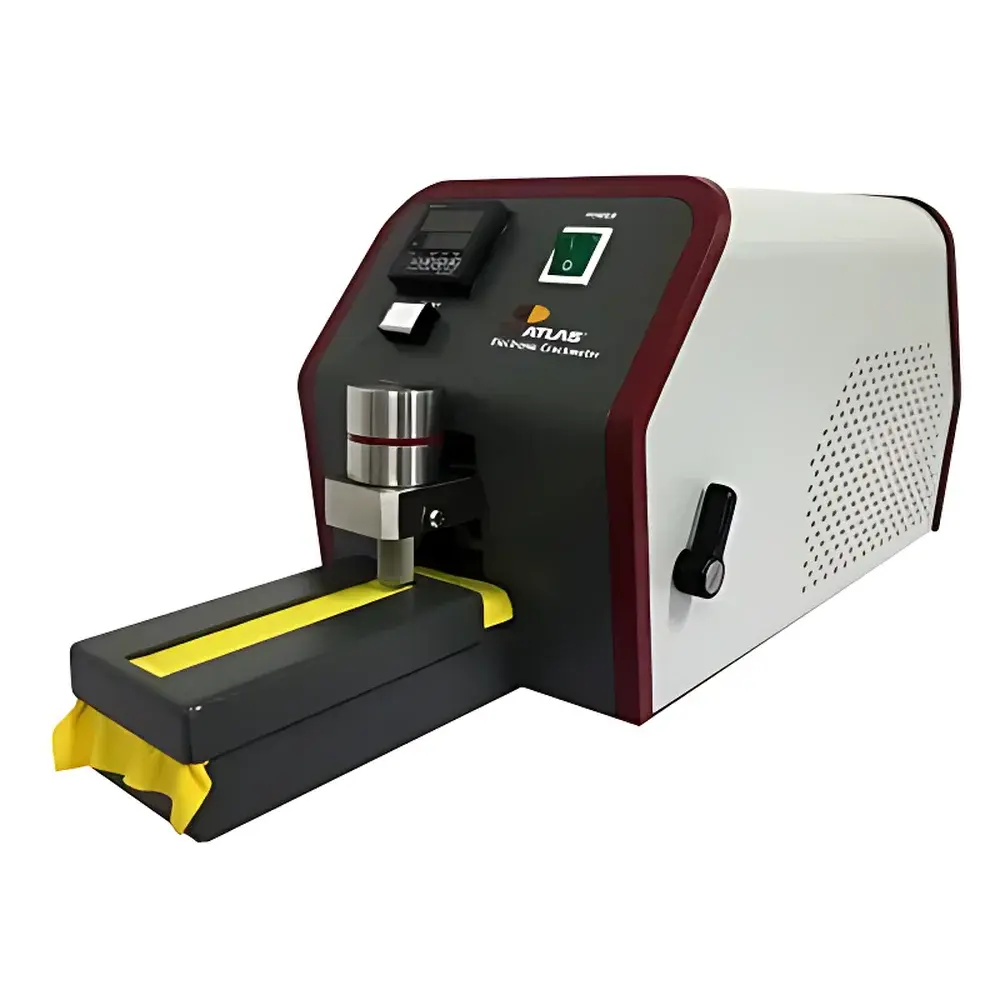
SDL Atlas M238BB Electric Crockmeter
| Brand | SDL Atlas |
|---|---|
| Origin | Guangdong, China |
| Manufacturer Type | Manufacturer |
| Country of Origin | China |
| Model | M238BB |
| Price Range | USD 7,000 – 14,000 |
| Load | 9 N (standard arm) |
| Cycle Counting Range | 0–9,999 cycles (electronic preset counter) |
| Compliance | AATCC Test Method 8, AATCC Test Method 165, ISO 105-X12 (equivalent), ASTM D1509, BS EN ISO 105-X12 |
Overview
The SDL Atlas M238BB Electric Crockmeter is an electromechanically actuated instrument engineered for precise and repeatable assessment of color fastness to dry and wet rubbing (crocking) in textile materials. It operates on the principle of controlled linear reciprocating motion between a standardized abrasive surface—typically cotton fabric—and the test specimen under defined normal force and stroke length. The device conforms to the fundamental mechanical requirements specified in AATCC Test Method 8 (Colorfastness to Crocking: Crockmeter Method) and AATCC Test Method 165 (Colorfastness to Crocking: Rotary Crockmeter Method), while maintaining compatibility with ISO 105-X12, ASTM D1509, and BS EN ISO 105-X12 through its calibrated load application and motion profile. Designed for routine quality control laboratories and R&D facilities in global textile supply chains, the M238BB delivers high reproducibility across extended testing campaigns due to its robust stepper motor drive, precision-machined guide rails, and thermally stable aluminum frame.
Key Features
- Electronically programmable cycle counter with full-digit display (0–9,999 cycles), supporting both single-cycle initiation and batch-mode auto-termination.
- Standard 9 N loading arm with integrated stainless-steel weight carrier and quick-release mechanism for rapid calibration verification.
- Optional lightweight friction arm available—designed for manual load customization via supplementary calibrated weights (e.g., 2 N, 4 N, 12 N), enabling method-specific adaptation without hardware modification.
- Fixed stroke length of 104 mm ± 1 mm, compliant with AATCC 8 and ISO 105-X12 geometrical specifications.
- Adjustable sample clamping system accommodating specimens up to 140 mm × 50 mm, with uniform pressure distribution across the gripping area.
- Integrated LED status indicators for power, motor operation, and cycle completion; front-panel tactile buttons with haptic feedback for glove-compatible operation.
Sample Compatibility & Compliance
The M238BB accommodates woven, knitted, nonwoven, and dyed or printed textile substrates—including technical textiles, apparel fabrics, home furnishings, and automotive interiors. Specimen thickness up to 8 mm is supported without interference to stroke integrity. All mechanical interfaces—including the standard cotton crocking cloth holder, specimen backing plate, and load arm pivot geometry—meet dimensional tolerances defined in AATCC TM8 Annex A and ISO 105-X12 Clause 5. The instrument’s load application accuracy (±0.1 N at 9 N setting) and motion repeatability (±0.3 mm stroke deviation over 10,000 cycles) are validated per internal metrology protocol traceable to NIM (National Institute of Metrology, China) standards. While not certified to IEC 61000-6-3 or ISO/IEC 17025 as a standalone unit, the M238BB is routinely deployed in GLP-compliant textile testing labs where method validation, equipment qualification (IQ/OQ), and periodic performance verification are conducted in accordance with ISO/IEC 17025:2017 Clause 6.5.
Software & Data Management
The M238BB operates as a stand-alone electromechanical tester with no embedded microprocessor or data logging capability. All operational parameters—including cycle count, load configuration, and test date—are recorded manually or integrated into LIMS via external barcode-scanned test ID entry. For laboratories requiring digital audit trails, SDL Atlas recommends pairing the M238BB with the AtlasView™ QC Suite (v4.2+), which supports structured test record generation, pass/fail rule application against AATCC Gray Scale or ISO Evaluation Scale, and export to CSV or PDF for FDA 21 CFR Part 11–aligned archival when deployed with validated electronic signature modules.
Applications
- Quality assurance of reactive, vat, and pigment-printed cotton fabrics prior to shipment.
- Comparative evaluation of anti-crocking finishing agents (e.g., cationic polymers, crosslinking resins) in pilot-scale trials.
- Validation of digital inkjet print durability on polyester blends used in sportswear.
- Regulatory submission testing for OEKO-TEX® Standard 100 Class II products requiring documented crocking performance.
- Internal method transfer studies between satellite labs operating different generations of crockmeters (e.g., M238BB vs. older M238A).
FAQ
Does the M238BB support wet crocking tests?
Yes—the instrument includes a removable fluid reservoir tray beneath the specimen stage and is compatible with AATCC Test Method 8’s wet crocking procedure using distilled water-saturated cotton cloth.
Is calibration certification included with purchase?
A factory-issued Certificate of Conformance (CoC) is provided; optional UKAS-accredited calibration certificate (per ISO/IEC 17025) is available upon request at additional cost.
Can the M238BB be used for leather or coated fabrics?
It is validated for textile substrates per AATCC/ISO standards; use on non-textile materials requires method adaptation and in-house verification of stroke fidelity and load distribution.
What maintenance intervals are recommended?
Lubrication of linear guides every 6 months and annual verification of load arm pivot friction torque (target: ≤0.05 N·m) are advised per SDL Atlas Maintenance Bulletin MB-M238-2023.






