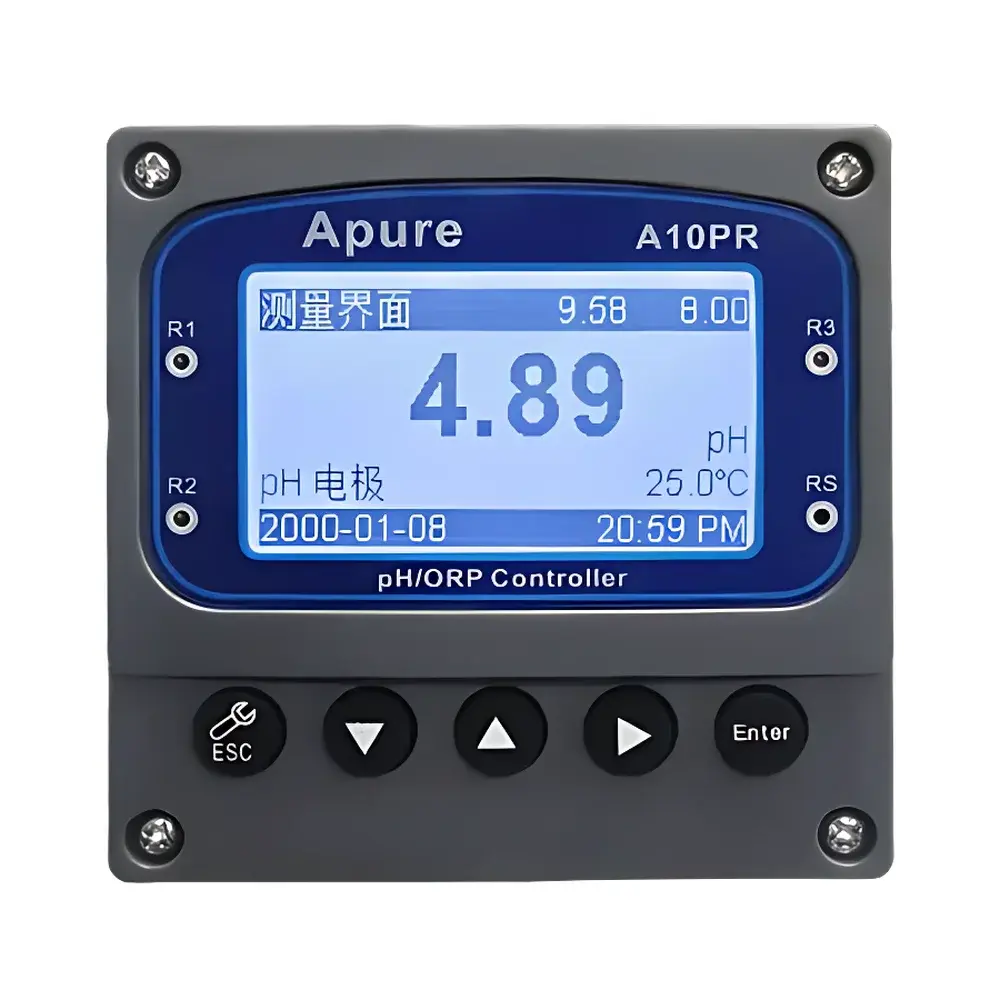
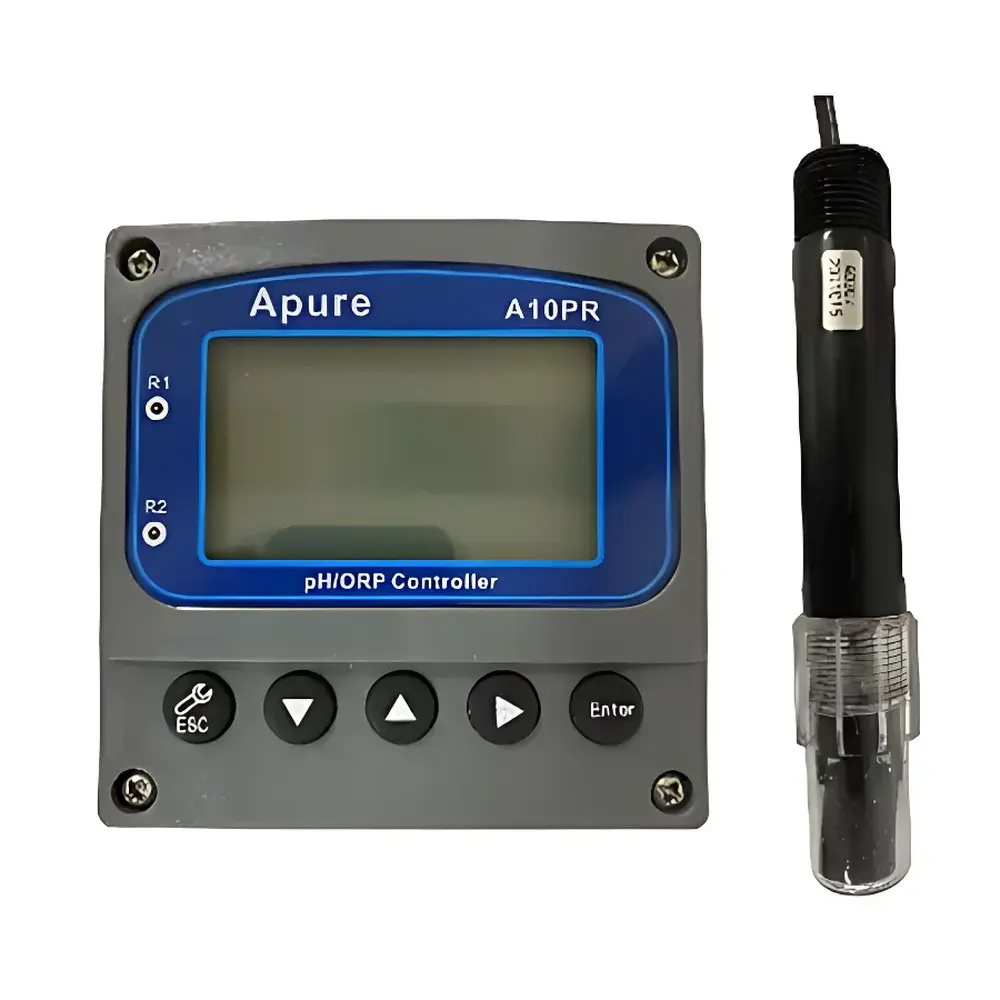
APURE A10PR-SA1-CCEP Online pH Meter with Environmental Certification
| Brand | APURE |
|---|---|
| Model | A10PR-SA1-CCEP |
| Origin | Shanghai, China |
| Manufacturer Type | Direct Manufacturer |
| Measurement Range | pH 0.00–14.00 |
| Resolution | ±0.01 pH |
| Accuracy | ±0.01 pH |
| Temperature Compensation | 0–100 °C (Manual / PT1000 / NTC10K) |
| Output | Isolated 4–20 mA (pH or temperature selectable) |
| Communication | MODBUS RTU (RS-485) |
| Relay Outputs | 2 × SPDT, 3 A / 250 V AC, programmable high/low setpoints with adjustable hysteresis |
| Power Supply | AC 220 V, ≤7 W |
| Dimensions | 96 mm (H) × 96 mm (W) × 132 mm (D) |
| Panel Cutout | 92.5 mm × 92.5 mm |
| Operating Environment | 0–50 °C, ≤85% RH (non-condensing) |
| Data Logging | Real-time pH trend + 30-event relay alarm history |
| User Interface | Dual-language (Chinese/English), menu-guided navigation |
| Security | Password-protected configuration access |
Overview
The APURE A10PR-SA1-CCEP is an industrial-grade online pH meter engineered for continuous, high-stability measurement of aqueous solution acidity in demanding process environments. Designed around a robust two-electrode or three-electrode sensing architecture (compatible with standard glass pH electrodes and reference electrodes), it employs potentiometric measurement principles compliant with ISO 3696, ASTM D1293, and IEC 60746-1 standards for electrochemical pH determination. Its certified environmental compliance—verified against RoHS Directive 2011/65/EU and meeting CE marking requirements for electromagnetic compatibility (EN 61326-1) and low-voltage safety (EN 61010-1)—ensures suitability for regulated water quality monitoring applications, including those subject to municipal discharge reporting or ISO 14001-aligned facility management systems.
Key Features
- True dual-range digital resolution: configurable display modes supporting 0.0–14.0 pH (one decimal) and 0.00–14.00 pH (two decimals), enabling trace-level process deviation detection without mode switching.
- Triple-mode temperature compensation: automatic compensation via integrated PT1000 or NTC10K sensors, or manual input—critical for maintaining accuracy across thermal gradients in wastewater influent, boiler feedwater, or bioreactor streams.
- Galvanically isolated 4–20 mA analog output with independent channel assignment: one loop dedicated to pH value, the second assignable to temperature—each protected against ground loops and common-mode noise per IEC 61000-4-5 surge immunity Class 3.
- MODBUS RTU protocol support over RS-485 interface: enables seamless integration into SCADA, DCS, or PLC-based control systems (e.g., Siemens S7, Rockwell ControlLogix, Schneider EcoStruxure) with full register mapping for real-time parameter read/write and event-triggered diagnostics.
- Dual programmable relays: SPDT contacts rated at 3 A / 250 V AC, configurable as high/low alarms, pump control interlocks, or neutralization dosing triggers; hysteresis adjustable from 0.01 to 2.00 pH units to prevent chattering under marginal conditions.
- Secure operational integrity: password-protected configuration mode prevents unauthorized calibration or setpoint changes—supporting audit-ready workflows aligned with GLP and internal QA protocols.
Sample Compatibility & Compliance
The A10PR-SA1-CCEP interfaces with standard industrial pH electrodes (e.g., double-junction gel-filled, refillable liquid-filled, or solid-state variants) and supports both direct immersion and flow-through cell configurations. It is validated for use in non-explosive atmospheres (IEC 60079-0 general-purpose rating) and meets IP65 front-panel ingress protection when installed with appropriate gasketed enclosures. Regulatory conformance includes CE marking under the Electromagnetic Compatibility Directive 2014/30/EU and Low Voltage Directive 2014/35/EU; environmental certification covers restricted substance compliance per EU RoHS Annex II and REACH SVHC screening. While not intrinsically safe, it is routinely deployed in municipal wastewater treatment plants (per EN 12952-12), pharmaceutical clean utility monitoring (aligned with USP <797> environmental controls), and food-grade CIP rinse validation per FDA 21 CFR Part 11 data integrity prerequisites.
Software & Data Management
No proprietary PC software is required for basic operation; all configuration is performed locally via the intuitive membrane keypad and LCD interface. However, the MODBUS RTU interface permits integration with third-party historian platforms (e.g., Ignition SCADA, Siemens Desigo CC, or custom Python-based logging tools) for long-term trend analysis, automated report generation, and alarm correlation. The built-in non-volatile memory stores up to 30 timestamped relay activation events—including date, time, pH value, and triggered setpoint—with retention persisting through power cycles. Real-time pH values are continuously buffered for local display scrolling, supporting immediate operator assessment without external instrumentation.
Applications
This analyzer serves as a primary or backup pH monitoring node in continuous-flow applications where regulatory or process stability demands traceable, repeatable measurements. Typical deployments include: effluent pH compliance monitoring prior to municipal sewer discharge; upstream/downstream pH verification in lime softening or acid-neutralization stages; conductivity-pH co-monitoring in reverse osmosis pretreatment; fermentation pH feedback control in biopharmaceutical upstream processing; and final rinse verification in medical device cleaning validation per ISO 15883. Its compact 96×96 mm panel-mount form factor allows retrofit installation into legacy control panels without structural modification.
FAQ
Does the A10PR-SA1-CCEP support automatic calibration?
No—it is designed for manual calibration using standard buffer solutions (pH 4.01, 7.00, and 10.01) per ISO 8655-4; automatic calibration requires external electrode management modules not included in this model.
Can the 4–20 mA outputs be scaled independently?
Yes—each analog output channel supports user-defined span mapping (e.g., 4 mA = pH 6.5, 20 mA = pH 7.5) to optimize resolution within narrow critical control bands.
Is NIST-traceable calibration documentation available?
Factory calibration certificates (with uncertainty budgets per ISO/IEC 17025 principles) are provided upon request; field recalibration must be performed using accredited laboratory-grade buffers.
What electrode types are recommended for high-suspended-solids wastewater?
Double-junction electrodes with ceramic junctions or open-flow reference systems (e.g., APURE E-202D series) are advised to minimize clogging and junction potential drift.
Does the unit meet FDA 21 CFR Part 11 requirements for electronic records?
While the device itself does not provide electronic signature capability, its MODBUS-accessible real-time data and alarm logs—when captured and archived by a validated Part 11-compliant system—fulfill data integrity requirements for GxP environments.