
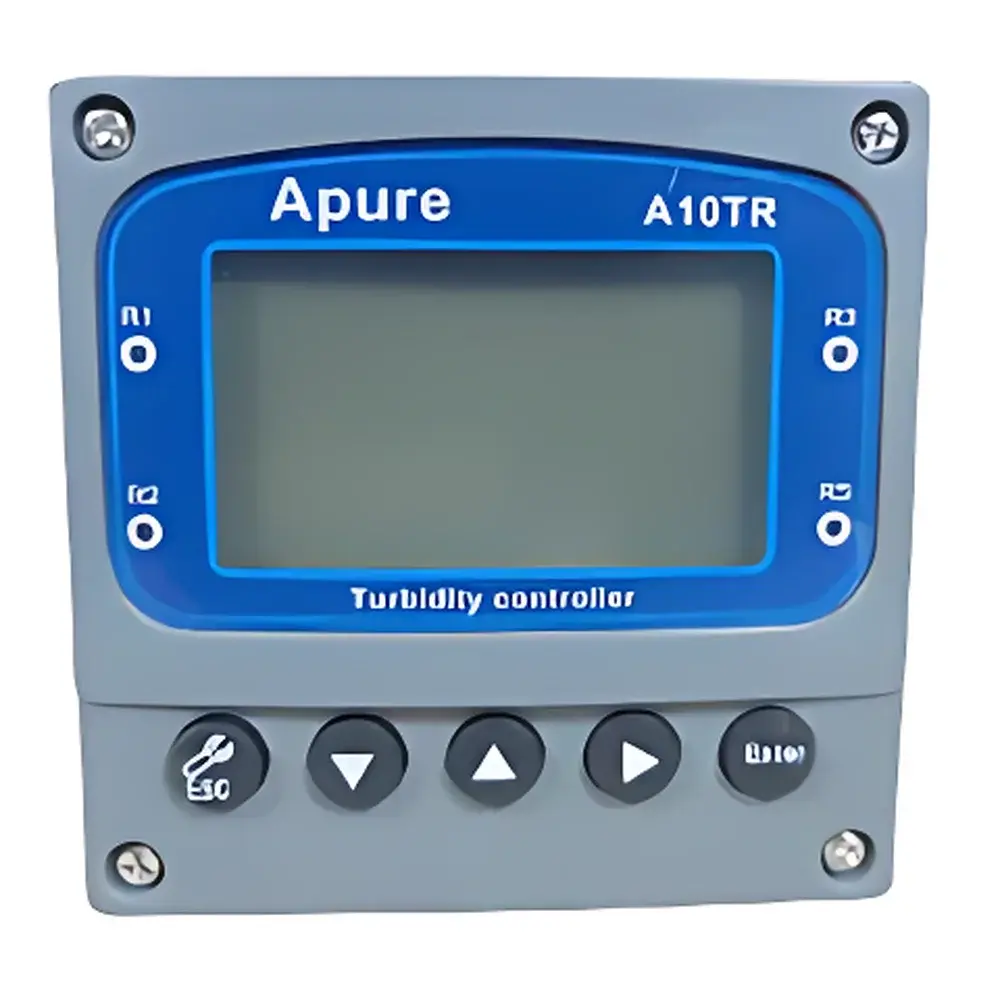
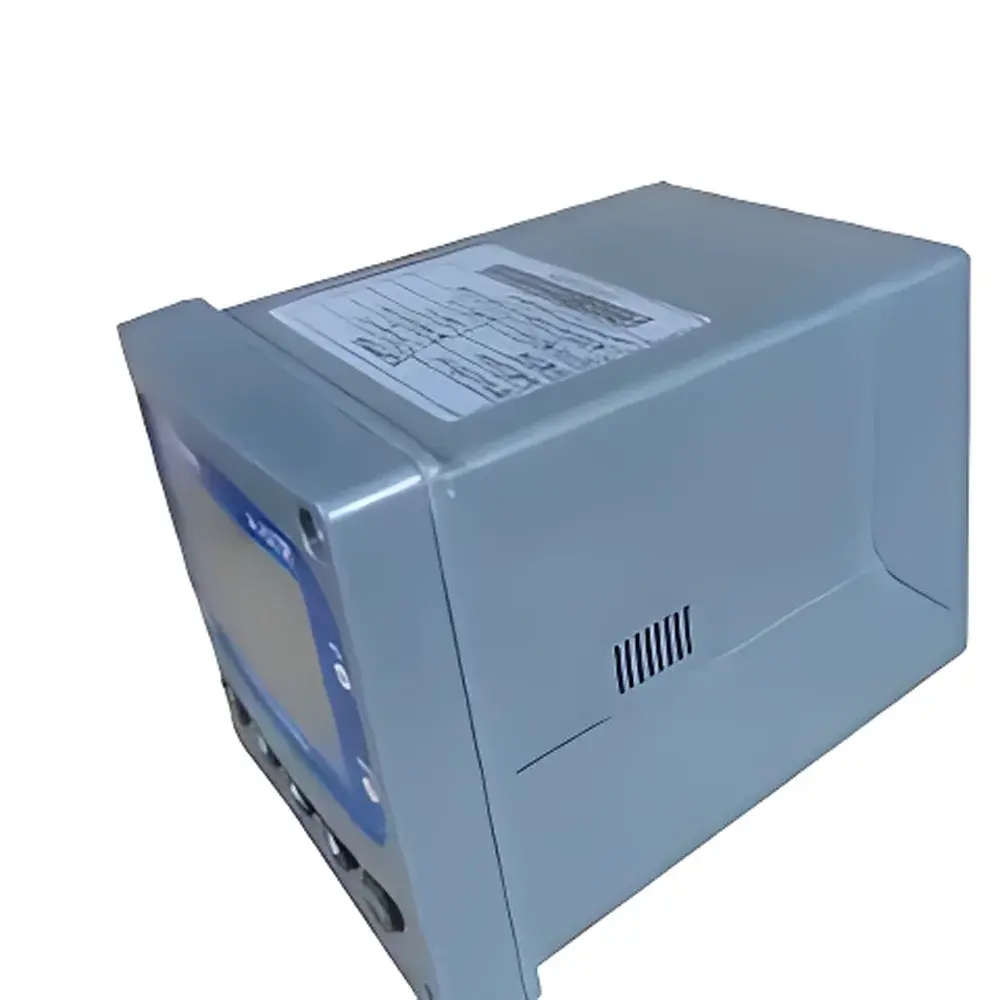
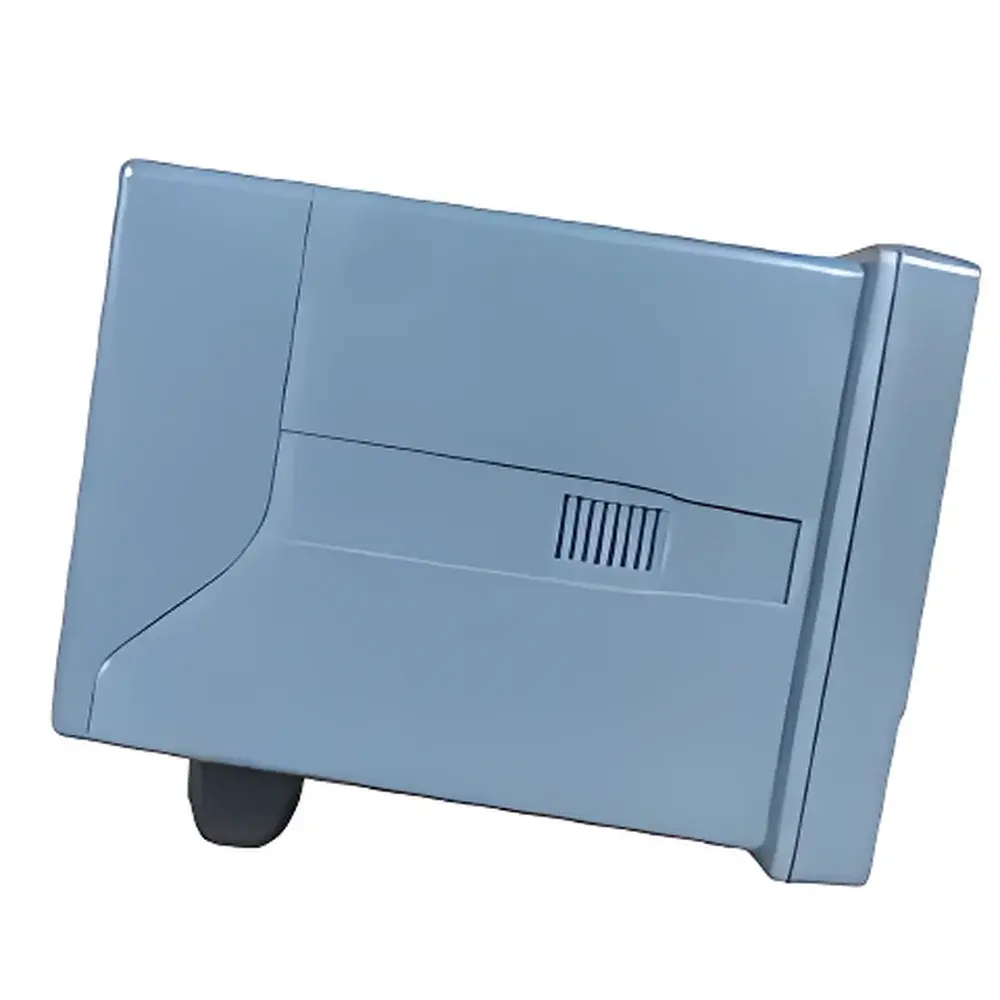
APURE A10TR-AA1 Online Turbidimeter
| Brand | APURE |
|---|---|
| Origin | Shanghai, China |
| Manufacturer Type | OEM/ODM Manufacturer |
| Regional Classification | Domestic (China) |
| Model | A10TR-AA1 |
| Price | USD 195 (FOB Shanghai) |
| Instrument Type | Online Turbidimeter |
| Measurement Ranges | 0–20 NTU, 0–400 NTU, 0–4000 NTU (custom ranges available) |
| Resolution | 0.01 NTU |
| Operating Temperature | 0–60 °C |
| Accuracy | ±1.0 % FS |
| Temperature Compensation | 0–100 °C (manual or automatic) |
| Output Signals | Isolated 4–20 mA (max. load 500 Ω), assignable to turbidity or temperature |
| Relay Outputs | 3 × SPDT relays (3 A / 250 V AC, NO contact), programmable high/low alarm thresholds with adjustable hysteresis |
| Power Supply | AC 220 V ±10 % / 50–60 Hz or DC 24 V ±10 % |
| Power Consumption | ≤7 W |
| Enclosure Dimensions | 96 × 96 × 132 mm (H × W × D) |
| Panel Cutout | 92.5 × 92.5 mm |
| Environmental Rating | IP65 front panel |
| Relative Humidity | ≤85 % RH (non-condensing) |
Overview
The APURE A10TR-AA1 Online Turbidimeter is an industrial-grade optical instrument engineered for continuous, real-time measurement of turbidity in aqueous process streams using the nephelometric principle—detection of scattered light at a 90° angle relative to the incident beam, in strict compliance with ISO 7027 and EPA Method 180.1. Designed for permanent installation in fixed-location monitoring applications, it employs a stable LED light source (850 nm) and precision photodetector assembly to deliver high reproducibility across extended operational cycles. Its compact 96×96 mm DIN-form factor enables seamless integration into existing PLC-controlled water treatment panels, SCADA systems, or centralized QC dashboards. The instrument operates without consumables or reagents, relying solely on calibrated optical path geometry and signal processing algorithms validated against NIST-traceable turbidity standards.
Key Features
- Multi-range capability with factory-configurable spans: 0–20 NTU (high-sensitivity for potable water), 0–400 NTU (municipal wastewater influent/effluent), and 0–4000 NTU (sludge dewatering or industrial effluent); custom calibration curves available upon request.
- Isolated 4–20 mA analog output with galvanic isolation (>1500 VDC), supporting two independent channels—one for turbidity value and one for internal temperature reading—enabling simultaneous process and thermal condition monitoring.
- Three fully configurable SPDT relay outputs (3 A / 250 V AC), each programmable as high-alarm, low-alarm, or latching alarm; hysteresis adjustment prevents chattering during marginal threshold crossings.
- Dual-language interface (English/Chinese) with intuitive menu navigation and context-sensitive on-screen prompts—designed to reduce operator training time and minimize configuration errors in multilingual plant environments.
- Robust mechanical architecture: front-panel IP65 rating, reinforced polycarbonate housing, and conformal-coated PCBs ensure reliable operation in humid, chemically aggressive, or vibration-prone utility corridors and pump stations.
- Password-protected configuration mode restricts access to calibration, range selection, and relay logic settings—supporting GLP-aligned operational discipline and audit readiness.
Sample Compatibility & Compliance
The A10TR-AA1 is optimized for clean-to-moderately turbid aqueous solutions with suspended particle diameters ranging from sub-micron colloids to ~100 µm flocs. It is compatible with standard 1/4″–3/8″ stainless steel or PVC sample tubing (flow-through cell option available separately). The sensor meets electromagnetic compatibility requirements per IEC 61326-1 (industrial environment) and electrical safety standards per IEC 61010-1. Calibration traceability follows ISO/IEC 17025 guidelines when performed using APURE-certified Formazin or AMCO AEPA standards. While not intrinsically safe, it is suitable for Zone 2/Class I Div 2 areas when installed outside hazardous boundaries per NEC Article 500.
Software & Data Management
No proprietary software is required for basic operation; all configuration is performed via the built-in membrane keypad and LCD display. For system-level integration, the 4–20 mA output interfaces directly with Siemens S7, Rockwell ControlLogix, or Schneider Modicon PLCs using standard HART-compatible analog input modules. Optional Modbus RTU (RS-485) communication module (A10TR-MB) enables digital readout of turbidity, temperature, relay status, and diagnostic flags—including sensor fouling detection (via signal drift trend analysis) and lamp aging compensation. All parameter changes are timestamped and logged locally (non-volatile memory), satisfying basic FDA 21 CFR Part 11 data integrity expectations for non-GMP utility monitoring.
Applications
- Municipal drinking water treatment: monitoring filter backwash efficiency, clarifier performance, and final distribution line quality.
- Wastewater plants: tracking primary sedimentation, activated sludge health, and tertiary membrane filtration integrity.
- Pharmaceutical utilities: verifying purified water (PW) and water-for-injection (WFI) loop clarity prior to point-of-use sampling.
- Power generation: detecting condenser tube leakage and monitoring boiler feedwater pretreatment stages.
- Food & beverage processing: ensuring rinse water clarity in CIP systems and verifying particulate removal in juice/cider clarification lines.
FAQ
What turbidity standards are supported for calibration?
The A10TR-AA1 supports calibration using Formazin (FTU), AMCO AEPA (NTU), and StablCal polymer standards. Factory calibration is performed with AMCO AEPA reference materials traceable to NIST SRM 2134b.
Can the instrument operate in pressurized sample lines?
Yes—when paired with the optional flow-through quartz cell (A10TR-FC1), it accommodates pressures up to 6 bar (87 psi) and flow rates of 10–500 mL/min.
Is temperature compensation mandatory?
Automatic temperature compensation (0–100 °C) is enabled by default but may be disabled for applications where thermal effects are negligible or intentionally excluded from reporting.
How often does the sensor require maintenance?
Under typical municipal water conditions, optical window cleaning is recommended every 3–6 months; no lamp replacement is needed within the 50,000-hour LED service life.
Does the device support MODBUS TCP/IP?
No—the base model supports only analog (4–20 mA) and relay outputs. Modbus RTU (RS-485) is available via add-on module A10TR-MB; Ethernet-based protocols require external gateway integration.





