
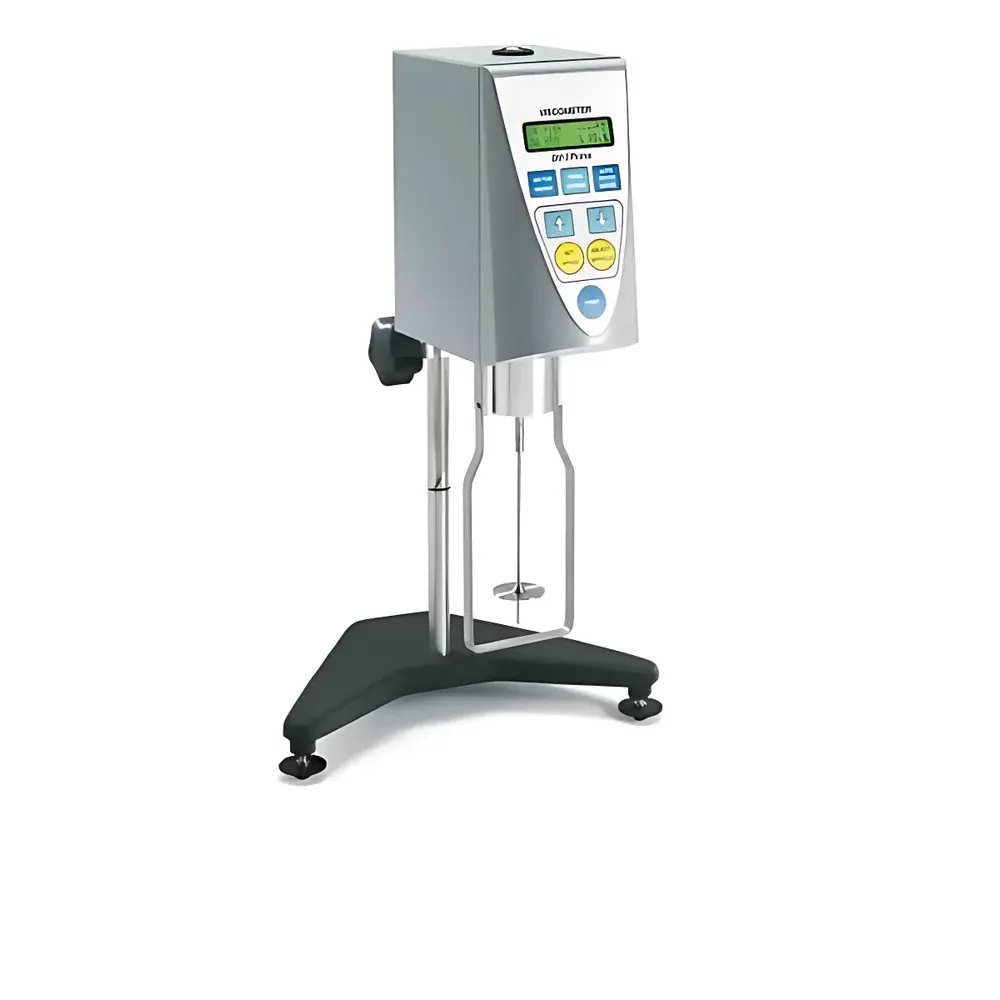
SDL Atlas D443 Digital Rotational Viscometer
| Brand | SDL Atlas |
|---|---|
| Origin | USA |
| Manufacturer Type | Original Equipment Manufacturer (OEM) |
| Import Status | Imported |
| Model | D443 |
| Pricing | Upon Request |
Overview
The SDL Atlas D443 Digital Rotational Viscometer is a precision-engineered instrument designed for reliable, repeatable viscosity measurement in textile dyeing and printing processes. It operates on the principle of rotational viscometry—measuring the torque required to rotate a spindle (rotor) at a defined angular velocity within a fluid sample under controlled shear conditions. This method conforms to fundamental rheological standards including ASTM D1084 and ISO 2555, enabling quantification of apparent viscosity under steady-state shear flow. The D443 delivers direct digital readouts in centipoise (cP) or pascal-seconds (Pa·s), with simultaneous display of percent torque, rotational speed (RPM), and selected spindle rotation rate—providing immediate insight into sample rheological behavior without post-processing.
Key Features
- 18 discrete rotational speeds ranging from 0.3 to 100 RPM, allowing flexible shear rate selection across low- to medium-viscosity ranges typical of dye baths, thickeners, sizing agents, and binder formulations.
- Dual-unit display capability: real-time output in both cP and Pa·s, supporting international reporting requirements and unit consistency across laboratory documentation.
- Integrated torque monitoring: displays % torque in real time, serving as an indicator of instrument loading and aiding in optimal rotor selection and measurement validity assessment.
- Modular rotor set included: standardized spindles calibrated for low-viscosity (e.g., L-series) and medium-viscosity (e.g., M-series) applications—ensuring appropriate shear stress application and minimizing wall effects in non-Newtonian textile fluids.
- Built-in support stand with leveling feet: ensures mechanical stability during operation and eliminates external vibration interference critical for reproducible low-torque measurements.
- Rugged, impact-resistant carrying case: facilitates secure transport between production labs, quality control stations, and R&D facilities—maintaining calibration integrity during relocation.
Sample Compatibility & Compliance
The D443 is optimized for aqueous and solvent-based systems commonly encountered in textile wet processing: dye solutions, reactive thickener pastes, starch- and polyacrylate-based printing slurries, desizing agents, and synthetic lubricant emulsions. Its rotor geometry and speed range are validated for samples exhibiting mild to moderate non-Newtonian behavior—such as shear-thinning thickeners used in screen and roller printing. Instrument design adheres to IEC 61000-6-3 (EMC emission standards) and meets general safety requirements per UL 61010-1. While not certified for GLP/GMP environments out-of-the-box, its stable analog-to-digital signal path, absence of internal memory for audit trail, and manual data recording workflow align with basic QC documentation practices compliant with ISO/IEC 17025 clause 7.7 (result reporting) when paired with traceable calibration records.
Software & Data Management
The D443 operates as a standalone benchtop instrument with no embedded software or USB/Bluetooth connectivity. All measurements are displayed locally on the integrated LCD screen; data export requires manual transcription or optional third-party analog-output interfaces (e.g., 0–5 V DC signal output via accessory module, sold separately). This architecture supports environments where IT security policies restrict networked instrumentation or where process validation mandates deterministic, non-programmable measurement pathways. For laboratories requiring electronic records, integration with LIMS or Excel-based logging is achievable using external analog-to-digital converters compliant with FDA 21 CFR Part 11 Annex 11 principles—provided user-defined SOPs govern calibration frequency, operator training, and record review protocols.
Applications
- Viscosity verification of reactive dye stock solutions prior to padding or exhaust dyeing—ensuring uniform liquor circulation and consistent color yield.
- Quality control of sodium alginate and synthetic thickener pastes used in pigment and reactive printing—correlating viscosity with print definition and edge sharpness.
- Batch-to-batch consistency testing of sizing formulations (e.g., PVA, modified starch) applied to warp yarns—supporting tensile integrity and weaving efficiency.
- Stability assessment of emulsified lubricants in mercerization and finishing baths—detecting phase separation through viscosity drift over time.
- Formulation development of binder dispersions for digital textile inkjet inks—evaluating low-shear viscosity relevant to printhead compatibility.
FAQ
Is the D443 suitable for measuring highly shear-thinning or thixotropic textile pastes?
It provides valid single-point apparent viscosity values at each selected RPM but does not perform dynamic ramp or time-dependent scans. For full thixotropy characterization, a controlled-stress rheometer is recommended.
What calibration standards are supplied with the instrument?
NIST-traceable silicone oil standards (e.g., 100 cP and 1000 cP) are available as optional accessories; factory calibration certificates reference ASTM D2196 procedures.
Can the D443 be used for hot melt or high-temperature dye baths?
No—the standard rotors and housing are rated for ambient temperature operation only (15–30 °C); elevated temperature measurements require specialized heated jacket systems not supported by this model.
Does the D443 meet ISO 8504-2 requirements for coating viscosity testing?
While not explicitly certified to ISO 8504-2 (which specifies Ford cups and flow cups), its rotational methodology satisfies the broader metrological intent of viscosity quantification for process liquids per ISO 2555.
How often should rotor calibration be verified?
SDL Atlas recommends annual verification against certified reference oils or after any physical impact to the spindle assembly—documented per internal QA procedure aligned with ISO/IEC 17025 section 6.4.
Related Products





