
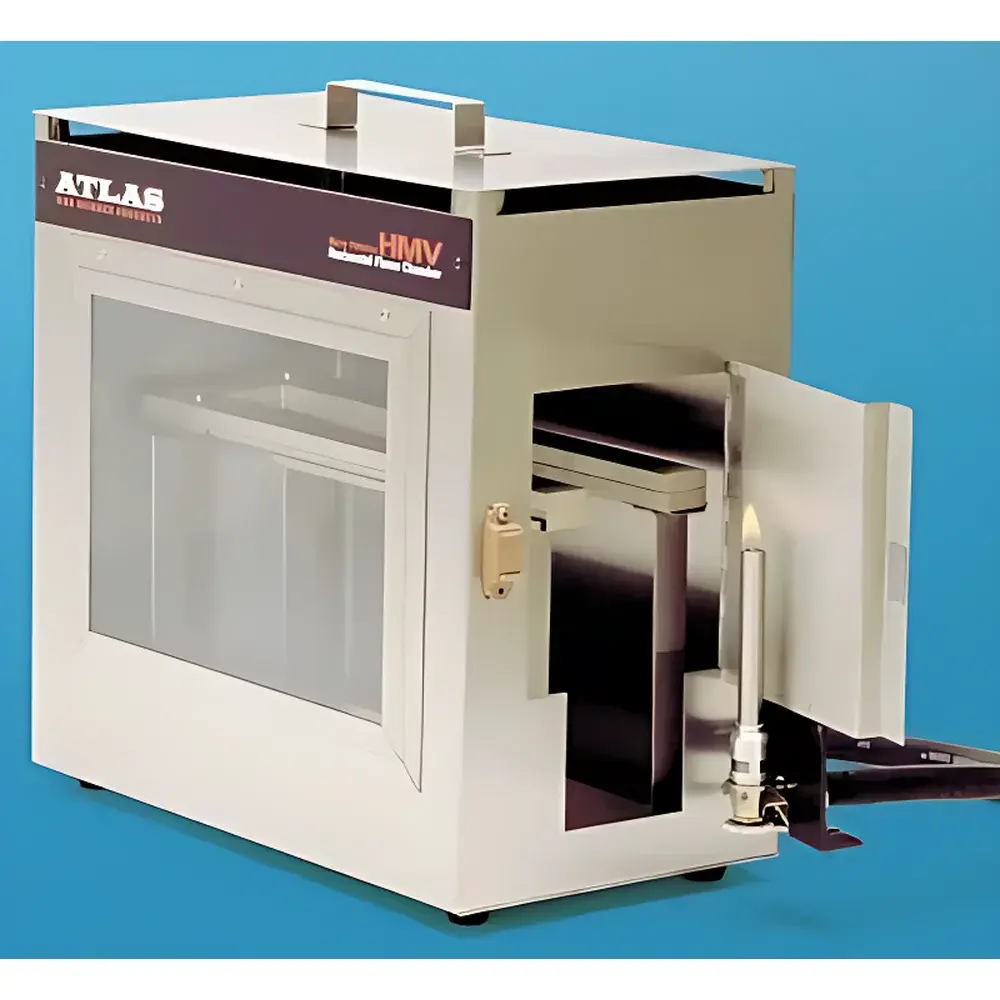
ATLAS M233F Horizontal Flame Resistance Tester
| Brand | ATLAS |
|---|---|
| Origin | USA |
| Model | M233F |
| Application | Textile and Automotive Interior Materials |
| Compliance Basis | ASTM D5132, ISO 3795, FMVSS 302, DIN 75200, JIS D1201 |
| Chamber Construction | Sealed stainless steel combustion chamber with borosilicate observation window |
| Burner Type | Door-mounted Bunsen-type burner |
| Ignition Method | Manual or optional automatic spark ignition |
| Timing Control | Manual stopwatch interface or programmable digital timer (optional) |
| Gas Supply | Regulated propane or butane (user-supplied, certified grade) |
| Sample Holder | Precision-machined horizontal specimen clamp with adjustable positioning |
| Safety Features | Interlocked access door, flame-out detection, ventilation interlock |
Overview
The ATLAS M233F Horizontal Flame Resistance Tester is a precision-engineered instrument designed to evaluate the horizontal flame propagation behavior of flat textile materials—particularly automotive interior fabrics, seat covers, headliners, and carpeting—under standardized thermal exposure conditions. It operates on the principle of controlled open-flame impingement at a defined angle (0°, i.e., parallel to the specimen surface), followed by measurement of flame spread distance and afterflame/afterglow duration in accordance with internationally recognized flammability test protocols. The system implements a repeatable, gravity-driven flame travel regime across horizontally oriented specimens, enabling quantitative assessment of relative burning rate (mm/min) and pass/fail compliance against regulatory thresholds. Its robust architecture ensures consistent thermal flux delivery, minimal environmental interference, and operator safety during routine QC testing and R&D validation.
Key Features
- Sealed stainless steel combustion chamber with high-temperature-resistant borosilicate glass viewport for real-time visual monitoring without compromising containment integrity.
- Door-mounted Bunsen-type burner with calibrated orifice and adjustable height, enabling precise flame geometry and reproducible heat flux distribution per ASTM D5132 Annex A1.
- Horizontal specimen holder fabricated from corrosion-resistant alloy, accommodating standard 356 mm × 100 mm test specimens with ±0.5 mm positional repeatability.
- Manual timing interface integrated into the control panel, supporting synchronized start/stop functions aligned with flame application and extinction events.
- Optional automated gas control module featuring solenoid-regulated propane/butane supply, microsecond-precision spark ignition, and programmable dwell time sequencing (0–180 s).
- Interlocked access door with positive mechanical latch and integrated flame-sensing circuitry that halts gas flow upon unintended opening or flameout detection.
- Integrated ventilation interlock ensuring exhaust airflow verification prior to test initiation—critical for maintaining safe oxygen concentration and preventing backdraft.
Sample Compatibility & Compliance
The M233F accommodates woven, knitted, nonwoven, laminated, and coated textile substrates up to 13 mm thick, including foam-backed composites commonly used in automotive OEM specifications. It supports preconditioning per ISO 139 (standard atmosphere: 23 °C ± 1 °C, 50 % RH ± 2 %) and is validated for conformance to multiple regulatory frameworks: ASTM D5132 (Standard Test Method for Determining Horizontal Burning Characteristics of Automotive Interior Materials), ISO 3795 (Road Vehicles — Determination of Burning Behaviour of Interior Materials), FMVSS 302 (Federal Motor Vehicle Safety Standard No. 302), DIN 75200 (Motor vehicles — Interior materials — Determination of burning behaviour), and JIS D1201 (Automotive interior materials — Flammability test). All test reports generated are compatible with GLP-compliant documentation workflows and support audit-ready traceability when paired with optional digital logging.
Software & Data Management
While the base M233F operates via hardwired analog controls, the optional ATLAS TestLink™ Digital Module enables full PC-based operation through USB or Ethernet connectivity. This module provides timestamped event logging (ignition, flame front arrival at reference marks, self-extinguishment), automatic calculation of burning rate (mm/min), and export of CSV/Excel-formatted datasets compliant with FDA 21 CFR Part 11 requirements—including electronic signatures, audit trails, and user-access level management. Raw video capture via external HD camera integration is supported for forensic review and internal training archives.
Applications
- Quality assurance of automotive interior textiles across Tier-1 suppliers and OEM validation labs.
- Regulatory pre-compliance screening for FMVSS 302 submissions prior to third-party certification.
- Comparative flame retardant efficacy studies during formulation development of FR-treated fibers and coatings.
- Failure analysis of non-conforming lots exhibiting marginal afterflame durations or excessive char length.
- Technical service support for textile mills producing certified interior fabrics under IATF 16949-aligned process controls.
FAQ
What standards does the M233F directly support?
ASTM D5132, ISO 3795, FMVSS 302, DIN 75200, and JIS D1201.
Is propane the only approved fuel gas?
Propane is the primary specified fuel per ASTM D5132; butane may be used if validated per laboratory SOP and referenced in the test report.
Can the M233F be used for non-automotive textiles?
Yes—though optimized for automotive-grade materials, it is applicable to any horizontally oriented flat combustible material meeting dimensional and mounting criteria.
Does the system include calibration certification?
ATLAS supplies NIST-traceable calibration documentation for burner orifice dimensions, gas pressure regulators, and timing circuits upon installation and annually thereafter.
Is ventilation ducting included?
No—exhaust ducting and fume hood integration must be engineered per local industrial hygiene regulations and facility HVAC specifications.



