
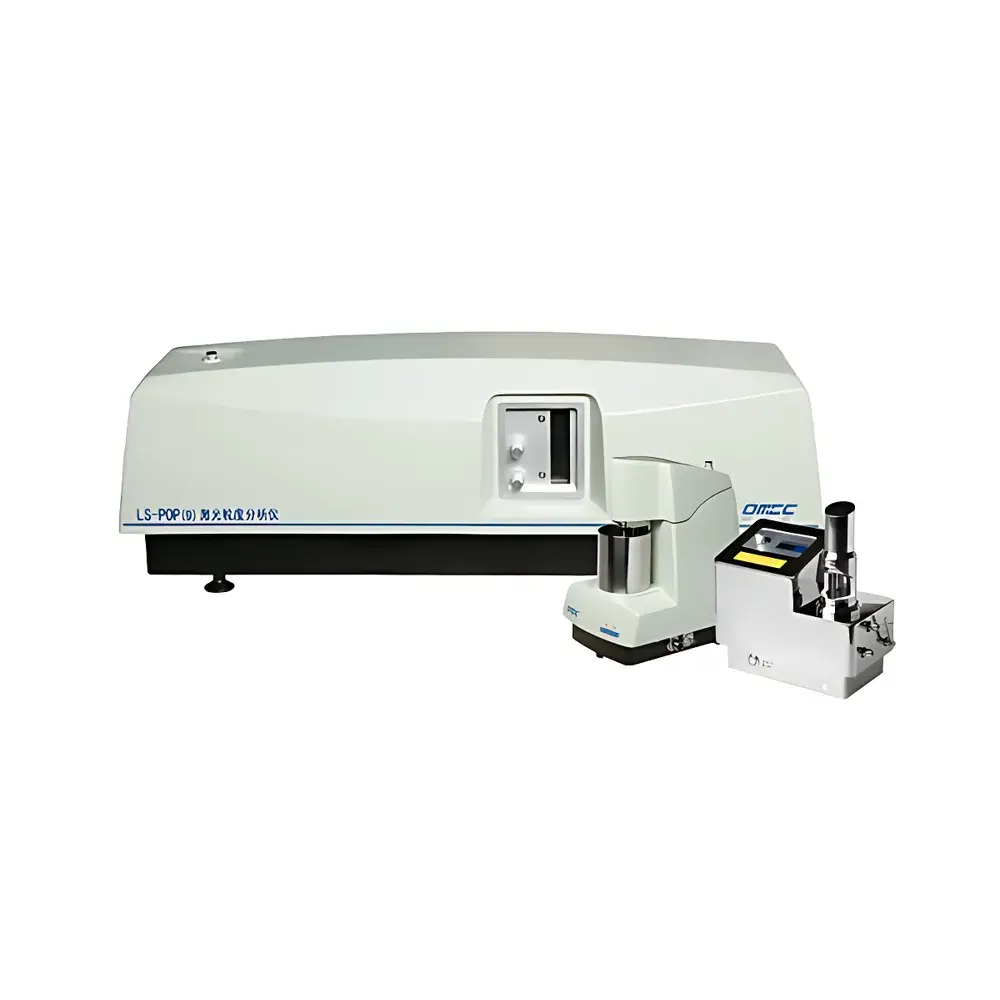
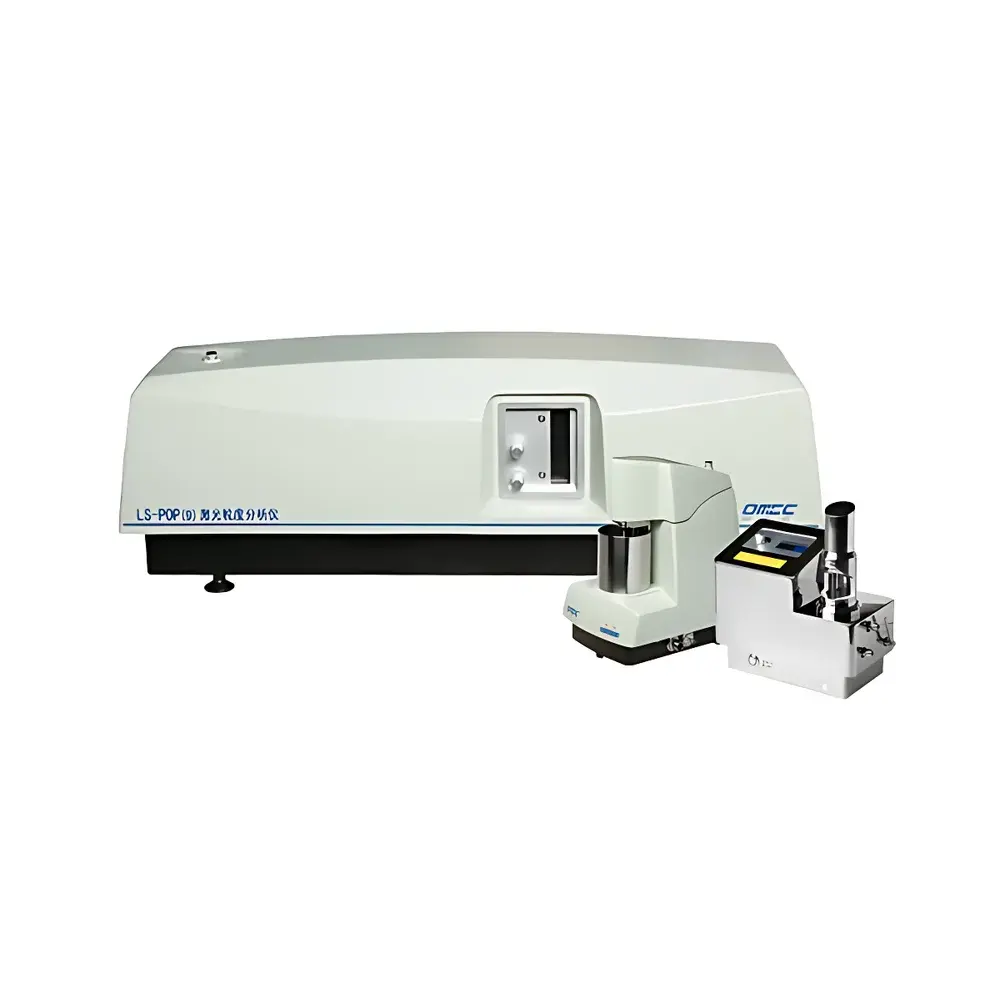
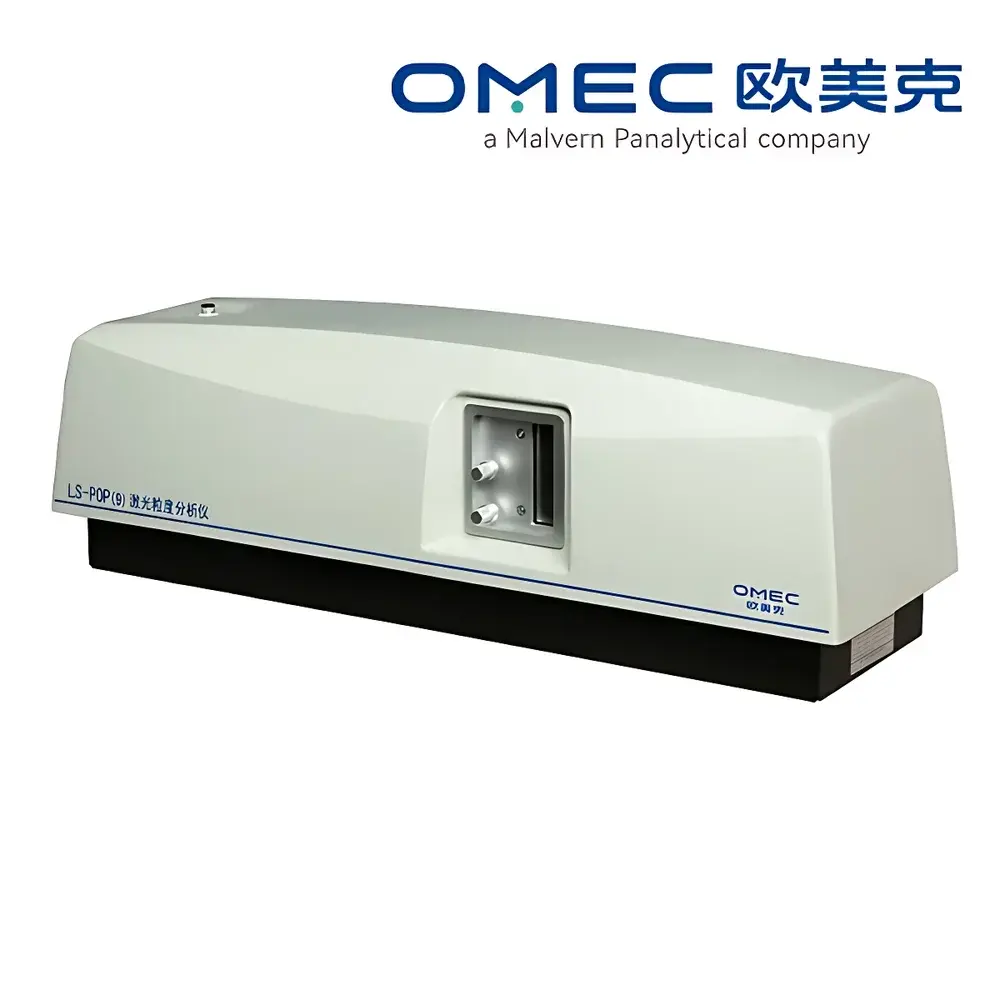
OMEC LS-POP(9) Laser Particle Size Analyzer
| Brand | OMEC |
|---|---|
| Origin | Guangdong, China |
| Manufacturer Type | Original Equipment Manufacturer (OEM) |
| Instrument Type | Laboratory Wet-Dispersion Laser Diffraction Particle Size Analyzer |
| Measurement Range | 0.1–750 µm |
| Repeatability | <1% (D50 deviation against certified reference material) |
| Measurement Time | 1–2 minutes |
| Dispersion Method | Wet Dispersion |
| Number of Independent Detection Channels | 49 |
| Light Source | He-Ne laser, 2.0 mW output power, wavelength 632.8 nm |
| Sampling Frequency | 1 kHz |
| Operating Environment | 5–35 °C, RH <85% |
| Dimensions (L×W×H) | 838 × 265 × 295 mm (main unit) |
Overview
The OMEC LS-POP(9) Laser Particle Size Analyzer is a high-performance, wet-dispersion laboratory instrument engineered for precise and reproducible particle size distribution (PSD) analysis of powders, suspensions, and emulsions. It operates on the fundamental principle of laser diffraction—specifically, Mie scattering theory across the full measurement range—enabling robust quantification of particle size from 0.1 µm to 750 µm. Developed following OMEC’s integration into Spectris plc (UK), the LS-POP(9) leverages enhanced R&D governance, optical platform refinement, and industrial-grade mechanical design inherited from its predecessor LS-POP(6), while incorporating advanced optical architecture inspired by international platform standards. Its horizontal straight-line optical path eliminates reflective prisms, ensuring long-term alignment stability and resistance to mechanical drift. The instrument is calibrated and validated using NIST-traceable reference materials and conforms to ISO 13320:2020 (Particle size analysis — Laser diffraction methods), supporting compliance-critical workflows in QC/QA, R&D, and regulatory submissions.
Key Features
- Stable optical platform with monolithic base frame machined in one operation, minimizing thermal and mechanical misalignment.
- Fourier-transform optical design with backscattering detector extension, enabling reliable sub-0.1 µm sensitivity via optimized large-angle spherical detection geometry.
- High-stability He-Ne laser source (632.8 nm, 2.0 mW) with integrated thermal compensation and real-time power stability monitoring—exceeding IEC 60825-1 laser safety Class II requirements.
- 49-channel photodetector array featuring symmetrical fan-shaped main detector and arc-distributed side detectors aligned precisely on the focal plane for accurate angular light energy capture.
- 8-channel simultaneous-sampling 16-bit ADC with 1 kHz frame acquisition rate and <0.15% full-scale linearity; includes electronic background subtraction for improved signal-to-noise ratio.
- Modular, IP54-rated enclosure with dust- and splash-resistant housing—validated per GB/T 4857.18 for transport shock and drop resilience.
Sample Compatibility & Compliance
The LS-POP(9) supports aqueous and organic dispersions across diverse material classes—including metal oxides, pharmaceutical actives, catalysts, ceramics, pigments, and polymer latexes. Its wet dispersion capability accommodates densities ranging from low-density polymers (~0.9 g/cm³) to high-density tungsten carbide (>15 g/cm³), facilitated by optional SCF-105B, SCF-108, or SCF-126 circulation systems. All systems feature programmable ultrasonication (up to 100 W, 40 kHz), variable-speed centrifugal pumping (0–4000 rpm, ±20 rpm control accuracy), and automated rinse/drain cycles. The instrument meets essential regulatory expectations for data integrity: audit trails, user-level access control, electronic signature support, and exportable raw scattering data align with FDA 21 CFR Part 11 readiness. Routine verification follows ISO/IEC 17025-aligned procedures, and SOP-driven operation ensures GLP/GMP traceability in pharmaceutical and materials certification labs.
Software & Data Management
OMEC’s proprietary ParticleExpert™ software provides ISO 13320-compliant data inversion using non-negative least-squares (NNLS) algorithms with Mie theory inputs (refractive index real/imaginary components fully user-definable). It supports multiple distribution models (Rosin-Rammler, Enhanced, Universal, Single-Peak), dual cumulative directions, bilingual reporting (English/Chinese), and customizable report templates—including industry-specific metrics (D10, D50, D90, span, specific surface area). Raw scattering patterns, detector voltage arrays, and time-resolved intensity profiles are stored in HDF5 format for third-party reprocessing. Export options include .xlsx, .docx, .csv, and XML; multi-report comparison mode enables batch statistical evaluation (e.g., %RSD across replicates). Software validation documentation (IQ/OQ/PQ protocols) is available upon request for regulated environments.
Applications
The LS-POP(9) serves as a primary PSD characterization tool in quality control laboratories for cement, battery cathode materials (e.g., NMC, LFP), inhalable drug formulations (DPIs), food additives (starch, cocoa), and nanomaterial synthesis monitoring. Its rapid 1–2 minute cycle time and <1% D50 repeatability make it suitable for high-throughput release testing. In R&D, the instrument supports formulation optimization—e.g., correlating milling parameters with median particle shift—or validating dispersion stability over time via sequential measurements. Academic users apply it to colloidal kinetics studies, sedimentation modeling, and fractal dimension estimation via scattering exponent analysis.
FAQ
What optical theory does the LS-POP(9) use for size calculation?
It applies Mie scattering theory across the entire 0.1–750 µm range, with optional Fraunhofer approximation for coarse particles where appropriate.
Is the instrument compliant with ISO 13320?
Yes—the optical design, calibration protocol, and software inversion engine are fully aligned with ISO 13320:2020 requirements for laser diffraction instruments.
Can the system be validated for GMP environments?
Yes—full IQ/OQ/PQ documentation packages, 21 CFR Part 11 configuration settings, and audit-trail-enabled software are available for qualification in pharmaceutical and medical device manufacturing.
What sample volume is required for standard wet analysis?
Typical suspension volume is 400–600 mL depending on concentration; SCF-108 and SCF-126 systems accommodate up to 1000 mL with adjustable flow rates up to 2.5 L/min.
Does the instrument support refractive index correction for absorbing materials?
Yes—users input both real and imaginary components of complex refractive index, critical for carbon black, metal nanoparticles, and dyes.



