
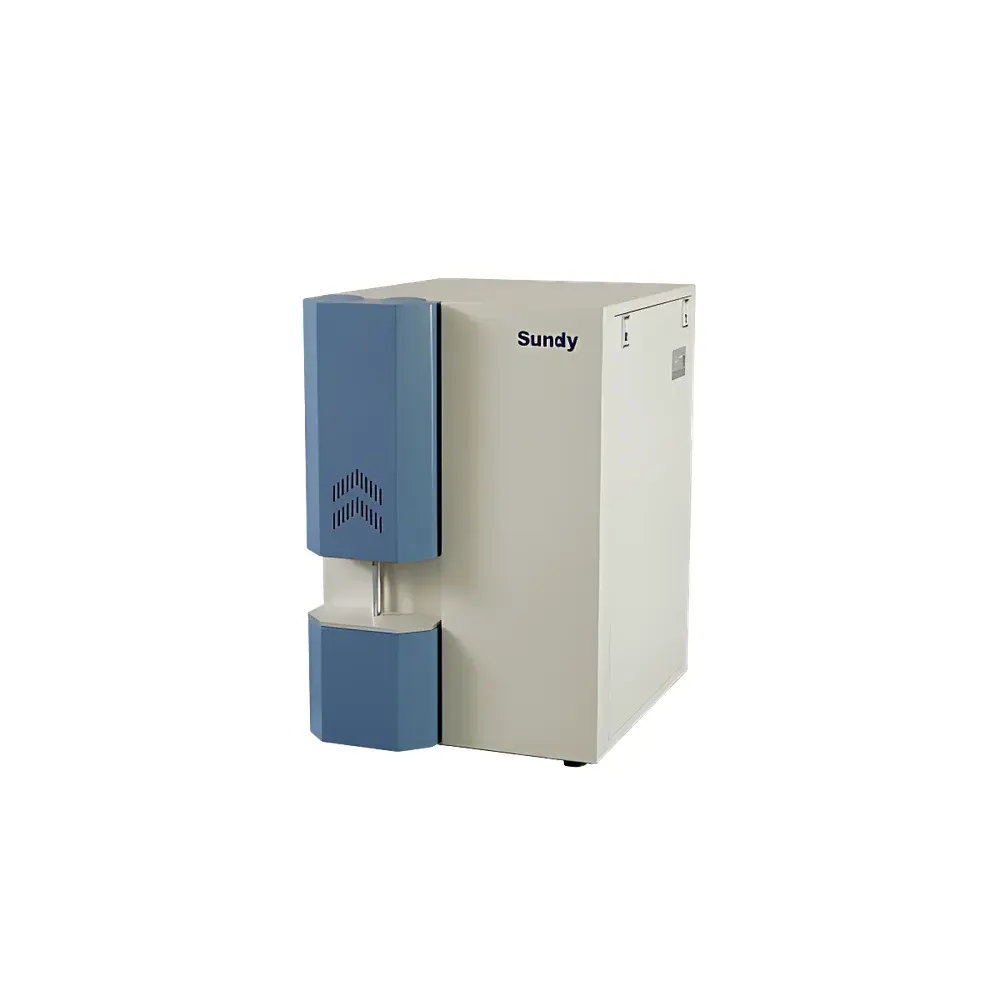
Sundy SDHFCS1000 High-Frequency Infrared Carbon-Sulfur Analyzer
| Brand | Sundy |
|---|---|
| Model | SDHFCS1000 |
| Origin | Hunan, China |
| Measurement Principle | Infrared Absorption |
| Heating System | High-Frequency Induction Furnace |
| Carbon Range | Low-C: 0.00001–0.3 wt%, High-C: 0.1–99.99 wt% |
| Sulfur Range | Low-S: 0.00001–0.3 wt%, High-S: 0.1–99.99 wt% |
| Sensitivity | C: 0.00001 wt% or RSD ≤ 0.5% |
| S | 0.00001 wt% or RSD ≤ 1.0% |
| Analysis Time | Adjustable from 25–99 s (typical: 35 s) |
| Sample Mass | 0.05–1.0 g |
| Max Power | 4 kW |
| Voltage | AC 220 V ±10%, 50 Hz ±1 Hz |
| Compliance | ISO 9556:1989, ISO 4935:1989, ISO 15350:2000, GB/T 20123–2006, JJG 395–2016 |
Overview
The Sundy SDHFCS1000 High-Frequency Infrared Carbon-Sulfur Analyzer is a precision elemental analyzer engineered for the quantitative determination of total carbon (C) and total sulfur (S) in solid inorganic materials. It operates on the principle of high-frequency induction combustion followed by non-dispersive infrared (NDIR) absorption spectroscopy. A precisely weighed sample is combusted quantitatively in a high-purity oxygen atmosphere within a high-frequency induction furnace (operating at ~20 kHz), converting carbon to CO₂ and sulfur to SO₂. The resulting gases are swept through optimized gas-handling modules—drying, filtering, and pressure-regulated—before entering dual NDIR cells calibrated for CO₂ and SO₂ absorbance at specific wavelengths (4.26 µm and 7.35 µm, respectively). Signal intensity is converted to concentration via factory-established calibration curves traceable to certified reference materials (CRMs), enabling trace-level detection and full-range quantification without manual range switching.
Key Features
- Simultaneous dual-element measurement: Full-range carbon and sulfur results generated in a single combustion cycle, eliminating sequential analysis delays.
- Four-detector IR cell configuration: Independently optimized low- and high-range cells for both carbon and sulfur ensure linear response across six orders of magnitude—from sub-ppm (0.00001 wt%) to near-hundred-percent levels.
- High-frequency induction furnace with electromagnetic shielding: Delivers rapid, uniform heating (>2000 °C) with minimized RF leakage, meeting IEC 62471 photobiological safety guidelines for operator protection.
- Intelligent thermal management and auto-idle mode: Reduces power consumption during idle periods while maintaining furnace readiness; extends crucible and IR cell lifetime.
- Integrated particulate filtration and catalytic oxidation: Ensures baseline stability and prevents optical contamination; includes CuO-based catalyst for complete SO₂ conversion and CO-to-CO₂ oxidation.
- Stable pneumatic architecture: Mass-flow-controlled O₂ delivery, pressure-compensated gas sampling, and leak-tight stainless-steel manifolds minimize drift and support long-term reproducibility (RSD ≤ 0.5% for C, ≤ 1.0% for S over 24 h).
Sample Compatibility & Compliance
The SDHFCS1000 accommodates diverse solid matrices including ferrous and non-ferrous metals (e.g., steels, cast irons, aluminum alloys, nickel superalloys), ores, slags, ceramics, battery cathode materials (e.g., LiFePO₄, NMC), titanium dioxide pigments, nuclear-grade graphite, and geological samples (soils, sediments). Sample mass is user-selectable between 0.05 g and 1.0 g to match expected C/S content and optimize signal-to-noise ratio. The system complies with international standards governing combustion-infrared analysis, including ISO 9556:1989 (carbon in iron and steel), ISO 4935:1989 (sulfur in iron and steel), ISO 15350:2000 (total C/S in ferrous materials), and GB/T 20123–2006 (Chinese national standard equivalent to ISO 15350). It also satisfies metrological verification requirements per JJG 395–2016 for carbon-sulfur analyzers used in accredited testing laboratories.
Software & Data Management
The embedded Windows-based control software provides full instrument automation—including method selection, weight import (via RS232/USB scale interface), combustion parameter definition (time, power ramp), real-time gas signal monitoring, peak integration, and CRM-based calibration. All analytical events—including sample ID, timestamp, operator login, raw absorbance values, integrated peak areas, calculated concentrations, and QC flag status—are recorded with immutable audit trails. Data export supports CSV, XML, and LIMS-compatible formats. Optional 21 CFR Part 11 compliance package available, featuring electronic signatures, role-based access control, and encrypted database logging for regulated environments operating under GLP or GMP frameworks.
Applications
This analyzer serves quality control laboratories in metallurgical production (incoming raw material verification, melt process monitoring, final product certification), third-party testing facilities performing ISO/IEC 17025-accredited analyses, R&D centers developing advanced alloys and energy materials, and environmental labs quantifying sulfur in coal ash or carbon in contaminated soils. Its wide dynamic range eliminates the need for dilution or re-analysis when encountering unexpected compositional outliers—critical for failure analysis of high-carbon tool steels or ultra-low-sulfur stainless grades. Routine analysis of titanium dioxide for residual carbon (affecting photocatalytic activity) or battery anode/cathode materials for sulfur impurities (linked to SEI layer instability) is performed with documented repeatability and traceability.
FAQ
What sample types require flux addition during analysis?
Fluxes such as tungsten or tin are recommended for refractory oxides (e.g., Al₂O₃, SiO₂) and low-conductivity materials (e.g., ceramics, graphite) to ensure complete combustion and prevent splattering.
Can the SDHFCS1000 be integrated into an automated sample handling system?
Yes—the instrument supports RS485 and Ethernet interfaces for remote command execution and status polling, enabling compatibility with robotic autosamplers and centralized lab automation platforms.
How often must the IR cells be recalibrated?
Factory calibration remains stable for ≥12 months under normal operation; annual verification using CRMs is recommended, with full recalibration required only after cell replacement or major maintenance.
Is helium carrier gas required?
No—high-purity oxygen (≥99.995%) is the sole required gas; helium is not used in this combustion-IR configuration.
What maintenance intervals are recommended for the high-frequency furnace?
Crucibles should be inspected after every 50–100 analyses; ceramic tubes and induction coils require visual inspection quarterly and replacement based on operational hours or performance degradation (e.g., inconsistent ignition, reduced temperature ramp rate).



