
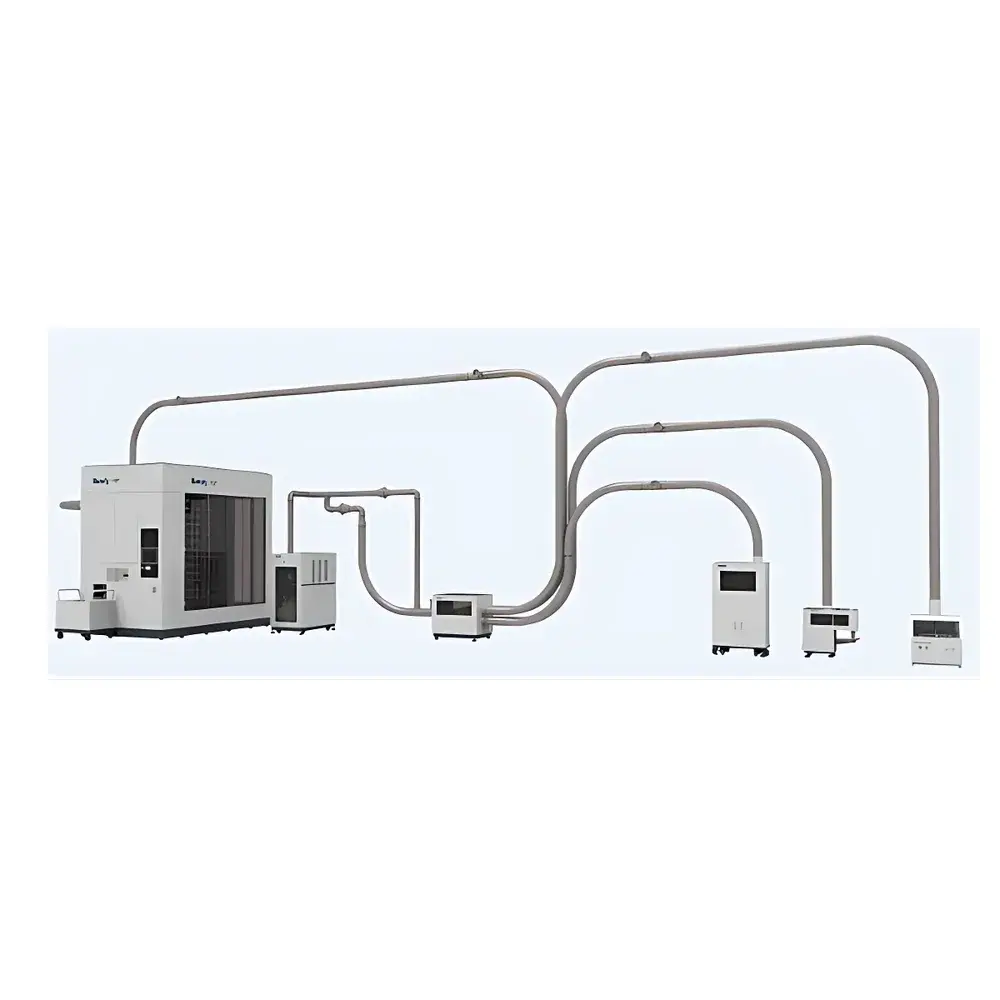
Sundy SDAST Pneumatic Sample Transport System
| Brand | Sundy |
|---|---|
| Origin | Hunan, China |
| Manufacturer Type | Authorized Distributor |
| Country of Origin | China |
| Model | SDAST Pneumatic Sample Transport System |
| Pricing | Upon Request |
| Transport Direction | Unidirectional or Bidirectional |
| Conduit Material | PVC or Steel Pipe |
| Conduit Diameter | Φ140 mm or Φ160 mm |
| Minimum Bend Radius | R = 1000 mm (Φ140 mm), R = 800 mm (Φ160 mm) |
| Transport Velocity | High-Speed Mode: 5–8 m/s |
| Low-Speed Mode | 2–3 m/s |
| Maximum Sample Bottle Payload | 3 kg (Φ140 mm), 4 kg (Φ160 mm) |
| Horizontal Reach | <1000 m (single blower), Vertical Lift: <20 m (single blower) |
| Supported Stations | Automatic Sample Preparation Lab, Manual Sample Preparation Lab, Analytical Lab, Retention Sample Storage Cabinet, Waste/Reject Sample Disposal Station |
| Power Supply | 380 V AC, 11 kW (configurable based on system scale) |
Overview
The Sundy SDAST Pneumatic Sample Transport System is an engineered solution for the automated, contactless conveyance of standardized coal sample containers across distributed laboratory and preparation infrastructure. Designed specifically for thermal power plants, coal testing centers, and integrated quality control facilities, the system operates on the principle of differential-pressure pneumatic conveying—utilizing controlled air flow generated by industrial blowers to propel sample bottles through sealed conduit networks. It supports both unidirectional and bidirectional transport protocols, enabling flexible routing between up to five defined operational nodes: automatic sample preparation stations, manual preparation bays, analytical laboratories, retention sample storage cabinets, and waste/reject disposal terminals. The system accommodates three standard coal sample formats—0.2 mm analytical subsamples, 3 mm retention samples, and 6 mm or 13 mm total moisture specimens—ensuring full traceability and physical integrity throughout transit.
Key Features
- Fully automated transport cycle with zero manual intervention during bottle transfer—eliminating cross-contamination risk, human error in labeling or routing, and exposure to hazardous environments.
- Dual-speed pneumatic drive architecture: high-velocity mode (5–8 m/s) for rapid inter-station transfer; low-velocity mode (2–3 m/s) for gentle handling of fragile or precision-weighted containers.
- Integrated bottle buffering and dynamic airflow path switching: minimizes mechanical impact noise and ensures millisecond-level directional response without pressure surges or flow instability.
- Passive buffer terminal design at receiving stations—no actuated gates or PLC-triggered release mechanisms—enables immediate, tool-free access to delivered sample bottles upon door opening.
- Non-volatile memory retention for system state: preserves last-known position, active route, and operational mode during unexpected power interruption, resuming from checkpoint upon restoration.
- Modular conduit layout compatible with Φ140 mm or Φ160 mm rigid piping (PVC or carbon steel), supporting minimum bend radii of 1000 mm and 800 mm respectively—optimized for spatial constraints in retrofit installations.
Sample Compatibility & Compliance
The SDAST system is validated for use with standardized cylindrical sample bottles conforming to GB/T 474–2008 and ISO 18283:2015 requirements for coal sample containment. Bottle dimensions, mass distribution, and cap sealing integrity are factored into aerodynamic modeling to ensure stable suspension and laminar transit under varying load conditions (up to 3 kg for Φ140 mm lines, 4 kg for Φ160 mm). All electrical components comply with IEC 60204-1 for industrial machinery safety. While not certified to ATEX or IECEx for explosive atmospheres, the system may be deployed in Zone 2 classified areas when integrated with upstream dust suppression and grounding protocols per GB 15577–2018. Documentation supports GLP-aligned audit trails when interfaced with LIMS via optional RS485/Modbus RTU output.
Software & Data Management
The SDAST operates via a dedicated embedded controller (ARM Cortex-A9, Linux-based RTOS) with local HMI touchscreen interface. Transport logs—including timestamped origin/destination pairs, bottle ID (via optional RFID reader integration), velocity profile, and blower duty cycle—are stored onboard for ≥30 days. Exportable CSV reports support integration into enterprise LIMS platforms. Optional OPC UA server module enables real-time status monitoring and remote configuration within ISA-95 Level 2 supervisory systems. Audit trail functionality meets basic ALCOA+ principles (Attributable, Legible, Contemporaneous, Original, Accurate) and supports 21 CFR Part 11 compliance when paired with external digital signature and user role management layers.
Applications
- Coal-fired power plant QC labs requiring synchronized sample movement between on-site preparation lines and central analytical suites.
- Third-party coal inspection agencies managing multi-client sample workflows across segregated preparation and testing zones.
- Research institutes conducting comparative ash fusion, calorific value, or proximate analysis where sample chain-of-custody must remain uninterrupted.
- Automated coal blending facilities integrating real-time assay feedback loops—where rapid delivery of freshly prepared subsamples enables closed-loop process adjustment.
- Multi-floor laboratory complexes where vertical lift limitations preclude conventional conveyor belts or robotic AGVs.
FAQ
What sample bottle specifications are supported?
Standard 100–200 mL cylindrical HDPE or glass bottles with threaded caps, outer diameter ≤120 mm and height ≤250 mm. Custom adapters available for non-standard geometries.
Can the system interface with existing LIMS or MES platforms?
Yes—via Modbus RTU (RS485) as standard; OPC UA and MQTT interfaces available as configurable options.
Is explosion-proof certification available?
Not natively; however, intrinsically safe variants with ATEX-certified blowers and purge-protected control cabinets can be commissioned as project-specific configurations.
What maintenance intervals are recommended?
Blower filter replacement every 500 operating hours; conduit inspection for wear or blockage every 6 months; valve actuator lubrication annually per ISO 13374 condition monitoring guidelines.
Does the system support priority routing or emergency abort protocols?
Yes—priority queues and emergency stop propagation across all stations are implemented in firmware v2.3+, with hardware-level E-stop circuit integration per IEC 61800-5-2.




