
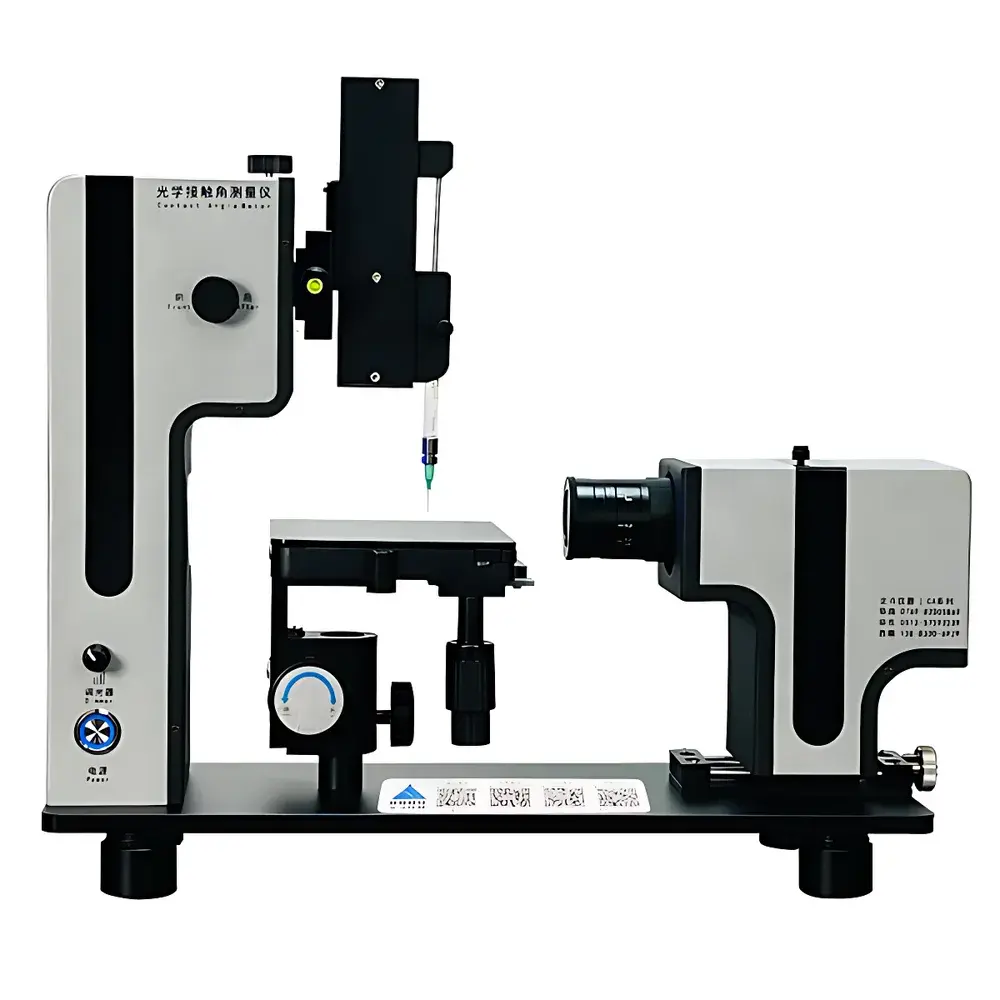
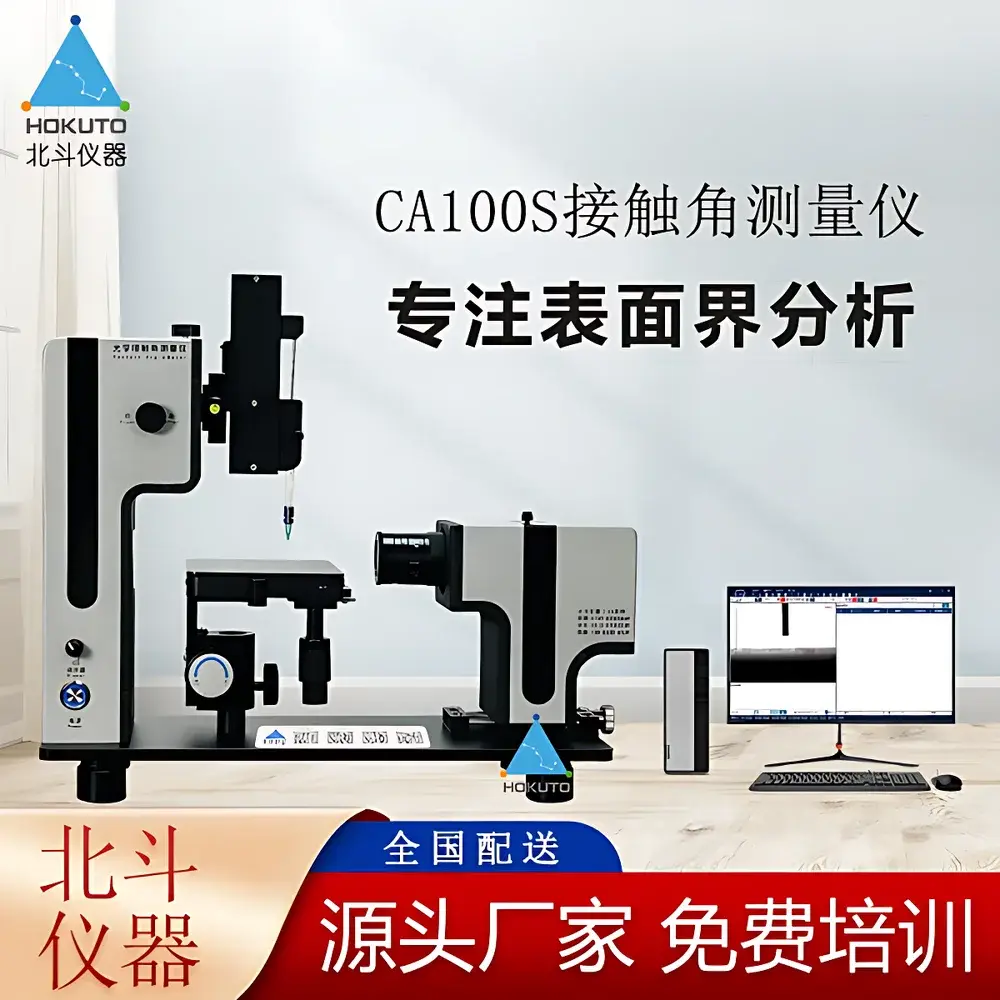
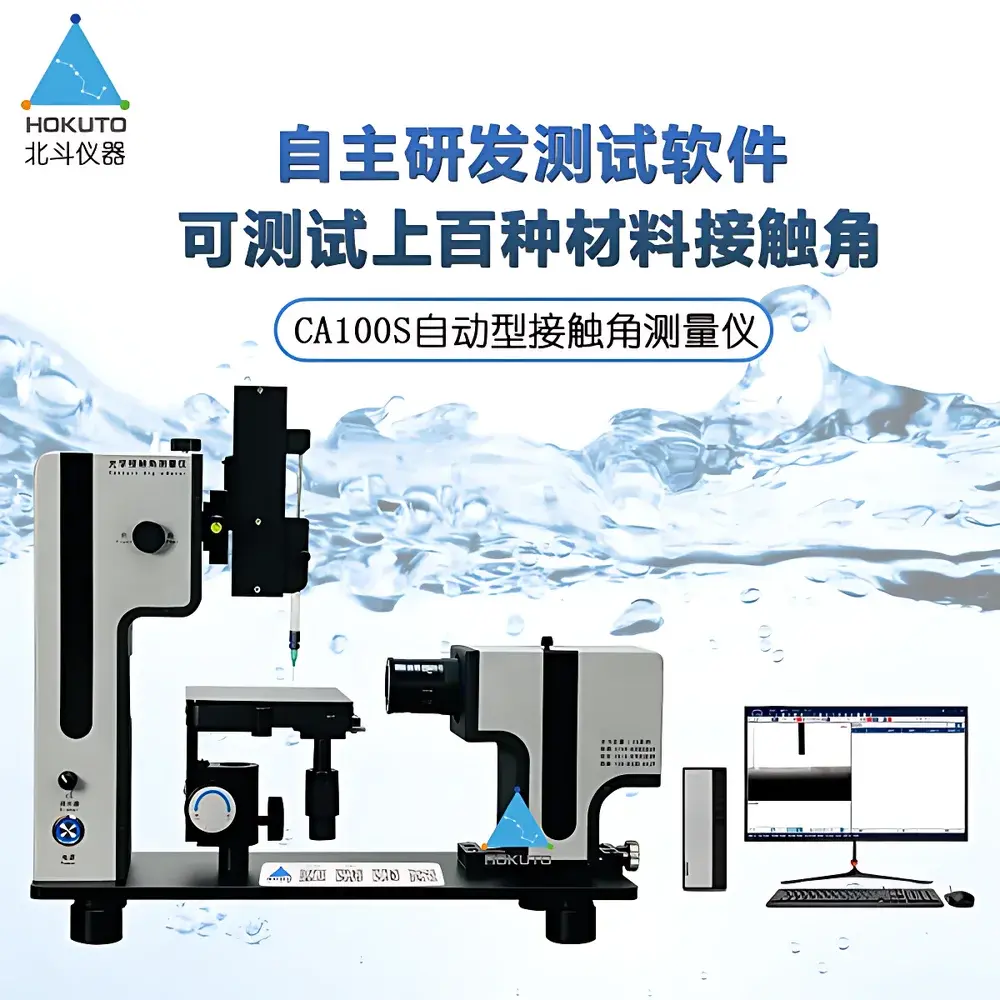
Beidou Instruments CA100S Automated Optical Contact Angle Analyzer for Photovoltaic & Fuel Cell Surface Wettability Assessment
| Brand | Beidou Instruments (HOKUTOcn) |
|---|---|
| Origin | Dongguan, Guangdong, China |
| Manufacturer Type | OEM Manufacturer |
| Instrument Category | Domestic |
| Model | CA100S |
| Price | USD 5,000 (approx.) |
| Instrument Type | Video-Based Optical Contact Angle Meter |
| Form Factor | Benchtop Laboratory System |
| Contact Angle Range | 0° < θ < 180° |
| Measurement Accuracy | ±0.1° |
| Angular Resolution | 0.001° |
| Standard Sample Stage | 130 × 150 mm (customizable) |
| Max Sample Dimensions | 200 (W) × ∞ (L) × 30 (H) mm |
| Imaging Sensor | 1/1.8″ Progressive Scan CMOS (1280 × 1024) |
| Frame Rate | 30 fps |
| Optical Zoom | 0.7×–4.5× |
| Droplet Dispensing Precision | ±0.1 µL |
| Dispensing Speed | 0.01–25 µL/s |
| Light Source | Industrial-grade white LED (400–760 nm), PWM-dimmable, >20,000 h lifetime |
| Power Supply | 220 V AC, 50–60 Hz |
| Power Consumption | 10 W |
| Dimensions (W × L × H) | 655 × 180 × 500 mm |
| Weight | 14 kg |
Overview
The Beidou Instruments CA100S Automated Optical Contact Angle Analyzer is a precision benchtop instrument engineered for quantitative characterization of solid surface wettability via optical droplet contour analysis. It operates on the fundamental principle of interfacial thermodynamics: the contact angle θ—defined as the angle formed between the tangent to the liquid–vapor interface and the solid–liquid boundary at the three-phase contact line—is a direct indicator of surface energy heterogeneity, chemical composition, and topographic uniformity. Designed specifically for high-reproducibility evaluation in photovoltaic cell manufacturing, proton exchange membrane (PEM) fuel cell electrode development, and functional coating R&D, the CA100S integrates high-fidelity imaging, motorized fluid delivery, and algorithm-driven image analysis to deliver traceable, operator-independent measurements compliant with ISO 19403-2:2017 (Contact angle measurement — Part 2: Static contact angle) and ASTM D7334-22 (Standard Practice for Surface Energy Determination of Polymer Coatings Using Contact Angle Measurements). Its modular architecture supports both static and dynamic contact angle acquisition—including advancing, receding, and hysteresis angles—enabling comprehensive assessment of surface aging, cleaning efficacy, plasma treatment uniformity, and inkjet printability.
Key Features
- Automated syringe pump system with real-time liquid-level detection, enabling precise dispensing from 0.01 µL/s to 25 µL/s and repeatable volume control within ±0.1 µL
- High-resolution USB 2.0 CMOS camera (1280 × 1024, 30 fps) coupled with continuously variable zoom optics (0.7×–4.5×) and software-assisted auto-focus for sub-pixel edge detection
- Dual-needle configuration: standard 0.5 mm stainless steel needles (10 pcs) and ultra-low-adhesion 0.25 mm hydrophobic needles (10 pcs) for reliable dispensing on low-energy surfaces
- Motorized XYZ sample positioning stage with manual fine-adjustment capability: X (±15 mm, 0.1 mm resolution), Y (±25 mm, 0.1 mm), Z (±15 mm, 0.1 mm); integrated XY bubble level for rapid alignment
- Industrial-grade cold-white LED illumination (400–760 nm) with dual-stage brightness control—hardware PWM + software feedback loop—ensuring optimal contrast across hydrophilic to superhydrophobic substrates
- Modular mechanical design using aerospace-grade 6061 aluminum alloy frame, vibration-damped support feet, and CNC-machined kinematic mounts for long-term dimensional stability
Sample Compatibility & Compliance
The CA100S accommodates rigid and semi-rigid planar samples up to 200 mm wide and 30 mm thick, with unlimited length—ideal for continuous web-based PV module substrates or large-area PEM catalyst layers. The 130 × 150 mm standard stage is fully customizable for specialized fixtures (e.g., electrochemical cells, heated stages, environmental chambers). All measurement protocols align with internationally recognized standards: ISO 19403-1 to -4 for contact angle and surface energy determination; ASTM D5725 for surface tension and wettability of coated fabrics; and USP <1058> guidance for analytical instrument qualification in regulated environments. While not pre-certified for FDA 21 CFR Part 11, the CA V2.0 software architecture supports audit trail logging, electronic signatures, and user access controls—enabling laboratory compliance with GLP and GMP documentation requirements upon internal validation.
Software & Data Management
The CA V2.0 software suite—developed in-house since 2010 and continuously refined through collaboration with national standardization committees and industrial users—provides dual-mode operation: fully automated batch analysis and interactive manual refinement. Static contact angle calculation employs seven validated algorithms (Circle, Oblique Circle, Ellipse, Oblique Ellipse, Spline, Young–Laplace fitting, and baseline-free tangent methods), all executable in <10 ms per frame. Dynamic contact angle analysis supports video-based sequential fitting across hundreds of frames, automatically extracting advancing/receding angles and hysteresis values. Surface energy modeling includes Fowkes, OWRK, Zisman, EOS, Acid–Base Theory, Wu harmonic mean, and Extended Fowkes models, with a built-in database of 37 reference liquids (including water, diiodomethane, ethylene glycol, formamide) and full customization for proprietary formulations. All raw images, metadata, calibration logs, and report exports (PDF, CSV, XML) are timestamped and stored in a structured local repository, supporting traceability per ISO/IEC 17025:2017 clause 7.7.
Applications
- Photovoltaic R&D: Quantifying anti-reflective coating hydrophobicity, evaluating EVA encapsulant adhesion, mapping surface energy gradients across textured silicon wafers
- Fuel cell engineering: Assessing gas diffusion layer (GDL) wettability under humidified conditions, optimizing catalyst ink spreading on PEM membranes, validating hydrophobic agent distribution
- Plasma & corona treatment verification: Measuring contact angle reduction pre/post surface activation to determine treatment uniformity and shelf-life decay
- Coating & ink formulation: Correlating surface energy components (dispersive, polar, hydrogen-bonding) with substrate adhesion performance and print-through resistance
- Biomedical device testing: Characterizing protein adsorption propensity on polymer implants, verifying cleaning residue removal from surgical instruments
- Quality control in glass, semiconductor, and flexible electronics manufacturing: In-line compatibility via optional integration with LabVIEW or Python API
FAQ
What standards does the CA100S comply with for contact angle measurement?
The instrument adheres to ISO 19403-2:2017 (static contact angle), ISO 19403-3:2017 (dynamic contact angle), and ASTM D7334-22. Full traceability requires user-performed calibration using certified reference surfaces (e.g., PTFE, silicon wafer).
Can the CA100S measure contact angles on curved or textured surfaces?
Yes—the software supports concave/convex surface fitting via oblique ellipse and spline-based contour modeling, provided surface curvature radius exceeds 5 mm and local roughness Ra < 1 µm.
Is the software compatible with Windows 11 and 64-bit systems?
CA V2.0 is validated for Windows 10 (64-bit) and Windows 11 (64-bit); driver signing and .NET Framework 4.8 dependencies are included in the installation package.
Does the system support automated surface energy mapping?
Not natively—but multi-point acquisition is scriptable via the included Python SDK; users can define grid patterns, automate stage movement, and batch-process results using custom Jupyter notebooks.
What maintenance is required for long-term accuracy?
Annual recalibration of the optical axis and dispensing volume is recommended; needle replacement every 500–1,000 measurements depending on solvent aggressiveness; lens cleaning with spectroscopic-grade methanol every 3 months.



