
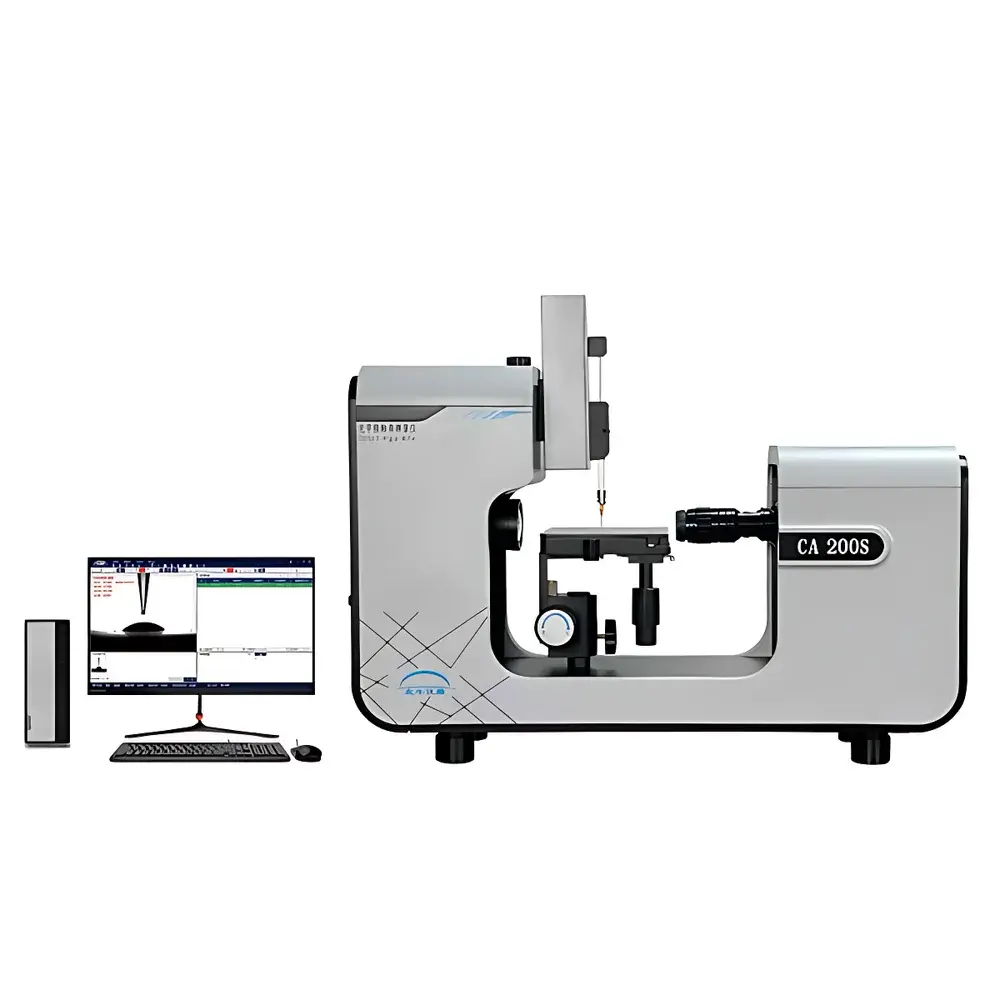
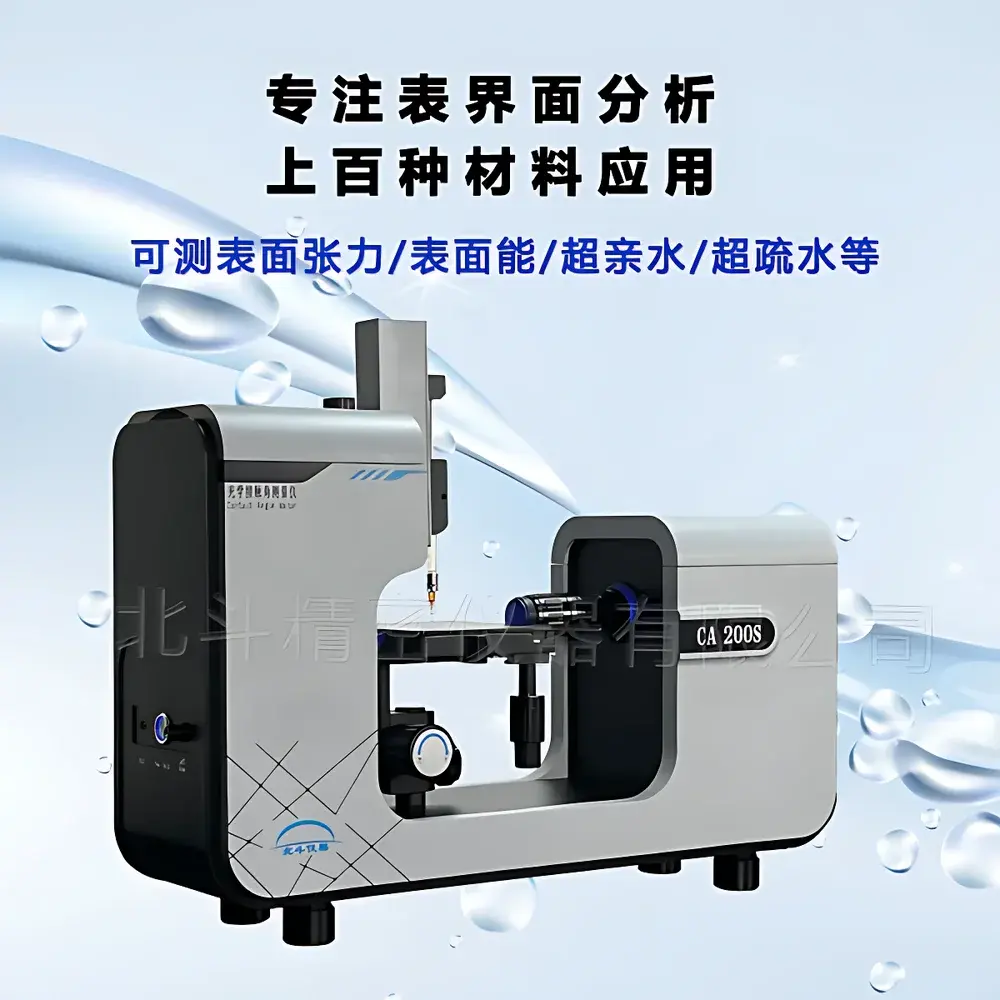
Beidou CA200S Advanced Video-Based Static & Dynamic Contact Angle Analyzer
| [Brand | Beidou Instruments / HOKUTOcn |
|---|---|
| Origin | Dongguan, Guangdong, China |
| Manufacturer Type | OEM Manufacturer |
| Instrument Type | Benchtop Optical Contact Angle Meter |
| Measurement Principle | Digital Image Analysis (Sessile Drop, Pendant Drop, Tilting Plate) |
| Contact Angle Range | 0° < θ < 180° |
| Contact Angle Accuracy | ±0.1° |
| Angular Resolution | 0.001° |
| Surface/Interfacial Tension Range | 0.1–2000 mN/m |
| Surface/Interfacial Tension Accuracy | ±0.01 mN/m |
| Sample Stage Dimensions | 130 × 150 mm (customizable) |
| Max Sample Size | 200 mm (W) × ∞ (L) × 30 mm (H) |
| Imaging System | Sony 1/1.8″ Progressive Scan CMOS, 1280 × 1024 @ 80 fps, Rolling Shutter |
| Lens | 0.7×–4.5× Telecentric Contour Lens with ±2.5 mm Focus Adjustment |
| Light Source | Imported Industrial White Cold LED (400–760 nm), PWM + Software Brightness Control, >50,000 h Lifetime |
| Droplet Dispensing | Motorized Syringe Pump, 0.01–25 µL/s, 0.01 µL Precision, Programmable Multi-Point Sequencing |
| Software | CA V2.0 Static & Dynamic Contact Angle + Surface Energy Analysis Suite (Windows 10 64-bit)] |
Overview
The Beidou CA200S is a high-precision, benchtop video-based optical contact angle analyzer engineered for rigorous surface wettability characterization in research and industrial quality control environments. It operates on the principle of digital image analysis—capturing high-fidelity silhouettes of liquid droplets on solid substrates—and applying advanced contour detection algorithms to determine contact angles with sub-pixel accuracy. The system supports multiple measurement modes including sessile drop, pendant drop, and dynamic tilt-stage analysis, enabling quantitative evaluation of static contact angle (SCA), advancing/receding contact angles, contact angle hysteresis, surface free energy, interfacial tension, adhesion work, spreading coefficient, and wetting kinetics. Designed for reproducibility and long-term stability, the CA200S integrates aerospace-grade aluminum frame construction, precision mechanical translation stages, and thermally stable illumination to eliminate thermal drift-induced evaporation artifacts during extended acquisition sequences.
Key Features
- Sub-pixel resolution contact angle calculation using proprietary B-Snake, Oblique Ellipse, and multi-point fitting algorithms—enabling robust analysis of asymmetric, distorted, or low-contrast droplets.
- Motorized, programmable microdispensing system with real-time liquid level monitoring and 0.01 µL dispensing precision—compatible with standard Hamilton, Boli, and custom syringes (25–1000 µL).
- Dual-mode imaging architecture: high-speed (80 fps) rolling shutter CMOS sensor paired with telecentric contour lens ensures minimal perspective distortion and optimal edge contrast for automated three-phase line detection.
- Intelligent adaptive illumination: imported cold white LED source with quartz diffuser and PWM/software dual brightness control delivers uniform backlighting across full field-of-view without thermal interference.
- Full-axis manual stage adjustment (X/Y/Z ±0.1 mm resolution) with integrated XY leveling system—ensuring precise sample alignment and eliminating baseline tilt bias.
- Comprehensive surface energy modeling suite supporting OWRK, Fowkes, Zisman, Acid-Base (van Oss), Wu harmonic mean, and Extended Fowkes methods—with built-in database of 37 reference liquids and user-defined parameter import/export.
Sample Compatibility & Compliance
The CA200S accommodates flat, rigid, or flexible substrates up to 200 mm wide and 30 mm thick—including glass, silicon wafers, polymer films, metal foils, textiles, and coated surfaces. Its modular design permits integration with environmental chambers (temperature/humidity control), plasma treatment units, and solvent vapor exposure modules for in situ dynamic wettability studies. The instrument conforms to multiple international test standards governing surface characterization, including ASTM D5725 (wettability of sheet materials), ASTM D724 (paper surface wettability), ASTM C813 (hydrophobic contamination on glass), ISO 1409 (polymer dispersion surface tension), ISO 4311 (CMC determination), and DIN EN 14370 (surfactant surface tension). All software operations comply with GLP documentation requirements, featuring audit-trail-enabled user permissions (administrator/experimenter roles), timestamped raw image archiving, and version-controlled report generation.
Software & Data Management
CA V2.0 software serves as the analytical core of the CA200S platform. It provides fully automated workflow execution—from droplet deposition and image capture to batch processing of video sequences and statistical reporting. Key capabilities include real-time contact line tracking, automatic baseline correction for tilted samples, multi-image sequential fitting, and video-based dynamic contact angle extraction at user-defined time intervals. Surface energy calculations are performed using rigorously validated thermodynamic models, with uncertainty propagation reporting for each derived parameter (e.g., dispersive/polar components, Lewis acid/base contributions). Data export supports native .csv, .xlsx, .pdf, and .docx formats; all measurement metadata—including hardware configuration, calibration logs, and operator ID—are embedded within output files. The software architecture supports FDA 21 CFR Part 11 compliance through electronic signature enforcement, data integrity validation, and immutable audit trail logging.
Applications
The CA200S is routinely deployed across R&D and production settings where surface functionality dictates performance: plasma activation efficacy verification in semiconductor packaging; hydrophobic coating validation for automotive windshields and architectural glass; inkjet printability assessment of functional inks on flexible electronics substrates; surface cleanliness quantification prior to adhesive bonding in medical device assembly; surfactant formulation optimization in agrochemicals and personal care products; and biocompatibility screening of implantable biomaterials via protein adsorption correlation studies. Its versatility extends to nanomaterial dispersion stability analysis (via pendant drop interfacial tension), self-cleaning surface development (superhydrophobicity mapping), and stimuli-responsive polymer hydration kinetics under controlled vapor environments.
FAQ
What measurement methods does the CA200S support?
It supports sessile drop, pendant drop, captive bubble, and dynamic tilt-stage methods—including advancing/receding angle acquisition and hysteresis calculation.
Can the system measure surface energy of unknown solids?
Yes—using any combination of at least two probe liquids and one of seven embedded theoretical models (OWRK, Fowkes, Acid-Base, etc.), with full customization of liquid property databases.
Is the software compliant with regulatory data integrity requirements?
Yes—CA V2.0 implements role-based access control, electronic signatures, immutable audit trails, and 21 CFR Part 11–ready report templates.
What is the maximum sample thickness accommodated?
30 mm vertical clearance above the stage plane, with optional height-extension kits available upon request.
Does the system require external PC hardware?
No—the CA200S includes an embedded controller; however, a Windows 10 (64-bit) host PC is required for full software operation and data analysis.



