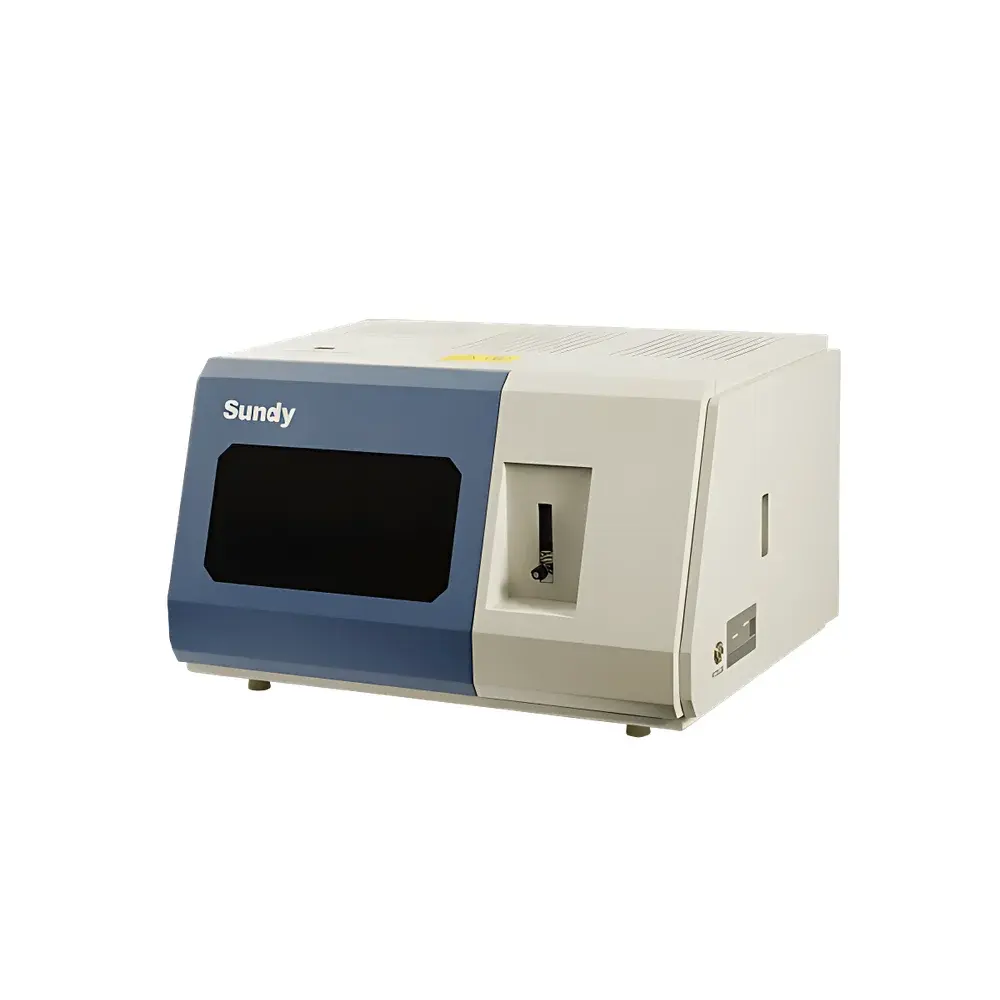
Sundys SDS-V Coulometric Sulfur Determinator
| Brand | Sundy |
|---|---|
| Origin | Hunan, China |
| Model | SDS-V |
| Measurement Principle | Coulometric Titration |
| Sulfur Range | 0.01–40 wt% |
| Resolution | 0.001 wt% |
| Temperature Control Accuracy | ±1 °C |
| Sample Mass | ~50 mg (adjustable) |
| Combustion Furnace Temp | 1150 ±5 °C (coal & coke), 900 ±5 °C (oil & pyrite), 1150–1200 °C (cement) |
| Test Duration | ~200 s per sample |
| Max Power | 3.5 kW |
| Voltage | AC 220 V ±10%, 50 Hz ±1 Hz |
| Dimensions (L×W×H) | 680 × 520 × 395 mm |
| Weight | ~78 kg |
| Compliance | GB/T 214–2007, JJG 1006–2005 |
Overview
The Sundys SDS-V Coulometric Sulfur Determinator is a dedicated analytical instrument engineered for precise quantification of total sulfur content in solid and liquid combustible materials—including coal, coke, petroleum-based fuels, solid biomass, and cement—using the standardized coulometric titration method. Based on controlled high-temperature combustion followed by electrochemical detection of sulfur dioxide (SO₂), the SDS-V operates in full compliance with GB/T 214–2007 (“Determination of Total Sulfur in Coal”) and JJG 1006–2005 (“Verification Regulation for Total Sulfur Analyzers”). The system thermally decomposes samples under precisely regulated inert or oxidative atmospheres, converting all sulfur species into SO₂ gas, which is then swept into a dual-electrode coulometric cell for quantitative electrolytic oxidation. The integrated charge integration circuit measures the total electric charge required to re-oxidize iodide to iodine—directly proportional to sulfur mass via Faraday’s law—ensuring trace-level reproducibility without reliance on calibration curves.
Key Features
- Hardware-based coulometric charge integration ensures direct, real-time measurement of electrochemical charge transfer—eliminating software interpolation artifacts and preserving linearity across low-, medium-, and high-sulfur matrices.
- Optimized combustion architecture delivers complete sample oxidation at user-selectable furnace temperatures (900–1200 °C), with independent thermal profiles for coal/coke (1150 ±5 °C), oil/pyrite (900 ±5 °C), and cement (1150–1200 °C).
- Self-contained gas-tightness verification: a single manual actuation initiates automated pressure decay testing of the entire gas pathway, confirming integrity prior to analysis.
- Dual-electrode electrolytic cell features precision-machined electrode positioning and wide-area platinum electrodes—enhancing current distribution uniformity, minimizing polarization error, and improving long-term stability.
- Corrosion-resistant electrolyte containment design prevents leakage-induced degradation of internal components; integrated spill containment channels divert accidental electrolyte overflow away from critical electronics.
- Industrial-grade maintenance-free diaphragm pump eliminates consumable elastomer parts (e.g., rubber diaphragms), delivering consistent gas flow rates over extended service intervals without recalibration.
Sample Compatibility & Compliance
The SDS-V accommodates heterogeneous solid fuels (powdered coal, crushed coke, pelletized biomass), liquid hydrocarbons (crude oil, fuel oil), and inorganic matrices (Portland cement clinker, fly ash). All sample introduction is performed manually via a single-position ceramic boat loader, ensuring repeatable positioning within the combustion zone. The instrument meets metrological requirements defined in JJG 1006–2005 for verification of sulfur analyzers and supports routine quality assurance under ISO/IEC 17025-accredited laboratory environments. While not pre-certified for FDA 21 CFR Part 11, its hardware-integrated data acquisition architecture allows implementation of audit-trail-enabled software extensions compliant with GLP/GMP documentation standards.
Software & Data Management
Data acquisition and report generation are handled via dedicated Windows-based control software that records raw current-time integrals, furnace temperature profiles, gas flow status, and endpoint detection events. Each analysis generates a timestamped .csv file containing primary coulometric charge values, calculated sulfur mass percentages, reference electrode potentials, and diagnostic flags (e.g., incomplete combustion, electrolyte saturation, pressure anomaly). Exported datasets retain native precision (0.001 wt% resolution) and support batch statistical evaluation (mean, SD, RSD, recovery %) against certified reference materials (CRMs) such as NIST SRM 1632E (bituminous coal) or BCR-380 (petroleum coke). Audit-ready log files include operator ID, sample ID, method version, and environmental conditions.
Applications
- Quality control of thermal and coking coals in power generation and steelmaking supply chains
- Compliance monitoring of sulfur limits in ASTM D3177-compliant coal specifications
- Research-grade sulfur speciation studies when coupled with sequential leaching protocols
- Environmental testing of alternative solid fuels (wood pellets, torrefied biomass, RDF)
- Routine sulfur screening in cement raw meal and finished clinker per EN 196-2
- Method validation and inter-laboratory comparison exercises under ISO 5725 guidelines
FAQ
What combustion atmosphere is used during analysis?
Nitrogen or oxygen-enriched nitrogen gas is supplied continuously during combustion to ensure stoichiometric conversion of sulfur to SO₂ without forming sulfate residues.
Is the SDS-V compatible with automated sample changers?
No—the SDS-V is configured for single-sample operation only; automation requires external robotic integration beyond factory specifications.
How frequently must the electrolyte be replaced?
Typical electrolyte service life exceeds 150 analyses under standard operating conditions; replacement is indicated by rising baseline current or prolonged endpoint stabilization time.
Can the instrument quantify organic vs. inorganic sulfur fractions?
No—total sulfur measurement only. Speciation requires complementary techniques such as XANES or sequential chemical extraction.
Does the system support remote diagnostics or firmware updates?
Firmware updates are performed locally via USB interface; remote access is not implemented due to industrial cybersecurity constraints.