
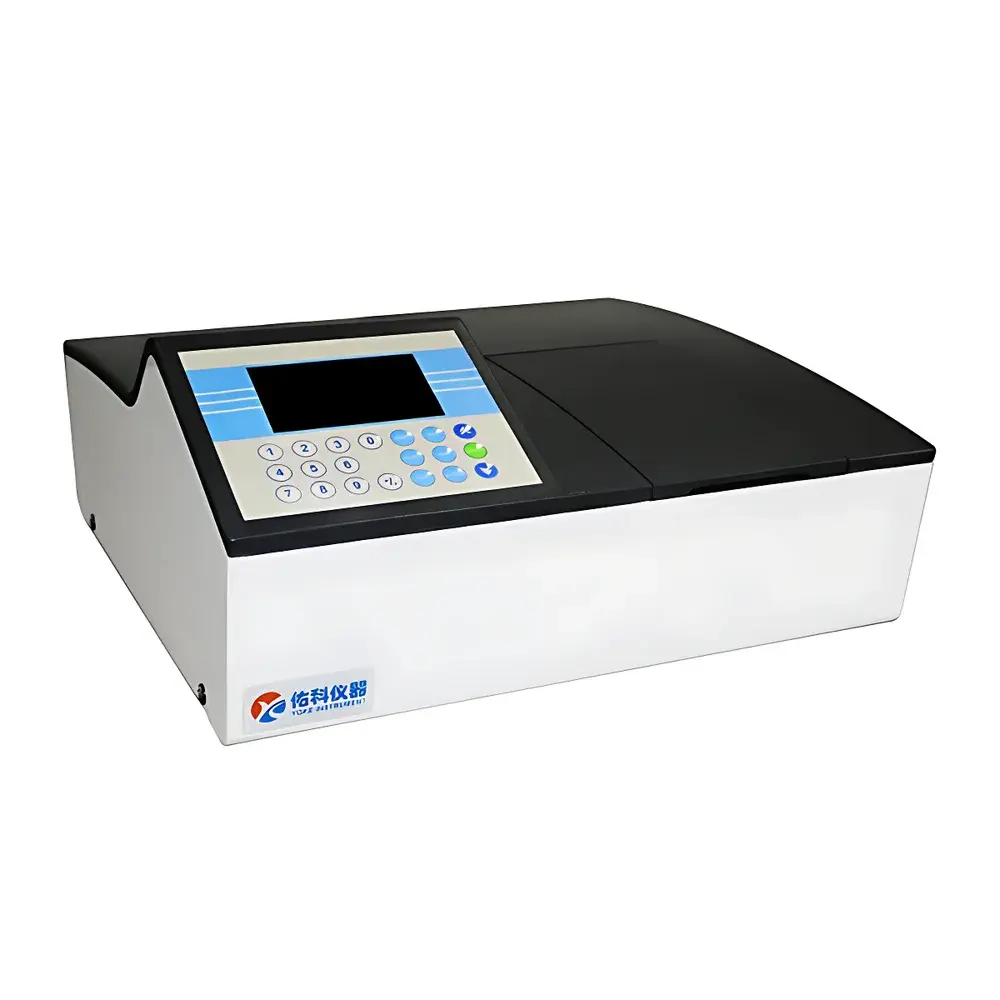
Yoke YKG-B1 Multi-Parameter Water Quality Analyzer for Ammonia Nitrogen, COD, and Total Phosphorus
| Brand | Yoke |
|---|---|
| Origin | Shanghai, China |
| Manufacturer Type | Direct Manufacturer |
| Model | YKG-B1 |
| Instrument Type | Laboratory Benchtop Analyzer |
| Measurement Principle | Colorimetric Method (Standardized Spectrophotometric Absorption) |
| Measurement Range (Ammonia Nitrogen) | 0.01–100 mg/L |
| Accuracy | ≤5% RSD |
| Detection Limit | 0.01 mg/L (NH₃-N) |
| Measurement Time | 10–20 min per batch |
| Batch Capacity | 20 samples |
| Optical Stability | ≤0.001 A/10 min |
| Light Source | Long-life Imported Tungsten Halogen Lamp |
| Cuvette Compatibility | Standard 10-mm Pathlength Glass or Plastic Cuvettes (GB/T 5750 & HJ 535–2009 Compliant) |
| Data Storage | ≥5000 Records (with Timestamp, Parameter ID, Calibration Curve ID) |
| Preloaded Curves | 200 (5 Factory-default + 195 User-expandable) |
| Interface | 4.3″ TFT Color LCD (Chinese/English Switchable), USB Device/Host, RS-232C, Bluetooth (Optional) |
| Internal Memory | 512 MB NAND Flash |
| Repeatability | ≤±5% RSD |
| Chloride Interference Tolerance | ≤1000 mg/L Cl⁻ (NH₃-N & TP) |
Overview
The Yoke YKG-B1 Multi-Parameter Water Quality Analyzer is a compact, laboratory-grade benchtop spectrophotometer engineered for routine quantification of ammonia nitrogen (NH₃-N), chemical oxygen demand (COD), and total phosphorus (TP) in environmental water matrices. It operates on the standardized colorimetric principle—measuring absorbance at specific wavelengths following controlled reagent-mediated chromogenic reactions—as defined in ISO 11908 (ammonia nitrogen), ISO 6060 (COD), and ISO 11348 (phosphorus). Designed for compliance with Chinese national standards (HJ 535–2009, HJ/T 399–2007, GB/T 11893–1989) and aligned with broader international methodological frameworks, the YKG-B1 delivers reproducible, traceable results without requiring external calibration verification for daily QC checks. Its optical architecture integrates a thermally stabilized tungsten halogen lamp, precision interference filters (FWHM < 10 nm), and a low-noise photodiode detector to ensure long-term photometric stability (<0.001 A drift over 10 minutes), critical for multi-shift laboratory operation.
Key Features
- 4.3-inch high-resolution TFT color display with intuitive, menu-driven interface supporting both Chinese and English language modes
- Dual-mode data handling: internal storage of ≥5000 measurement records (including date/time stamp, parameter ID, curve identifier, and raw absorbance values) plus direct export via USB flash drive or real-time transfer via USB Device mode
- Expandable calibration library: 200 programmable calibration curves—5 factory-loaded reference curves and up to 195 user-defined or segmented curves, enabling concentration-dependent slope adjustment (variable K-factors) for enhanced accuracy across wide dynamic ranges
- ARM9-based embedded control system ensuring responsive navigation, rapid spectral acquisition, and robust firmware execution
- Optimized optical path design compliant with standard 10-mm cuvettes per GB/T 32205–2015, eliminating need for custom cell geometry
- Pre-formulated, lot-certified liquid reagents supplied for NH₃-N, COD (low/high range), and TP assays—reducing analyst error, minimizing hazardous powder handling, and improving inter-laboratory comparability
- Modular hardware architecture supporting optional Bluetooth 4.2 module for wireless data streaming to LIMS or local network endpoints
Sample Compatibility & Compliance
The YKG-B1 accepts clarified, filtered, or centrifuged aqueous samples from surface water, wastewater effluent, drinking water pre-treatment streams, and industrial process water. It accommodates chloride concentrations up to 1000 mg/L without correction for NH₃-N and TP determinations; for COD analysis, an optional high-chloride interference kit extends tolerance to 8000 mg/L Cl⁻. All measurement protocols adhere to the fundamental requirements of ISO/IEC 17025:2017 for testing laboratories, including documented traceability of calibration standards (NIST-traceable potassium hydrogen phthalate for COD, ammonium chloride for NH₃-N, potassium dihydrogen phosphate for TP), regular photometric verification, and procedural validation per HJ 168–2020. The instrument supports GLP-aligned audit trails when paired with timestamped USB exports and printed reports (via optional RS-232-connected thermal printer).
Software & Data Management
Data integrity is maintained through time-stamped, immutable record generation upon each assay completion. Each entry includes sample ID, operator ID (configurable), measurement wavelength, applied calibration curve ID, raw absorbance, calculated concentration, and QC flag status. Internal memory retains full datasets for ≥12 months of typical lab usage (assuming 20 samples/day). USB Host functionality enables direct firmware updates and mass data backup without PC dependency. When connected to a Windows-based workstation via USB Device mode, the analyzer emulates a virtual COM port—compatible with third-party data acquisition software (e.g., LabVIEW, MATLAB, or custom SQL-based LIMS interfaces). No proprietary cloud platform is required; all data remain under user control.
Applications
- Regulatory compliance monitoring for municipal wastewater treatment plants (WWTPs) per GB 18918–2002 discharge limits
- Source water quality assessment in reservoirs and rivers during seasonal nutrient loading studies
- In-process control of biological nutrient removal (BNR) systems, particularly nitrification/denitrification unit optimization
- Validation of membrane filtration or ion exchange performance in potable water reclamation facilities
- Educational laboratories conducting EPA Method 351.2 (COD), 350.1 (NH₃-N), and 365.2 (TP)–equivalent exercises
- Field-deployable lab support for mobile environmental testing units requiring benchtop-grade precision without benchtop footprint
FAQ
Does the YKG-B1 meet international regulatory requirements for certified labs?
Yes—the instrument’s optical performance, calibration traceability, and data logging structure align with ISO/IEC 17025:2017 clause 7.2.2 (method validation) and support compliance with China’s CNAS-CL01 requirements. While not FDA 21 CFR Part 11–certified out-of-box, its audit-ready data export format facilitates integration into validated electronic record systems.
Can users modify or validate their own calibration curves?
Absolutely. The analyzer allows creation, editing, and versioning of up to 195 custom curves—including multi-segment linear fits with independent slope/intercept parameters per concentration zone—to optimize accuracy across non-linear response regions.
Is reagent lot traceability supported?
Yes. Each pre-formulated reagent kit includes a certificate of analysis with lot number, expiration date, and certified concentration uncertainty. Users may manually log reagent lot IDs against measurement records for full chain-of-custody documentation.
What maintenance is required to sustain photometric accuracy?
Annual verification using neutral density filters (NIST-traceable) and blank cuvette checks is recommended. The tungsten lamp has a rated lifetime exceeding 2000 hours; replacement is tool-free and requires no optical realignment.
How is method cross-contamination prevented during sequential multi-parameter analysis?
The YKG-B1 enforces strict workflow separation: users must explicitly select the target parameter (NH₃-N, COD-L, COD-H, or TP) before initiating analysis. Reagent-specific cuvette cleaning prompts and automatic zeroing between parameter switches prevent carryover-induced bias.







