
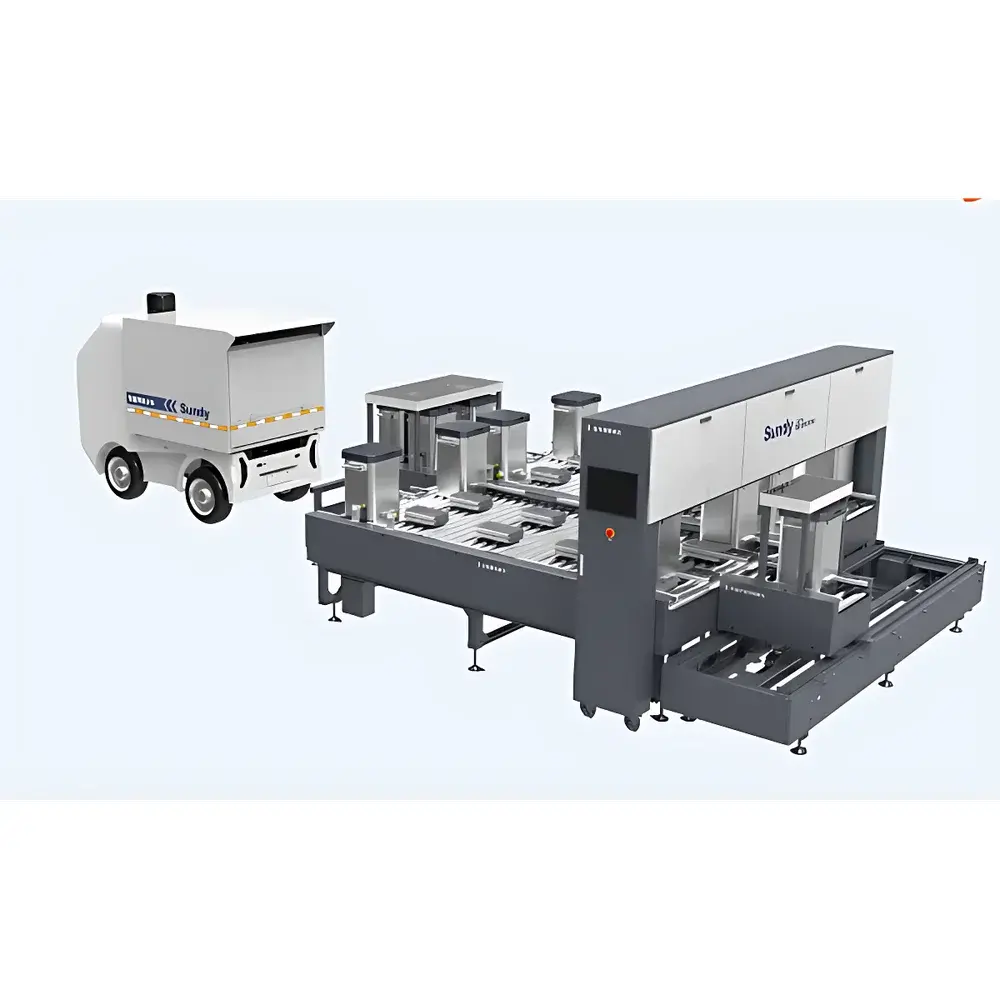
SDTS Sample Collection & Preparation Integration System by Sundy
| Brand | Sundy |
|---|---|
| Origin | Hunan, China |
| Manufacturer Type | Authorized Distributor |
| Product Category | Domestic |
| Model | SDTS Sample Collection & Preparation Integration System |
| Pricing | Available Upon Request |
Overview
The SDTS Sample Collection & Preparation Integration System is an industrial-grade, fully automated material handling solution engineered to bridge the operational gap between on-site sampling systems and laboratory-scale sample preparation units in bulk solid analysis workflows—primarily deployed in coal quality control, power generation, metallurgical feedstock management, and bulk commodity trading environments. Built upon a modular architecture, the system implements physical sample transport as a controlled, auditable, and tamper-evident process—eliminating manual intervention from sample collection through to preparation input. Its core functionality rests on deterministic mechanical transfer protocols (conveyor-based, overhead chain, roller conveyor, or AGV-assisted cart transport), integrated with real-time positional monitoring, sealed container integrity assurance, and synchronized data logging. Unlike conventional manual or semi-automated handoff points, the SDTS system enforces strict chain-of-custody compliance by design—ensuring sample identity, mass integrity, and temporal traceability are preserved across spatially distributed infrastructure.
Key Features
- Fully unattended operation: End-to-end automation from sample encapsulation in certified sealed buckets to final delivery at the preparation station’s feed hopper.
- Four configurable transport modalities: Belt + single-bucket elevator (short-range), overhead trolley chain (looped track), roller conveyor line, and GPS-tracked autonomous transfer carts (long-range).
- Tamper-resistant sample containment: Standardized 60 kg-rated sealed sample buckets with integrated lid retention and environmental shielding (dust/rain protection during transit).
- Real-time geofencing and motion monitoring: For cart-based long-distance configurations, onboard GPS enables deviation alerts and stoppage detection—triggering immediate SCADA-level notifications.
- High-tolerance docking interface: ±300 mm positional tolerance for cart alignment with the receiving module; automatic bucket extraction without operator guidance.
- Bi-directional throughput optimization: Simultaneous full-bucket delivery and empty-bucket return via dedicated parallel paths or shared looped infrastructure.
- Compact footprint: Modular layout options accommodate space-constrained sites—e.g., batch merging station occupies ≤11 m²; intelligent sorting module requires only ≈5.6 m².
Sample Compatibility & Compliance
The SDTS system is designed for heterogeneous granular solids with particle sizes up to 50 mm and bulk densities ranging from 0.6–1.4 g/cm³—fully compliant with ASTM D2234 (Standard Practice for Collection of a Gross Sample of Coal), ISO 18283 (Solid Mineral Fuels — Manual Sampling), and GB/T 19494 (Chinese national standard for coal sampling). All transport modules—including QXT250 overhead chain conveyors (pitch: 250 mm, max load per hanger: 60 kg, turning radius R=600 mm)—meet IP54 ingress protection requirements and operate within ambient temperature ranges of −20 °C to +50 °C. Bucket sealing mechanisms satisfy ISO/IEC 17025 clause 5.8.2 on sample integrity preservation. The system supports GLP-aligned audit trails when integrated with validated LIMS platforms—ensuring full traceability of sample ID, timestamped location events, and operator-free status logs.
Software & Data Management
The SDTS integrates with Sundy’s proprietary SDMS (Sample Data Management System) v3.x, providing centralized configuration, real-time dashboard visualization, and event-driven alerting via web-based HMI. Each sample bucket carries a unique RFID tag linked to its origin, collection time, moisture content (if pre-scanned), and destination batch ID. All motion events—including bucket loading/unloading, cart GPS coordinates, conveyor start/stop cycles, and door actuation—are time-stamped with microsecond precision and stored locally (industrial SSD) with redundant cloud backup. Audit log exports comply with FDA 21 CFR Part 11 requirements for electronic records and signatures when configured with role-based access control and digital signature modules. Historical throughput analytics (e.g., avg. bucket cycle time, downtime root cause tagging, cart route efficiency scoring) are exportable in CSV/Excel format for QA review.
Applications
- Coal-fired power plants: Seamless integration between yard sampling stations and central preparation labs—enabling daily ash/sulfur/moisture assay readiness without human handoff delays.
- Port terminal bulk handling: Long-distance cart-based transfer across roadways, rail sidings, and stockyard boundaries while maintaining sample chain-of-custody under ISO 9001-certified QC protocols.
- Steel mill raw material inspection: Short-range belt-and-elevator coupling between train-unload sampling arms and on-site pulverization units—reducing cross-contamination risk in multi-feedstock environments.
- Third-party testing laboratories: Remote sample receipt validation via synchronized bucket RFID scan + video verification at intake gates—supporting ISO/IEC 17025 accreditation evidence packages.
- Mining operations with distributed pit faces: Multi-node cart routing to consolidate samples from remote drill-core or shovel-scoop locations into a central prep facility.
FAQ
What standards does the SDTS system comply with for sample integrity?
The system adheres to ASTM D2234, ISO 18283, and GB/T 19494 for sampling representativeness, while mechanical components meet IP54 and CE machinery directive (2006/42/EC) requirements.
Can the system interface with existing LIMS or ERP platforms?
Yes—via RESTful API or OPC UA protocol; SDMS supports HL7, ASTM E1384, and custom XML schema mapping for bidirectional sample metadata exchange.
Is GPS tracking available for short-distance configurations?
No—GPS is reserved for long-range cart deployments (>200 m); short-range modes rely on encoder-based position feedback and RFID zone detection.
What maintenance intervals are recommended for the overhead chain conveyor?
Lubrication every 500 operating hours; sprocket and chain wear inspection every 2,000 hours; full tension calibration annually or after 10,000 cycles.
Does the system support hazardous area classification (e.g., ATEX Zone 2)?
Standard configurations are non-hazardous; ATEX-compliant variants (II 2G Ex db IIB T4 Gb) are available upon request with certified motors, enclosures, and grounding protocols.



